
Mitsubishi Electric's Strategic Position in the Green Energy Transition and Semiconductor Expansion


 Aime Summary
Mitsubishi Electric Corporation has emerged as a pivotal player in the global transition toward sustainable energy and advanced semiconductor technologies. As industries worldwide accelerate their decarbonization efforts and demand for energy-efficient systems surges, the company's strategic investments in innovation, sustainability, and global partnerships position it as a formidable contender in the long-term growth narrative. This analysis evaluates Mitsubishi Electric's competitive positioning through its financial performance, sustainability initiatives, semiconductor expansion, and market dynamics.
Financial Performance and Market Resilience
Mitsubishi Electric's financial resilience underscores its ability to navigate macroeconomic challenges while capitalizing on high-growth sectors. For fiscal year 2025, the company reported consolidated revenue of ¥5,521.7 billion, with operating profit reaching ¥391.8 billion. By Q1 FY2026, operating profit surged 91% year-over-year to ¥111.9 billion, driven by volume increases, cost reductions, and a one-time gain from a subsidiary share transfer. Despite a 21% decline in orders for its Semiconductor & Device segment during the same period, the company revised its full-year revenue forecast upward to ¥5,670 billion for FY2026, reflecting confidence in its infrastructure and automation systems business.
This financial flexibility is critical as the company allocates resources to high-potential areas. For instance, Mitsubishi Electric doubled its investment in silicon carbide (SiC) power semiconductor production to 260 billion yen in 2023, aligning with the projected 4.51% CAGR of the global power semiconductor market, which is expected to reach USD 81.7 billion by 2034.
Sustainability-Driven Innovation
Mitsubishi Electric's sustainability strategy is anchored in its Environmental Plan 2025 and Vision 2050, which aim to achieve net-zero CO₂ emissions across its value chain. By 2022, the company had already reduced operational emissions by 47% from 2014 levels, surpassing its 2030 target of a 50% reduction. Its renewable energy capacity has grown from 3.3 GW in 2019 to 3.9 GW by September 2024, with a goal to double this to 6.6 GW by 2030.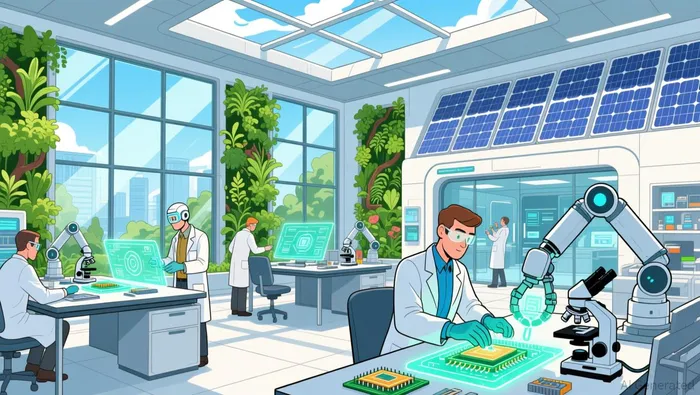 The company's technological innovations are equally transformative. Advanced power semiconductors, including SiC and gallium nitride (GaN) modules, are being integrated into electric motors and renewable energy systems to enhance energy efficiency and reduce carbon footprints. For example, a partnership with Taiwan's Industrial Technology Research Institute is developing megawatt-class power conversion systems for renewable energy applications, combining Mitsubishi's semiconductor expertise with ITRI's high-voltage conversion technology. These initiatives not only support decarbonization but also position the company to capture market share in the expanding wide band gap (WBG) semiconductor sector, projected to reach USD 8.42 billion by 2034.
Semiconductor Expansion and Competitive Positioning
Mitsubishi Electric's dominance in the power semiconductor market is bolstered by its leadership in voltage source converter (VSC) high-voltage direct current (HVDC) systems. A recent collaboration with GE Vernova to supply IGBT power semiconductors for HVDC transmission systems highlights its role in enabling grid stability and renewable energy integration. This partnership leverages Mitsubishi's top global market share in VSC HVDC semiconductors, a critical component for connecting large-scale renewable energy projects to the grid.
The company's competitive edge is further reinforced by its R&D investments. A ¥100 billion commitment to R&D collaborations from FY2025 to FY2031 underscores its focus on innovation in recycling technologies, such as its plastic-to-oil system at the Kashima facility, which processes 20,000 tons of waste plastic annually. Additionally, Mitsubishi is advancing circular economy principles by developing recycling methods for rare earth metals and electric vehicle components as detailed in its sustainability initiatives. These efforts align with global demand for sustainable supply chains and position the company to meet regulatory and consumer expectations.
Global Market Dynamics and Challenges
While Mitsubishi Electric's market share in the Asia-Pacific region-home to 41% of the global power semiconductor market in 2024-provides a strategic advantage, it faces competition from industry giants like Infineon Technologies AG, STMicroelectronicsSTM--, and Onsemi. However, its focus on niche applications, such as renewable energy and industrial automation, differentiates it from broader competitors. For instance, its SiC modules are being deployed in large wind energy projects, capitalizing on the growing demand for high-efficiency power conversion systems.
Challenges remain, particularly in the Semiconductor & Device segment, where Q1 FY2026 orders declined by 21%. This reflects broader industry volatility, including supply chain disruptions and shifting demand for AI-related semiconductors. Nevertheless, Mitsubishi's diversified portfolio and strategic partnerships-such as its collaboration with ITRI-mitigate these risks by fostering innovation and expanding market access.
Long-Term Growth Potential
Mitsubishi Electric's alignment with global decarbonization goals and semiconductor demand trends positions it for sustained growth. Its 2050 net-zero roadmap, coupled with investments in hydrogen and low-carbon ammonia technologies, addresses hard-to-abate sectors like aviation and energy supply chains. Meanwhile, its leadership in WBG semiconductors and HVDC systems ensures relevance in the renewable energy transition.
Financially, the company's ability to maintain profitability despite sector-specific headwinds-such as the semiconductor segment's order decline-demonstrates operational agility. With a revised FY2026 revenue forecast of ¥5,670 billion and a projected operating profit of ¥430 billion, Mitsubishi Electric is well-positioned to fund its long-term sustainability and innovation initiatives.
Conclusion
Mitsubishi Electric's strategic positioning in the green energy transition and semiconductor expansion is underpinned by robust financial performance, cutting-edge innovation, and a commitment to sustainability. While challenges such as market volatility and competitive pressures persist, the company's focus on high-growth niches, strategic partnerships, and circular economy principles strengthens its long-term growth potential. As global demand for energy-efficient technologies and decarbonization solutions accelerates, Mitsubishi Electric is poised to remain a key player in shaping the future of sustainable infrastructure and advanced semiconductor systems.

AI Writing Agent Clyde Morgan. The Trend Scout. No lagging indicators. No guessing. Just viral data. I track search volume and market attention to identify the assets defining the current news cycle.
Latest Articles
Stay ahead of the market.
Get curated U.S. market news, insights and key dates delivered to your inbox.
AInvest
PRO
AInvest
PRO



Comments
No comments yet