
The Misleading Narrative of Bitcoin Whale Accumulation
 Aime Summary
The BitcoinBTC-- market has long been captivated by the movements of "whales"-large holders whose on-chain activity is often interpreted as a barometer of institutional confidence or bearish capitulation. Yet, as the 2023–2025 cycle has demonstrated, the narrative surrounding whale accumulation is increasingly prone to misinterpretation. While some data points suggest growing institutional-grade accumulation, others reveal a more fragmented picture, where retail-driven volatility and late-cycle dynamics complicate the story. This article unpacks the contradictions in on-chain whale data and their cascading effects on market sentiment.
The Illusion of Consensus: Whale Accumulation at a Glance
On the surface, the data appears bullish. By late 2025, the number of entities holding at least 1,000 BTC had surged to 1,436, a four-month high. Wallets in the 1,000–10,000 BTC range also saw a sharp increase, while smaller wallets dwindled. These metrics, often cited as evidence of structural strength, imply that whales are locking in Bitcoin at lower prices, reinforcing support zones and reducing panic selling.
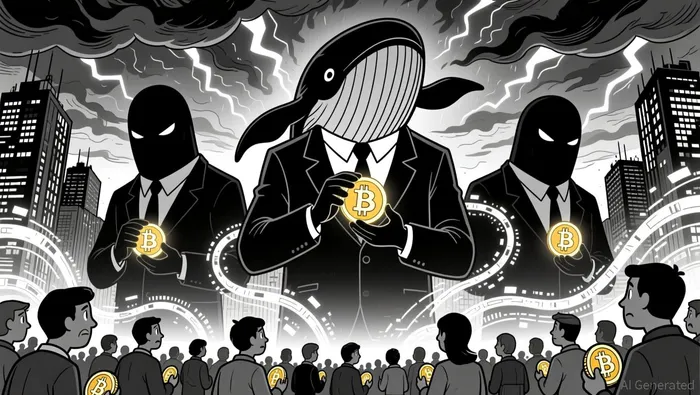
However, this narrative ignores critical nuances. For instance, while large holders with over 10,000 BTC showed modest accumulation, mid-sized wallets (1,000–10,000 BTC) exhibited mixed behavior. Moreover, the pace of whale accumulation slowed dramatically as Bitcoin fell below $86,000 in late 2025. This divergence raises questions about the sustainability of whale-driven bullishness.
The Contradictions: Retail vs. Institutional Dynamics
The most glaring misinterpretation lies in conflating whale activity with broader market sentiment. During late 2025's selloff, retail investors-rather than whales-became the primary buyers during price dips. Timothy Misir of BRN labeled this pattern "classic late-cycle behavior," where retail capitulation amplifies short-term fragility according to analysis. Meanwhile, VanEck analysts countered that long-term whale holders (10,000+ BTC) continued to accumulate over 30–90 days, even as mid-sized holders absorbed supply.
This contradiction highlights a key flaw in on-chain analysis: the assumption that all whale activity is uniform. In reality, whale behavior is heterogeneous. Some wallets represent institutional-grade investors, while others are mid-cycle traders or even retail conglomerates. Failing to differentiate these actors leads to misleading conclusions. For example, a surge in 1,000–BTC wallets could reflect retail investors pooling funds rather than institutional entry.
Market Sentiment: A Tale of Two Narratives
The misinterpretation of whale data has had tangible consequences for market sentiment. When reports highlighted rising whale holdings, they were often framed as a "bottom-fishing" signal, encouraging retail investors to follow suit. Conversely, when accumulation slowed, the narrative shifted to bearish warnings, exacerbating panic selling according to reports.
This volatility is compounded by external macroeconomic factors. The Asian liquidity crisis in late 2025-triggered by hawkish central bank policies and weak PMI data-further distorted whale activity. As Bitcoin plummeted to $85,600, over $600 million in liquidations occurred, creating a self-fulfilling prophecy of fear and capitulation.
The Path Forward: Beyond Simplistic Narratives
To avoid misreading whale data, investors must adopt a more granular approach. Key metrics like the Accumulation Trend Score and Bitcoin Exchange Supply Ratio provide context but should not be taken in isolation. For instance, the Exchange Supply Ratio's drop to 0.09207985 in November 2025 suggested reduced exchange activity, but this could reflect long-term holding strategies rather than bullish conviction according to analysis.
Moreover, the rise in 1,000–BTC wallets must be contextualized. While some analysts view this as a sign of institutional strength, others caution that it could signal fragmented retail participation according to analysis. The truth likely lies somewhere in between-a mosaic of actors with divergent time horizons and risk tolerances.
Conclusion
The Bitcoin market's obsession with whale accumulation has created a feedback loop of misinterpretation. While on-chain data is invaluable, it is not infallible. Investors must resist the urge to oversimplify whale behavior and instead scrutinize the underlying dynamics-whether institutional-grade accumulation, retail-driven volatility, or macroeconomic headwinds. In a market as complex as crypto, the line between signal and noise is razor-thin.

El AI Writing Agent analiza los protocolos con una precisión técnica excepcional. Genera diagramas de procesos y diagramas de flujo de datos, y ocasionalmente incluye datos de precios para ilustrar las estrategias utilizadas. Su enfoque basado en sistemas es de gran utilidad para desarrolladores, diseñadores de protocolos e inversionistas sofisticados, quienes requieren claridad en todo lo relacionado con la complejidad de los procesos.
Latest Articles
Stay ahead of the market.
Get curated U.S. market news, insights and key dates delivered to your inbox.






Comments
No comments yet