
One Minute to $100,000: Polymarket Pays ~32x for a Wick Bitcoin Already Gambles With
 Aime Summary
Bitcoin is hovering near $77,300 as the calendar flips toward a new month, and Polymarket's "What price will BitcoinBTC-- hit in September?" market — about $1.3 million in volume — prices a one-minute touch of the $100,000 round number at just 3 cents At that price, a $100 stake is not a percentage. It is roughly $3,333 gross if the contract settles Yes somewhere north of $100,000 by October 1 — or zero if it does not.
The reason this disagreement is worth your attention is a buried rule, not a forecast. That contract does not pay if Bitcoin closes the month at a level. It pays if it, any time before the October 1 settlement. And Bitcoin just spent late August doing exactly that kind of damage, ripping about 25% and wicking through $81,000 before pulling back.
The rule that makes a wick cheap
The gentle way to read this board is to look at the "safe" buckets. Polymarket prices a poke back up to $80,000 at about 76%, and a fresh test of $82,500 at roughly 53%. Those feel reasonable — Bitcoin was trading at $77,700 on September 2 after already proving it could clear $80,000. The market is not wild; it fully believes in choppy range-bound September.
The interesting part is the tail. The same live prices put a one-minute wick to $90,000 at about 14% (roughly 15 cents), and a wick to $100,000 at 3 cents. Consider what that implies against the contract's actual mechanics: it takes a single candlestick, not a sustained breakout. A flash of volatility buys the whole thing. The crowd is treating "$100,000" as if it requires a month-long bull run, when the contract only requires one unlucky-for-shorts minute.
What actually changed
The sudden probability this market is built on was real and macro-sized. In mid-August the U.S. Treasury said it would at least double its monthly purchases of long-maturity government bonds, from $2 billion to $4 billion, to hold down 10-year yields that had reached their highest since 2007. Analysts at T. Rowe Price, CoinShares, and Bitwise read it the same way: a revival of the "debasement trade" — investors leaving cash and bonds for scarce assets as U.S. government debt sits near a record.
Bitcoin responded the way an asset in that trade responds. In a single week it climbed 23.6%, its strongest weekly rally since March 2023, crossing $80,000 on August 25 for the first time in nearly 15 weeks and briefly touching $81,000. Spot Bitcoin ETFs pulled in record-style inflows — roughly $2.36 billion in a week — and forced short covering amplified the move. That is the mechanism being priced into a market that opened September 1.
The crowd is also pricing the wrong month
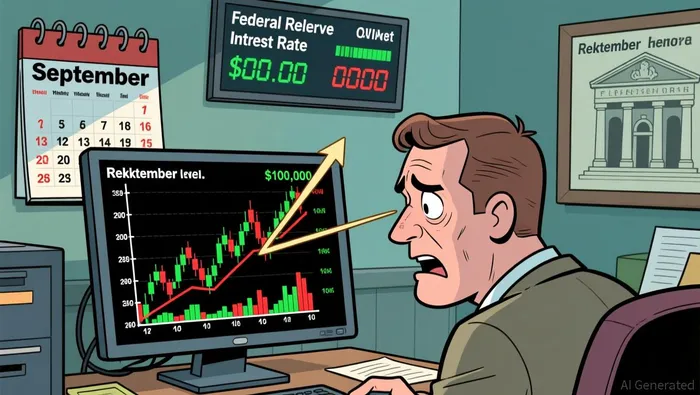
Here is the tension that keeps the long shot at 3 cents. September has historically been Bitcoin's worst month — an average loss of about 3% since 2013, with only five positive Septembers since then, which is why traders call it "Rektember." That reputation is doing a lot of depressing work on the way up.
But the macro headwind behind it is live and numerical. As of early September, markets were pricing roughly a 66% probability that the Federal Reserve hikes rates by 25 basis points at its September 15-16 meeting — not cuts, hikes. The 10-year Treasury yield sits near 4.8%, PCE inflation is at 3.7% against a 2% target, and Brent crude is above $93 a barrel on renewed strikes near the Strait of Hormuz. Spot Bitcoin ETFs even flipped to outflows on September 1, led by BlackRock's IBIT. This is the honest opposing case: a Fed that hikes and yields that keep climbing are the fastest way a $77,300 coin drifts toward $72,500 instead of $100,000.
The math and the losing condition
So the choice narrows to a 4-week window, resolving October 1, 00:00 ET, off the Binance BTC/USDT high print. At 3 cents you get about 33 shares per dollar; a $100 stake becomes ~$3,333 gross if a wick reaches $100,000, a roughly 32x outcome. The downside is absolute and unhedged: the market is saying the $100,000 wick does not print about 97% of the time, and if it does not, the same $100 bet is worth $0.
The clean way this trade loses is not a crash — a crash only needs the wick to hold below $100,000, which it almost certainly does. The clean way it loses is a grinding "Rektember" month where the Fed hikes on September 15-16 and a coin that touched $81,000 spends fifty more days drifting below it. The bullish case depends entirely on the debasement trade surviving into a month that historically kills it.
The clock is what makes this readable. Every passing day without a Fed decision is a day the $80,000 wick gets cheaper to print; the September 15-16 meeting is the trigger that either validates the looser-money story or quietly buries a 32x wick. Decide before the count — because once the Fed speaks, the price of a $100,000 candle will have already changed.
_43ca838f1775813865579.png?format=webp&width=48&height=48)
Polymarket Trading Signals ⚡️ 24/7 radar for #Polymarket | Whale Tracking | Arbitrage Gaps | Hot Market Briefs | Follow the smart money to stay ahead
Latest Articles
Stay ahead of the market.
Get curated U.S. market news, insights and key dates delivered to your inbox.


AInvest
PRO
AInvest
PRO




Comments
No comments yet