
U.S. Mint to end penny production under Trump's cost-cutting directive.
ByAinvest
Saturday, May 24, 2025 11:00 pm ET1min read
U.S. Mint to end penny production under Trump's cost-cutting directive.
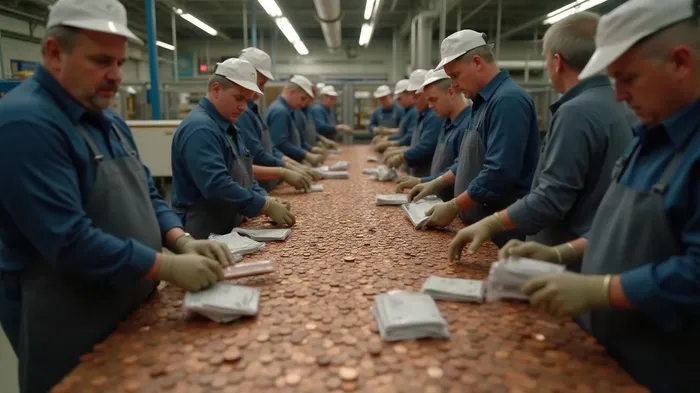
The U.S. Mint has placed its final order of penny blanks, signaling the imminent halt in the production of one of the nation's oldest continually printed coins. This decision, which is set to take effect once the current stock of pennies runs out, is part of a broader cost-cutting initiative directed by President Donald Trump [1].The production costs of pennies have significantly increased over the past decade, rising from 1.3 cents per coin to 3.69 cents in 2024 alone [2]. This escalation has prompted the Treasury Department to seek immediate savings, with the elimination of penny production projected to save $56 million annually [1].
The move to cease penny production is not without controversy. Advocates for the coin argue that it remains useful in charity drives and offers a relatively low production cost compared to the nickel, which costs almost 14 cents to mint [1]. However, opponents contend that the penny's high production cost and limited utility make it an inefficient use of resources.
Congress has taken notice of the potential elimination of the penny, with two bipartisan bills introduced this session to make the change permanent. The "Make Sense Not Cents Act" and the "Common Cents Act" aim to address the issue through legislation [1]. However, past efforts to ditch the penny have failed, and the success of these bills remains uncertain.
Once pennies are no longer in circulation, businesses will likely adopt a system of rounding prices to the nearest 5 cents, similar to the approach taken by Canada when it discontinued its one-cent coin [2]. This change could lead to increased demand for nickels, which are already more expensive to produce than pennies [1].
The U.S. Mint, established in 1792, has produced pennies in various designs and metallic compositions over the years. The coin has undergone several changes, including the introduction of Abraham Lincoln's likeness in 1909 [2]. Despite its historical significance, the penny's high production cost has made it a target for cost-cutting measures.
The elimination of penny production marks a significant shift in the nation's currency policy. While the move is driven by financial considerations, it also raises questions about the future of cash transactions and the role of small coins in the economy.
References:
[1] https://apnews.com/article/us-mint-treasury-department-penny-end-production-daf6367d7e8d31d6783720d5d4667115
[2] https://nypost.com/2025/05/22/us-news/us-mint-moves-to-kill-penny-with-production-ending-after-final-order/
Stay ahead of the market.
Get curated U.S. market news, insights and key dates delivered to your inbox.


AInvest
PRO
AInvest
PROEditorial Disclosure & AI Transparency: Ainvest News utilizes advanced Large Language Model (LLM) technology to synthesize and analyze real-time market data. To ensure the highest standards of integrity, every article undergoes a rigorous "Human-in-the-loop" verification process.
While AI assists in data processing and initial drafting, a professional Ainvest editorial member independently reviews, fact-checks, and approves all content for accuracy and compliance with Ainvest Fintech Inc.’s editorial standards. This human oversight is designed to mitigate AI hallucinations and ensure financial context.
Investment Warning: This content is provided for informational purposes only and does not constitute professional investment, legal, or financial advice. Markets involve inherent risks. Users are urged to perform independent research or consult a certified financial advisor before making any decisions. Ainvest Fintech Inc. disclaims all liability for actions taken based on this information. Found an error?Report an Issue




Comments
No comments yet