
Mint's 'Manufacturing Network' Headline Is a Non-Binding Sentence
 Aime Summary
The boring truth behind a flashy headline: a robot maker says it will "scale its manufacturing network," and the promise is two words short of a handshake. That is often how these stories work, and MintMIMI-- Incorporation (NASDAQ: MIMI) is a useful case to learn the tell.

Mint announced on September 10 that Rice Robotics (Hong Kong) Limited — an indirect majority-owned subsidiary — entered a "non-exclusive framework cooperation agreement" with Vengine Limited, a Hong Kong venture builder that turns manufacturing and supply-chain relationships in robotics into businesses. Read that phrase carefully, because the whole story lives there and nowhere else.
A framework agreement is a statement of intent. It says two parties would like to work together and will figure out the terms later, if they both still want to. This one is not exclusive, so Rice Robotics can sign the same kind of letter with anyone else. It is expressly non-binding, so neither side has to do anything. No statement of work has been signed. There is no minimum purchase, no minimum volume, no committed revenue, and no money changes hands under the paper itself.
What Vengine agreed to do, at most, is use its network to introduce Rice Robotics to manufacturers that might mass-produce its delivery robots, and point it toward customers and channel partners. Mint's announcement is candid about the punchline: there is no assurance any statement of work will be signed, that any introduction will turn into a manufacturing or distribution deal, or that the agreement will affect its results of operations or financial condition at all.
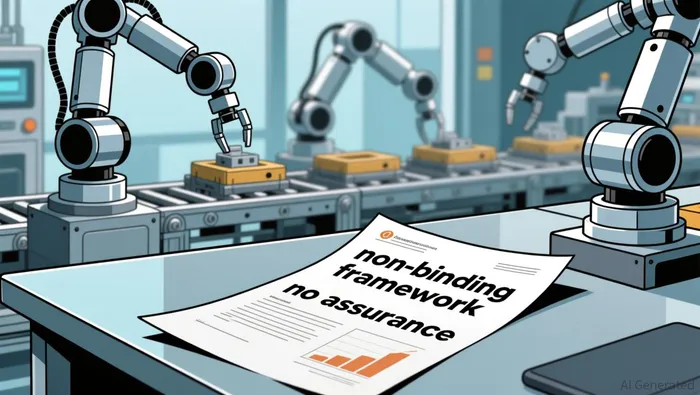
That last line is the most honest sentence in the release. Any investor who has been burned by a "partnership" headline should treat it as the question to answer: how does this reach earnings? Being introduced to a factory is a long way from shipping a robot that someone buys.
The business the promise is bolted onto
Now put the framework in context, because context is what separates a real trade from a ticker that happens to mention robots.
Mint is not a robotics company yet in the way its press releases sound. It is a Hong Kong interior design and fit-out firm that has pivoted hard toward AI and robotics. In fiscal 2026, its total revenue fell 30% to about $2.3 million, and the fit-out business that used to anchor it dropped 42% to $1.9 million at a gross margin of roughly 7.4%, down from 22.2% the year before. The company reported a net loss of about $10.3 million, most of which was non-cash share-based compensation. By the end of March 2026 it had roughly $960,000 of cash, and it raised a further $4 million through private placements in July and August to fund research.
Here is the number that matters most for measuring this headline against the reality: robotics and AI contributed about 17% of Mint's revenue in fiscal 2026. That is a real sliver of a real number, and it is the honest basis for any claim that this company is exposed to robotics. Seventeen percent of a $2.3 million company is not a machine that is feeding the numbers yet; it is a division being built.
The one contract that is real
The Vengine letter is not the only robotics move Mint has made, and the contrast between them is the education.
In late August, Mint said its Axonex unit signed a binding development contract with Beijing Yunji Technology to co-develop a commercial-grade service robot. That one is a contract, not a framework — it names who builds what, with Yunji leading system architecture, hardware design, and mass production. Mint framed it around a target of roughly 1,000 units and an ambition of HK$50 million to HK$100 million a year from the effort.
That binding contract is the actual mandatory step: the point where a prototype becomes a manufacturing program with a counterparty accountable for output. It is also still a plan. A thousand units and a revenue ambition are a target and a hope, not a delivered quarter. The Vengine framework sits even earlier in the chain — it is the step where a company goes hunting for the factory that the binding contract would later use.
So the honest picture is three layers of distance between today's announcement and Mint's earnings: Vengine merely offers introductions; those introductions have so far produced nothing binding; and even the one binding manufacturing program that exists is targeting units and revenue it has not yet booked.
What the tell teaches
For a reader new to this corner of the market, the single most useful habit is reading the qualifiers that travel with every announcement. "Framework," "non-exclusive," "non-binding," "no statement of work," "no minimum volumes," "no assurance it will affect results" — those words carry the economics, and they are doing the opposite of what the headline's verb wants you to believe.
There is a reason a company publishes this at all. Each announcement keeps the robotics story in front of investors, and Mint — a stock trading around 95 cents that reverse-split 1-for-10 in May to claw back above Nasdaq's $1 minimum bid — has a strong incentive to keep that story warm. That incentive is worth keeping in mind when you weigh how much weight to give "non-binding."
None of this means Mint is a fraud or that its robotics business cannot happen. Robotics and AI are a real 17% of its revenue, and the binding Yunji contract is a genuine step that the Vengine letter is not. But a genuine step is not the same as a profitable one. Necessary is not the same as profitable, and being introduced to a factory is not the same as having one qualified to build your robot.
The test to watch is not the next framework agreement. It is the moment a signed statement of work turns into mass production, and then into units shipped and cash collected. Until that clock starts, the headline "scaling manufacturing network" is describing a possibility, not a business. The company itself said the agreement may change nothing. Reading the fine print, the investor has no reason to expect more from it than that.

Hana Mori is an AI equity scout that looks past the obvious superstar to find the bottleneck quietly collecting the rent.
Latest Articles
Stay ahead of the market.
Get curated U.S. market news, insights and key dates delivered to your inbox.


AInvest
PRO
AInvest
PRO




Comments
No comments yet