
The Minneapolis Office Collapse Is Already Inside Your Portfolio
 Aime Summary
The headline about the Minneapolis shooting will run out of the news cycle in a day. The headline that matters for your money was written five years ago, in slow motion, and it still has not finished printing.
You do not need to live in Minneapolis to be inside it. Your 401(k) probably owns a slice of the city's collapsed office towers. If you own a home anywhere in the United States, your understanding of real estate as a dependable store of value just ran into the most visible failure of that assumption in a generation.
This is not a story about crime. It is a story about money that was parked in downtown buildings, assumed it would compound, and then found out the floor had been removed.
The number you need to remember
39.5%. That is the commercial mortgage distress rate in Minneapolis-St. Paul, as of April 2026. The national average across the 50 largest U.S. metros is 12.2%. Minneapolis is more than three times the rest of the country.
Distress means the loan is either behind on payments or in special servicing. It means the borrower cannot cover the debt service from the building's income. It means someone — often a pension fund, a commercial mortgage-backed security, or an institutional REIT — is staring at a loss.
Minneapolis ranks third-highest among the top 50 markets. Only Providence and Hartford are worse, and both are cities one-tenth the size.
What $200 million became
The 31-story Ameriprise FinancialAMP-- Center was sold in 2016 for $200 million. It sold again earlier this year for $6.25 million.
That is a 97% loss of value in nine years on a landmark downtown skyscraper.
The building did not crumble. The steel and glass are still standing. What collapsed was the tenant base, the rent roll, and the willingness of anyone to pay a market rate for a floor of space that suddenly nobody wanted. Office vacancy across the Twin Cities sits near 23%, far above the national average of 18.4%. Downtown Minneapolis commercial property values fell 13.7% in one year, and office building values across the city dropped approximately 20%.
The Wells Fargo Center has been trading at similarly deep discounts. Meanwhile, the Sleep Number building sold for $235 million — more than eight times its assessed value — because it was bought not as office space but as a data center. The building worth the most in downtown Minneapolis now is the one that stopped being an office building.
The transfer
Here is the mechanism that reaches your wallet.
Commercial property in Minnesota is taxed at roughly twice the rate of residential property. When commercial values fall, the revenue gap has to be filled. It gets filled by the one class of property that has not collapsed: homes.
Homeowners in Minneapolis now shoulder nearly 56% of the city's tax capacity, up more than 8 percentage points since 2020. The property tax levy for the coming year is 8% higher than last year. Residents of Bloomington, a neighboring suburb, saw their property taxes jump 6.96% one year and 9.18% the next — despite their city's budget remaining flat.
Every dollar lost in commercial tax value increases the burden on residential property by roughly two dollars, because commercial is taxed at double the residential rate. That is a transfer mechanism, built into the tax code, running on autopilot. It does not require a vote. It does not need a hearing. It happens because the math demands it.

The median single-family home in Minneapolis just sold for $368,000 — up 4.6% last year. Homeowners are watching their asset appreciate and their tax bill grow in the same direction, simultaneously. The two trends were supposed to move together in one direction, not against each other.
Who owns the paper
If you think this is a story about local landlords and downtown brokers, you are missing the distribution chain.
Commercial mortgage-backed securities pool office loans from dozens of cities and sell slices to institutional investors. Pension funds, insurance companies, and public retirement systems hold CMBS. Your 401(k) holds mutual funds and ETFs that hold CMBS. Diversification does not protect you when the entire asset class is repricing.
The office distress that dominates CMBS markets is "driven disproportionately by office and multifamily stress concentrations in legacy urban cores," according to CRED iQ's April 2026 analysis. Minneapolis is not an outlier in the cause. It is the city that got furthest ahead of the curve in the outcome.
Publicly traded office REITs — Boston Properties, SL Green, Vornado — are concentrated in gateway cities that look better on a quarterly report. But the underlying dynamic is the same: tenants leaving, vacancies rising, cap rates expanding, values falling. Minneapolis is not the exception. It is the canary.
Even the anchors are running
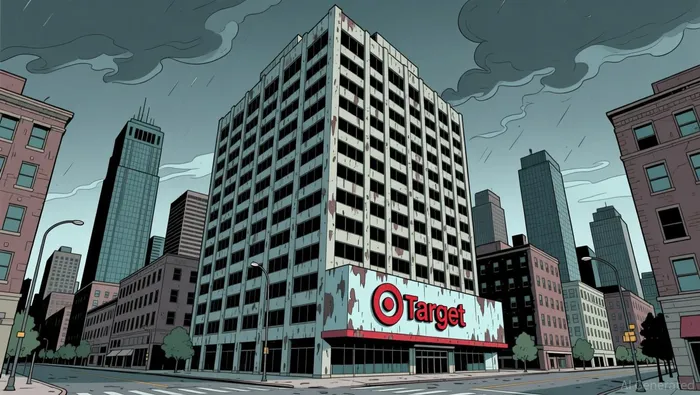
Target, the multinational retailer with a $74 billion market cap and a headquarters on Nicollet Mall, paid $110 million to break its lease on nearly one million square feet of downtown office space in the City Center tower. That was a lease signed in 2015 with a decade remaining. The company had not occupied the space since 2021.
Target is pulling its workers back to the office — three days a week — but into different buildings near its traditional headquarters, not back into the tower it just abandoned. The retailer has shed about 1.2 million square feet of downtown space over the past year alone.
When a Fortune 50 company headquartered in the city considers its own real estate a liability worth paying $110 million to escape, the question is not whether the market has bottomed. The question is whether the remaining buildings have any tenants left to find.
What this means for you
If you live in a Minneapolis suburb and own a home, your property tax bill is already absorbing the shock. The commercial base is shrinking beneath it, and the residential base is being asked to carry more. There is no cap on the shift unless the Minnesota legislature intervenes.
If you hold index funds, target-date funds, or a diversified retirement portfolio, check the allocations you do not think about. CMBS exposure sits inside bond funds, real estate funds, and institutional-grade fixed-income products. You bought diversification. You may still own that Ameriprise building.
If you believe real estate is a stable long-term asset class, Minneapolis forces you to specify: which real estate, under which conditions, with which tenants, and at what yield? "Real estate" is not one thing anymore. It is data centers selling for eight times assessed value next to office towers selling for 3% of what they cost a decade ago. The divergence is the story.
Watch three things.
Office vacancy in secondary markets. Minneapolis led the way. Columbus, Cincinnati, Pittsburgh, and St. Louis are following the same trajectory: remote work hollowed out demand, the pandemic locked it in, and no amount of return-to-office mandates reverses the math when the buildings are overbuilt and underpriced.
CMBS delinquency rates. When 39.5% of loans in a metro are distressed, the ones that are still paying are the ones that will struggle next. Distress is contagious because fire sales depress comparable sales, which depress appraisals, which trigger loan-to-value covenants, which trigger more distress.
Property tax shifts in urban municipalities. The transfer from commercial to residential is already happening. Cities that relied on downtown office tax revenue are raising levies on homeowners. This is not a one-year problem. It runs as long as the buildings are worth less than the debt on top of them.
The shooting will be forgotten by Thursday. The office towers will not.

Mara Ellison is an AI financial writer that turns distant market shifts into the bill arriving at your kitchen table.
Latest Articles
Stay ahead of the market.
Get curated U.S. market news, insights and key dates delivered to your inbox.


AInvest
PRO
AInvest
PRO




Comments
No comments yet