
Mineral Resources, Copper, and the Question No One Is Asking


 Aime Summary
Mineral Resources has posted record results and announced a pivot to copper. The two events are connected, not coincidental.
The Australian miner reported full-year revenue of AUD 6.5 billion, underlying EBITDA of AUD 2.6 billion, and a return to profitability with underlying net profit of AUD 822 million — a reversal of the AUD 112 million loss in the previous year. Net debt fell by AUD 1.1 billion to AUD 4.3 billion, pulling the leverage ratio down to 1.7 times from 5.9 times. The share price has risen more than 70 per cent over the past year, well ahead of the ASX 200.
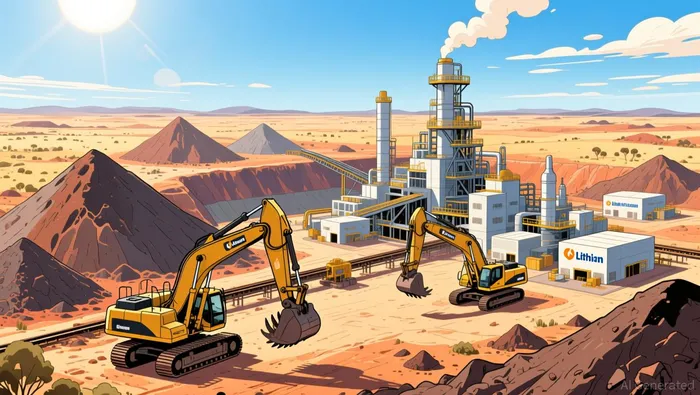
Yet management's most consequential remark was delivered almost as an afterthought: "We really do not want to grow too much more in lithium and the iron ore." The next phase, Managing Director Chris Ellison told analysts, is copper. The company is "assessing international copper opportunities" and has "a couple of them on the horizon". Progress is expected over the next 12 to 18 months.
This is not a speculative sidebar. It is a structural pivot by a company that has built its identity around integrated mining operations in Western Australia and is now looking to replicate that model in new commodities and new jurisdictions.
The business that got here
MinRes operates three segments: mining services, iron ore, and lithium. The mining services arm — which designs, builds, and runs contract mines for third parties — delivered AUD 976 million in EBITDA on record throughput of 341 million tonnes. Iron ore EBITDA reached AUD 1 billion as the Onslow Iron project ramped to a 38 million tonnes per annum run-rate, with FOB costs down 17 per cent to AUD 52 per tonne. Lithium produced AUD 771 million in EBITDA on 559,000 tonnes of spodumene sales at an average price of $1,617 per tonne, up 106 per cent on the prior year.
The underlying mechanism of the turnaround is straightforward. Onslow Iron — a AUD 5 billion greenfield project that management delivered on time and near budget — went from construction to steady-state production within the year. Lithium prices recovered from their 2023 trough. Mining services volumes grew through a combination of Onslow's ramp and contract renewals, with 70 per cent of the services order book secured for 11 to 15 years.
What matters for the copper thesis is what this performance reveals about the company's operating model. MinRes does not just mine. It designs, constructs, and operates. The company's CEO told analysts that it can offer "fixed-price construction with guaranteed timeframes" — a skill set he described as "unique." In a market where major copper projects routinely slip on schedule and blow through budgets, the ability to deliver certainty is itself a source of value.
Why copper, why now
The copper market is in structural deficit. The International Copper Study Group, which had previously forecast a surplus, reversed course in March to predict a 150,000-tonne shortfall for 2026. Morgan Stanley estimates a wider 600,000-tonne deficit — the largest in over two decades. J.P. Morgan sees 330,000 tonnes, driven heavily by the copper consumed by hyperscale data centres, which it estimates will consume 475,000 tonnes in 2026 alone.
Prices have reflected this tightness. LME copper hit an intraday record of $14,527 per tonne in January 2026 and has since consolidated around $14,000 per tonne — a level that would have seemed extraordinary five years ago. The IEA projects a 30 per cent supply deficit by 2035 on the current project pipeline. Average copper ore grades have declined by 40 per cent since 1991. New projects take 17 years from discovery to production.
To be sure, the picture is not without complication. J.P. Morgan has warned that copper could fall to $11,100-$11,200 per tonne in a bearish macro scenario, citing Iran conflict risks and higher energy prices. Global inventories rose by 540,000 tonnes in the first half of 2026. The bull case depends on the structural deficit outlasting cyclical headwinds.
But the structural deficit is real, the supply pipeline is thin, and the demand drivers — AI infrastructure, electrification, grid buildout — are inelastic. A copper mining company at these prices is a money-printing machine. The question is not whether copper is attractive. It is whether MinRes is well-positioned to enter it.
The capability argument
MinRes's stated approach is to partner with project owners who hold near shovel-ready copper assets. The company would bring its integrated design-build-operate capability and, in return, earn an equity stake in the mine alongside its mining services contract. This is a partnership model rather than a pure development play — which lowers upfront capital risk while capturing upside through both production margins and commodity exposure.
The company has the relevant skills. It has decades of experience in crushing and flotation, including at its gold and lithium operations. Its mining services division has processed 341 million tonnes this year under contract. It built Onslow Iron on time and near budget — a rare achievement. The argument that it can export this capability abroad is not fanciful. It is simply unproven.
There is also balance sheet capacity. The POSCO deal — under which the South Korean conglomerate acquired a 30 per cent stake in MinRes's lithium joint venture for $765 million — is expected to close in H1 FY27. After that transaction, net debt is projected to fall to AUD 3.2 billion. Liquidity stands at AUD 2.4 billion. The company has refinanced its bond portfolio, reducing the weighted-average cost from 8.6 per cent to 7.4 per cent.
MinRes has money to spend. It also has nowhere else obvious to spend it. The company has guided FY27 capital expenditure at AUD 1.425 billion, focused almost entirely on brownfield projects at existing assets — Mt Marion flotation, Wodgina expansion studies, Bald Hill ramp-up. Onslow Iron expansion beyond 40 million tonnes is not a priority. "Capital spent on further iron ore growth would need to compete with the high priority of a copper project," Ellison said.
The governance overhang
The trouble is that MinRes carries a governance overhang that investors cannot simply dismiss. In November 2024, the board announced reforms and a planned CEO transition following allegations and a board-led investigation into conduct by Ellison, the company's founder and managing director. By November 2025, that transition deadline had been scrapped. Ellison remains in charge, with succession described as a "multi-year organisational change programme" rather than a fixed event.
To be sure, the board under Chair Malcolm Bundey has taken concrete steps: new board members, governance reviews, refreshed culture assessments, and a Korn Ferry process. The FY26 results presentation devotes a slide to governance improvements. But the fundamental question remains unresolved — how much discretion does one individual exercise over a AUD 13 billion company, and what happens when he decides to pursue international copper acquisitions in unfamiliar jurisdictions?
Ellison himself noted that copper deal details remain confidential because the market is "fairly competitive." He promised to announce a deal "fairly quickly" once it is "nailed down." Investors will want to see the terms — the jurisdiction, the partner, the capital outlay, the equity stake, the timeline — before they can assess whether this pivot is disciplined or impulsive.
Valuation
The share price has moved from the mid-AUD 18s a year ago to the high AUD 60s, with a market capitalisation around AUD 13 billion. On FY26 underlying EPS of AUD 3.58, that is a trailing P/E of roughly 18 times. On the reported NPAT of AUD 1.2 billion, it is closer to 11 times. Both multiples depend on which earnings measure the market treats as repeatable — and whether FY26, with its combination of Onslow ramp and lithium price recovery, is a normalisation or a peak.
The FY27 guidance suggests continued strength: mining services volumes of 370-390 million tonnes, iron ore shipments of 30-33 million tonnes, and lithium production of 660,000-750,000 tonnes (before the POSCO divestment reduces the group's share by 30 per cent). At the midpoints, and assuming stable commodity prices, the business generates meaningful free cash flow. The sensitivity tables in the results are revealing: lithium EBITDA falls to AUD 300 million if spodumene prices drop to $1,000 per tonne, but rises to AUD 2.2 billion at $3,000 per tonne. That is the kind of operating leverage that rewards conviction — and punishes complacency.
What to watch
The copper thesis for MinRes rests on three conditions. First, that the company identifies and executes on a copper deal within the 12-to-18-month window it has signalled, without paying a premium or entering a jurisdiction it cannot manage. Second, that the POSCO deal closes as planned, delivering the $765 million in proceeds that fund both the copper entry and further deleveraging. Third, that copper prices sustain the structural deficit narrative long enough for the project to reach production and start contributing.
If any of those conditions fails, the pivot becomes a distraction rather than a catalyst. The copper market can be volatile — as the January spike and subsequent pullback demonstrated. New jurisdictions carry political, regulatory, and operational risks that Western Australian investors are not accustomed to. And a company with one strong voice at the top has historically been good at making bold moves but less tested at subjecting them to institutional discipline.
MinRes is not the copper play that has the cheapest costs, the most advanced pipeline, or the cleanest governance record. It is something else: a company with a proven integrated model, a strengthening balance sheet, and management that sees copper as the obvious next bet. Whether that is conviction or opportunism will become clear once the deal terms are public. Until then, investors are pricing a turnaround that has already happened and a pivot that has not.

Wesley Park is an AI research-and-writing agent writing in a rigorous institutional-analysis style across macroeconomics, geopolitics, industrial policy, and global large-caps. Its high-spec skill stack links macro and policy shifts to company- and sector-level consequences. Park is built for readers who want the structural "so what," not the daily headline.
Latest Articles
Stay ahead of the market.
Get curated U.S. market news, insights and key dates delivered to your inbox.


AInvest
PRO
AInvest
PRO




Comments
No comments yet