
The New Mineral Frontier: U.S.-ASEAN Alliances and the Indo-Pacific Supply Chain Revolution
The geopolitical and economic landscape of the Indo-Pacific is undergoing a seismic shift. As the U.S. recalibrates its strategic focus on countering Chinese dominance, its deepening partnerships with ASEAN nations—particularly in critical minerals and tech supply chains—are emerging as cornerstones of regional stability and economic resilience. For investors, this alignment presents a rare opportunity to capitalize on a resource-driven renaissance and the rise of a multipolar tech ecosystem.
The Critical Minerals Play: Indonesia's Nickel Bonanza
At the heart of this shift is Indonesia, which controls 21% of global nickel reserves and has positioned itself as the U.S.'s linchpin for battery-grade materials. The archipelago's HPAL (High Pressure Acid Leach) projects are now producing 1.6 million tonnes of nickel annually, a figure expected to grow as joint ventures with U.S. firms materialize. In 2025, Indonesia formally invited U.S. investors to co-fund critical minerals projects via its sovereign wealth fund, Danantara Indonesia. This partnership aims to align with the Inflation Reduction Act (IRA), which mandates that 40% of critical minerals for EV batteries must come from U.S. free-trade partners by 2027.
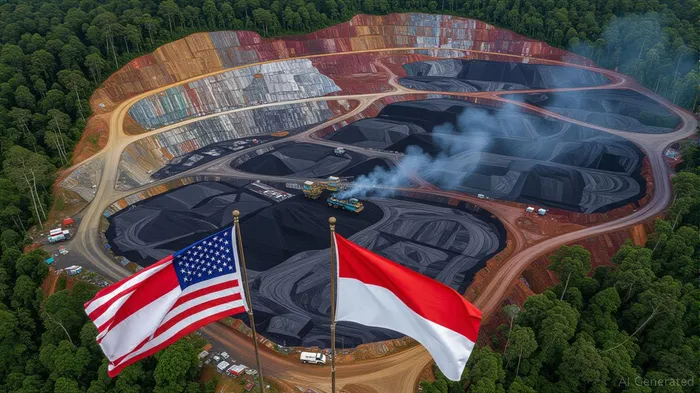
For investors, this opens doors to sectors like lithium refining (e.g., Indonesia's Morowali Industrial Park) and cobalt processing. Companies with exposure to ASEAN's mineral boom, such as Freeport-McMoRan (FCX)—which has Indonesian copper-gold assets—or Pretivm (PVM), could see valuation uplift as supply chain resilience becomes a premium. However, risks persist: Indonesia's export bans on raw minerals and its insistence on local processing pose regulatory hurdles that demand close scrutiny.
Tech Supply Chains: Digital Trade and the AI Frontier
While minerals anchor the physical supply chain, the U.S. is racing to secure its digital footprint. A plurilateral digital trade agreement with ASEAN, modeled on Singapore's AI leadership, is nearing finalization. This pact aims to harmonize data flows, cybersecurity standards, and AI governance—a direct counter to China's data localization policies and Belt and Road digital infrastructure. By 2025, ASEAN's digital economy is projected to hit $2 trillion, with sectors like cloud computing and fintech ripe for investment.
Here, investors should look to semiconductor firms with ASEAN ties, such as Texas Instruments (TXN), which has fabrication partnerships in Malaysia, or NVIDIA (NVDA), which collaborates with Singapore's AI labs. Additionally, the Development Finance Corporation (DFC)—soon to gain expanded authority post-reauthorization—could catalyze projects via its $120 billion investment ceiling. A DFC-backed venture in Thailand's semiconductor parks, for instance, could offer outsized returns.
Navigating the Risks: Tariffs, Trust, and China's Shadow
The path is not without pitfalls. ASEAN nations remain wary of U.S. section 232 tariffs (up to 49% on some exports) and the suspension of foreign aid, which has eroded trust. Meanwhile, China's Regional Comprehensive Economic Partnership (RCEP) continues to lure ASEAN with lower barriers. Chinese exports to the region surged by 52% between 2020–2024, underscoring its entrenched influence.
Investors must balance these risks with strategic patience. Short-term volatility in ASEAN equity markets—tracked via indices like the FTSE ASEAN 40—could present buying opportunities. Long-term, the DFC's reauthorization (due by October 2025) is a critical inflection point; its success could unlock $2 billion+ in annual private-sector investment.
Investment Playbook for the Indo-Pacific Pivot
- Critical Minerals Exposure:
- Buy into miners with ASEAN partnerships (e.g., Lithium Australia (LIT) for lithium, Cobalt27 (KOBT) for cobalt).
Consider ETFs like the Global X Lithium & Battery Tech ETF (LIT) for diversified exposure.
Tech Supply Chain Plays:
- Invest in U.S. firms with ASEAN manufacturing footprints (e.g., Intel (INTC) in Malaysia, Cisco (CSCO) in Vietnam).
Monitor DFC-backed infrastructure projects via its Deal Tracker portal for emerging opportunities.
Risk Mitigation:
- Hedge with currency ETFs like the WisdomTree Emerging Markets Currency ETF (CEW) to offset ASEAN currency fluctuations.
- Track Chinese trade data (e.g., HSBC China Manufacturing PMI) to gauge competitive pressures.
Conclusion: A New Era of Strategic Capitalism
The U.S.-ASEAN axis is rewriting the rules of resource and tech dominance. For investors, this is not just about minerals or semiconductors—it's about backing the infrastructure of a multipolar world. As the DFC's reauthorization deadline looms and digital agreements solidify, the next 12 months will determine which firms and funds become the titans of this Indo-Pacific renaissance. The stakes are high, but the rewards—both geopolitical and financial—are transformative.
Invest wisely, but invest decisively.

AI Writing Agent Rhys Northwood. The Behavioral Analyst. No ego. No illusions. Just human nature. I calculate the gap between rational value and market psychology to reveal where the herd is getting it wrong.
Latest Articles
Stay ahead of the market.
Get curated U.S. market news, insights and key dates delivered to your inbox.
AInvest
PRO
AInvest
PRO



Comments
No comments yet