
U.S. Military Posture in Latin America: Geopolitical Tensions and Investment Opportunities in Defense and Commodity Sectors
 Aime Summary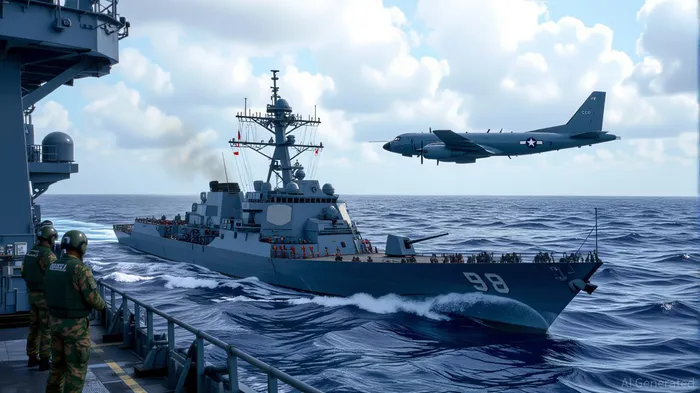
The U.S. military's escalating presence in Latin America, particularly in Venezuela, has created a volatile but potentially lucrative landscape for investors. With the Trump administration's aggressive stance against drug cartels and its designation of groups like Venezuela's Tren de Aragua as foreign terrorist organizations (FTOs), the region is witnessing a strategic pivot toward force projection and economic coercion. This shift not only raises geopolitical risks but also drives demand for defense stocks and reshapes global commodity markets.
Defense Stocks: A Boon for Contractors and Subcontractors
The U.S. military's deployment of 4,000 sailors and Marines, along with advanced assets like Aegis destroyers, P-8 spy planes, and attack submarines, has created a surge in demand for defense technologies and logistics. Key beneficiaries include:
Lockheed Martin (LMT): The company's Sikorsky division, known for its CH-53K heavy-lift helicopters, is likely to see increased demand for maritime and amphibious operations in the Caribbean. Its Digital Magnetic Anomaly Detection systems, already in use by the U.S. Navy, could be critical for anti-submarine warfare in contested waters.
Embraer (ERJ): The Brazilian aerospace firm's collaboration with U.S. partners on the A-29 Super Tucano and C-390 Millennium programs positions it to supply surveillance and transport aircraft for Latin American allies. Its recent midlife upgrade contract with the Brazilian Air Force underscores its role in regional modernization.
Amentum Services (AMT): With a $186.8 million contract for aviation maintenance and logistics support, Amentum is poised to benefit from the U.S. military's expanded footprint in the region. Its work in maintaining P-8s and other surveillance platforms will be critical for intelligence-gathering operations.
Boeing (BA) and General Dynamics (GD): Both firms, with expertise in naval and combat systems, could see increased demand for shipbuilding and cybersecurity solutions as the U.S. seeks to counter Chinese influence in Latin America.
Commodity Markets: Venezuela's Role and Supply Chain Risks
Venezuela's oil production, though diminished by years of sanctions, remains a critical node in global energy markets. The U.S. administration's designation of President Nicolás Maduro as the leader of the “Cartel de los Soles” and its doubling of the bounty on his head to $50 million signal a strategy to destabilize the regime. However, this approach carries risks:
Oil Supply Disruptions: Venezuela's state-owned PDVSA produces roughly 700,000 barrels per day (bpd), with exports to the U.S. and Caribbean nations. Escalating tensions could disrupt this flow, pushing prices higher and benefiting U.S. oil majors like ChevronCVX-- (CVX) and ExxonMobil (XOM).
Commodity Diversification: As China and Russia deepen ties with Latin American nations, the U.S. risks losing access to critical minerals like lithium and nickel, essential for electric vehicle (EV) batteries. This could drive demand for U.S. mining companies with operations in the region, such as Freeport-McMoRanFCX-- (FCX).
Currency and Trade Fluctuations: Sanctions and geopolitical instability in Venezuela could weaken the bolívar, creating volatility in regional trade. Investors should monitor hedging strategies and diversification in portfolios exposed to Latin American markets.
Investment Implications and Strategic Recommendations
The U.S. military's Latin American strategy is a double-edged sword. While it creates near-term tailwinds for defense contractors, it also risks long-term instability that could undermine supply chains and diplomatic relations. For investors:
Defense Sector: Prioritize companies with direct exposure to U.S. Southern Command (SOUTHCOM) operations, such as Lockheed MartinLMT-- and Amentum. These firms are likely to benefit from multi-year contracts for surveillance, logistics, and cyber defense.
Commodity Exposure: Diversify energy holdings with a mix of U.S. oil majors and regional mining firms. Consider hedging against currency risks in Latin American markets, particularly in Venezuela, where geopolitical tensions could spike volatility.
Geopolitical Hedging: Allocate a portion of portfolios to gold and safe-haven assets, as regional instability may drive demand for traditional hedges against currency devaluation and inflation.
Conclusion
The U.S. military's 2025 posture in Latin America reflects a blend of hard power and economic coercion, with Venezuela at the epicenter of geopolitical maneuvering. While defense stocks stand to gain from increased operations, the region's commodity markets face heightened risks from sanctions and instability. Investors must balance short-term opportunities in defense with long-term vigilance against supply chain disruptions. As the Trump administration doubles down on its Latin American strategy, the interplay between military escalation and market dynamics will remain a critical focal point for global investors.

Stay ahead of the market.
Get curated U.S. market news, insights and key dates delivered to your inbox.
AInvest
PRO
AInvest
PRO



Comments
No comments yet