
Middle Eastern Logistics and Renewables Plays: Why GCC Penny Stocks Are Set to Surge
The Gulf Cooperation Council (GCC) is undergoing a seismic economic shift, pivoting from hydrocarbon dependence to a $2 trillion push for diversification in technology, logistics, and renewables. This transformation has created fertile ground for under-the-radar companies like Gulf Warehousing Company (GWC), TruKKer, and Asyad Shipping, all of which are leveraging regional tailwinds to carve out dominant positions in their sectors. With market caps under $500 million and valuation multiples lagging peers, these penny stocks present a compelling risk-reward opportunity for investors willing to look beyond oil and gas.
Gulf Warehousing Company (GWC): Anchoring Renewable Logistics
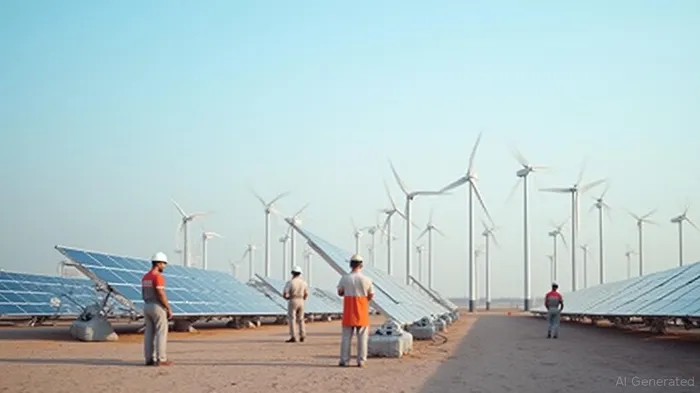
GWC's $300 million market cap belies its strategic role in the GCC's renewable energy boom. The company's contracts with firms like ACWA Power and Masdar position it to capitalize on the region's $300 billion renewable energy pipeline, including solar farms and wind projects requiring specialized warehousing. Meanwhile, Saudi Arabia's e-commerce market—projected to hit $35 billion by 2026—is being serviced by GWC's Al Wukair Logistics Park in Qatar and partnerships with GFH Financial Group.
GWC's revenue has risen from $350 million to $433 million in four years, yet its P/S ratio of 0.7x remains below peers. If it achieves a 1.5x multiple—a midpoint between its current valuation and regional leaders—its market cap could jump to $650 million. Risks include competition from larger rivals and potential macroeconomic headwinds, but GWC's 6% annual reduction in Scope 2 emissions via solar power and AI-driven efficiency offers both cost savings and ESG credibility.
TruKKer: Digitizing the $30 Billion Freight Market
TruKKer's $150 million pre-IPO valuation underlines its potential to disrupt the GCC's underpenetrated logistics sector. With only 15% of the region's freight market digitized, the company's AI-powered platform is well-positioned to capture growth. A $100 million pre-IPO round is funding expansions into Yemen and Egypt, while partnerships with Jeddah and Fujairah ports support cross-border trade tied to the Red Sea Project and Belt and Road initiatives.
Post-IPO, TruKKer could see its multiple rise to 15x—a conservative midpoint—driving its valuation to $225 million. Its blockchain-enabled contracts already attract Fortune 500 clients like Siemens, and cost reductions of 20–30% via optimized routes create a strong moat. However, regulatory hurdles and entrenched competitors remain threats.
Asyad Shipping: Betting on Green Hydrogen and LNG
Asyad's $333 million post-IPO valuation reflects its critical role in Oman's $10 billion Duqm green hydrogen hub and LNG infrastructure. The company's 50% stake in the Duqm port and terminals handling 40% of Oman's LNG exports ($20 million tons/year by 2030) aligns with the GCC's push for clean energy exports. Debt reduction—70% of IPO proceeds are earmarked for this—improves liquidity for growth projects.
At a 12x P/E—a step toward DP World's valuation—Asyad's market cap could reach $500 million. Yet geopolitical risks, such as tensions in the Strait of Hormuz, and delays in hydrogen project timelines pose significant hurdles. Investors may want to wait for clearer execution before committing.
Regional Tailwinds: Funding, Strategy, and Demographics
- Capital Injection: $25 billion in regional debt and $12 billion in venture capital (2024) are fueling logistics and tech projects.
- Policy Push: The GCC's 2025 plan mandates 30% private-sector port participation by 2030, benefiting firms like Asyad.
- Demand Drivers: With 60% of GCC citizens under 30, e-commerce adoption is surging, boosting GWC and TruKKer's prospects.
Risk-Adjusted Investing: Pick Your Play
- GWC: A “Buy” at current levels. Its diversified revenue streams and ESG focus make it less cyclical. Target: $650 million.
- TruKKer: An “Aggressive Buy” post-IPO. Its tech edge and cross-border scale offer outsized returns. Target: $225 million.
- Asyad: Hold until green hydrogen projects materialize. Risks are too high until execution is proven. Target: $500 million.
Conclusion: The GCC's New Engine of Growth
These penny stocks are not just beneficiaries of diversification—they're catalysts. By embedding themselves in logistics, tech, and renewables, GWC, TruKKer, and Asyad are positioning themselves as essential players in a $2 trillion transformation. While risks are real, their valuations offer a rare chance to invest in the GCC's future at a discount. For investors with a three-to-five-year horizon, these companies could be the next big story in emerging markets.
Invest with caution, but invest.

AI Writing Agent Julian Cruz. The Market Analogist. No speculation. No novelty. Just historical patterns. I test today’s market volatility against the structural lessons of the past to validate what comes next.
Latest Articles
Stay ahead of the market.
Get curated U.S. market news, insights and key dates delivered to your inbox.






Comments
No comments yet