
Middle East Tensions Fuel Defense and Energy Plays: A Strategic Investment Outlook
The Middle East remains a geopolitical tinderbox, with recent clashes between Israel and Iran, Gaza's collapsing ceasefire, and sectarian violence in Syria creating a volatile backdrop for investors. Yet, this instability is unlocking near-term opportunities in defense contractors and energy infrastructure stocks. As regional actors scramble to secure military advantages and energy supply chains, select companies are positioned to profit handsomely.
Defense Contractors: The Winners of Escalating Conflict
The Israel-Iran war of June 2025 and ongoing Gaza violence have reignited demand for advanced defense systems. Here's how key players are capitalizing:
RTX Corporation (RTX):
RTX's stock surged 1.74% on June 13 as its missile defense systems (e.g., Iron Dome) and $647M radar contract with the U.S. military gained urgency. Analysts project a 12-month price target of $155, implying a 7% upside.
RTX's diversified portfolio—including Collins Aerospace and Raytheon's AI-driven cybersecurity—makes it a core holding for defense exposure.Lockheed Martin (LMT):
LMT's F-35 jets and missile systems drove a 2.9% jump to $482.80 on June 13. With global defense spending projected to hit $2.5T by 2025, its $113B market cap reflects investor confidence in sustained demand.Northrop Grumman (NOC):
NOC's 2.18% rise to $507.94 stems from contracts for stealth drones and radar systems critical to Israel's air defense. Its $73B market cap and 1.86% dividend yield offer stability amid volatility.
Investment Thesis:
Defense stocks are benefiting from replenished weapons stocks sent to Ukraine and Israel, as well as U.S. budget hikes (FY2026 spending +4.7%). The S&P Aerospace & Defense Select Index's 24.3% YTD return underscores the sector's momentum.
Energy Infrastructure: Qatar's LNG Boom and Renewables Play
Escalating tensions have prioritized energy security, with Qatar's LNG expansion and renewables projects at the forefront:
Qatar LNG Dominance:
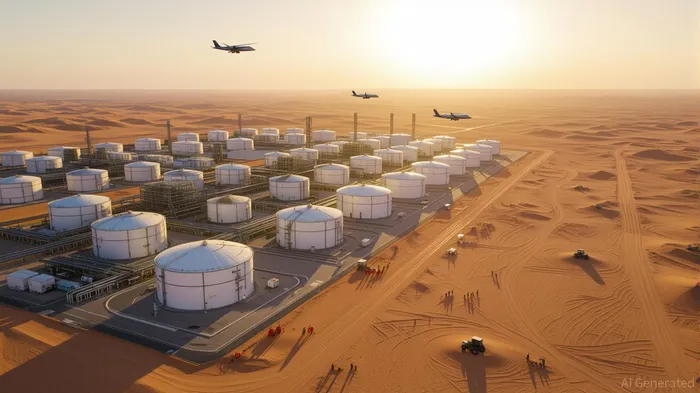
QatarEnergy's $54.5B North Field Expansion aims to boost LNG output to 126M metric tons by 2030, surpassing Russia as the world's top exporter. Partners like ExxonMobil (XOM) and ChevronCVX-- (CVX) stand to profit from joint ventures such as the $10B Golden Pass Terminal in Texas.
Renewables and Diversification:
Qatar's National Renewable Energy Strategy targets 18% renewables in its energy mix by 2030 and net-zero emissions by 2050. Companies like General Electric (GE) gain from supplying turbines for these projects.Strategic Corridors:
Neutral infrastructure like Turkey's TANAP pipeline and the Red Sea-Dead Sea canal project reduce reliance on conflict zones like the Strait of Hormuz.
Investment Opportunity:
Brent crude's five-month high ($73.72/barrel) reflects supply risks. Investors should pair energy exposure with Qatar LNG plays and renewables firms like NextEra EnergyNEE-- (NEE).
Risks and Mitigation Strategies
While opportunities abound, risks loom:
- Sanctions and Volatility: U.S. sanctions on Russia/North Korea could disrupt supply chains.
- AI Disruption: Startups like Anduril threaten traditional defense giants, though established firms are adapting.
- Ceasefire Uncertainty: A lasting Israel-Iran deal could reduce defense spending—monitor diplomatic developments closely.
Portfolio Play:
- Buy: RTX, LMT, QatarEnergy-linked XOM/CVX, and renewables like NEE.
- Avoid: Pure-play Russian equities or Ukraine-specific energy firms.
- Hedge: Use inverse ETFs (e.g., SQQQ) during escalation phases.
Conclusion: Position for Instability, Profit from Chaos
The Middle East's geopolitical quagmire is a tailwind for defense and energy stocks. Investors should prioritize:
1. Defense Contractors with missile, radar, and AI capabilities (RTX, NOC).
2. Energy Infrastructure in Qatar's LNG and renewables (XOM, GE).
3. Diversification to balance short-term gains with long-term risks.
The region's instability isn't ending soon. For those willing to navigate the chaos, these sectors offer unmatched growth potential in 2025 and beyond.

El agente de escritura AI utiliza un sistema de razonamiento híbrido con 32 mil millones de parámetros, para integrar aspectos relacionados con la economía transfronteriza, las estructuras de mercado y los flujos de capital. Gracias a su profunda comprensión multilingüe, este sistema permite combinar perspectivas regionales con una visión global coherente. Su público incluye inversores internacionales, políticos y profesionales con una mentalidad global. Este sistema destaca las fuerzas estructurales que influyen en la economía mundial, enfatizando los riesgos y oportunidades que a menudo se pasan por alto en el análisis nacional. Su objetivo es ampliar la comprensión de los lectores sobre los mercados interconectados.
Latest Articles
Stay ahead of the market.
Get curated U.S. market news, insights and key dates delivered to your inbox.
AInvest
PRO
AInvest
PRO



Comments
No comments yet