
Middle East Tensions Escalate: Israel Launches "Preventive Strike" on Iran – How Will Global Asset Classes React?
 Aime Summary
Global financial markets encountered a massive "black swan" event this weekend. According to the latest reports, Israel's Defense Minister confirmed that the Israeli military has launched a "preventive strike" against Iran. Following the military action, air raid sirens sounded across Israel. Concurrently, multiple nations have taken emergency precautionary measures: the U.S. has approved the departure of non-emergency personnel from its embassy in Israel, while airlines from various countries, including Turkey, have urgently canceled flights to Tehran.

The rapid escalation of geopolitical conflict in the Middle East—the "heart" of global energy—will undoubtedly send shockwaves through primary markets, OTC trading, and the global capital markets when they open on Monday. In the face of this sudden event, global risk appetite is set for a major recalibration.
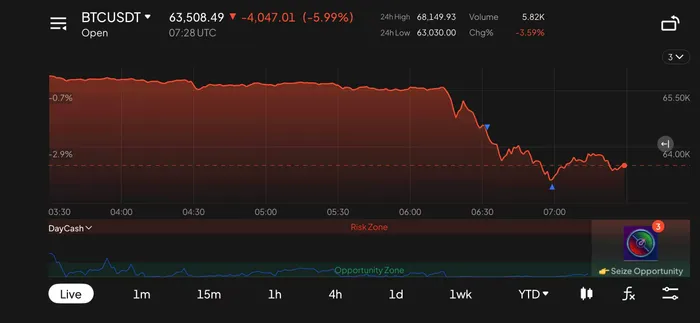
Bitcoin, trading 24/7, was the first to dive, plunging to $63,000 at one point.
"Geopolitical Risk Premium" Surges: The Strait of Hormuz Becomes a Critical Choke Point
Crude oil is unquestionably in the "eye of the storm" of this conflict. International oil prices have already been highly volatile recently due to geopolitical tensions, with Brent crude closing at $73.21/bbl and WTI crude at $67.02/bbl. Israel's direct military action will instantly ignite market fears of supply disruptions.
In the latest war games regarding the Middle East situation conducted this week, Matt Reed, Vice President of the geopolitical and energy consulting firm Foreign Reports, issued a stark warning that the nature of this conflict is fundamentally different from previous ones. He noted that as the situation is pushed to the brink, Iran might resort to extreme retaliatory measures, "including bombing the Strait of Hormuz or laying naval mines to create a blockade, even if only to increase the cost of external intervention". Analysts broadly agree that the threat of such a potential blockade will force the crude oil market to immediately price in an exceptionally high geopolitical risk premium.
Spot Gold to Challenge the $5,300 threshold again?
Under the extreme escalation of this geopolitical crisis, the iron rule of "Cash is King, Gold is Emperor" may once again be validated. Current spot gold has long decoupled from traditional real-yield valuation frameworks; as of the close on February 27 (last Friday), international spot gold (XAU/USD) had surged and firmly established itself above $5,230/oz, approaching the $5,300 threshold during pre-weekend intraday trading. This sudden event will act as a massive catalyst for safe-haven capital inflows.
Wall Street investment banks and trading platform analysts have universally upgraded their short-term price targets for gold this week; with the sudden intensification of geopolitical conflict risks, gold prices have been consolidating near $5,250, and if the news cycle worsens over the weekend and successfully breaches this key resistance level, a new wave of safe-haven buying will propel gold directly to $5,300 or even higher levels.
U.S. Equities Face the Dual Test of Sentiment and Valuation
For the U.S. stock market, this sudden event represents a classic "double whammy" threat to both sentiment and valuation. As of the close on February 27, the S&P 500 index ended at a lofty 6,878.41 points. Hovering near historical highs, U.S. equities are hyper-sensitive to any sudden geopolitical black swan event. The VIX volatility index is expected to gap up significantly at Monday's open, triggering an urgent exodus of capital from high-valuation risk assets such as tech stocks.
In fact, even before the outbreak of this weekend's geopolitical crisis, Wall Street had already issued warnings about the vulnerability of the U.S. stock market. David Sekera, Chief U.S. Market Strategist at Morningstar, explicitly stated in his latest market outlook that U.S. equities in 2026 will experience multiple periods of "extreme volatility," and cautioned investors to be wary of the simultaneous eruption of several key macroeconomic risks.
Furthermore, the current consensus among macroeconomic research firms is that the extreme valuations of U.S. stocks (especially mega-cap tech) following consecutive rallies "leave little room for disappointment". The market was already facing the test of waning upward momentum, and the reignition of war in the Middle East only adds fuel to the fire. The surge in crude oil prices driven by the war could easily trigger expectations of a "secondary inflation," which would directly derail the Federal Reserve's rate-cut trajectory for this year. Capital will have to navigate not only the emotional panic induced by the sudden outbreak of war but also a valuation reset triggered by the resurgence of "Higher for Longer" expectations; consequently, the broader S&P 500 index may face severe selling pressure and the risk of a technical pullback.
Here is a robust conclusion that synthesizes the key themes of your article, properly cited from your provided text. It is framed to leave your North American retail audience with a clear, actionable summary of the macro landscape.
Conclusion: A Defining Moment for Global Markets
In summary, the sudden "preventive strike" in the Middle East has introduced a massive "black swan" to global financial markets. As global risk appetite undergoes a dramatic recalibration , capital is aggressively seeking safe havens, with spot gold breaking from traditional valuation frameworks to challenge the $5,300 mark. Conversely, the threat of extreme retaliatory measures in the Strait of Hormuz has forced the crude oil market to price in an exceptionally high geopolitical risk premium. For U.S. equities, this environment represents a severe double threat of sentiment and valuation tests. The resulting surge in oil prices threatens to trigger a "secondary inflation" shock, which could directly disrupt the Federal Reserve's rate-cut trajectory. Ultimately, as "Higher for Longer" expectations reignite, the broader S&P 500 index faces imminent selling pressure and the very real risk of a technical pullback.

Senior Research Analyst at Ainvest, formerly with Tiger Brokers for two years. Over 10 years of U.S. stock trading experience and 8 years in Futures and Forex. Graduate of University of South Wales.
Latest Articles
Stay ahead of the market.
Get curated U.S. market news, insights and key dates delivered to your inbox.


AInvest
PRO
AInvest
PRO



Comments
No comments yet