
U.S. Middle East Policy and Its Impact on Geopolitical Risk Premium in Global Markets
 Aime Summary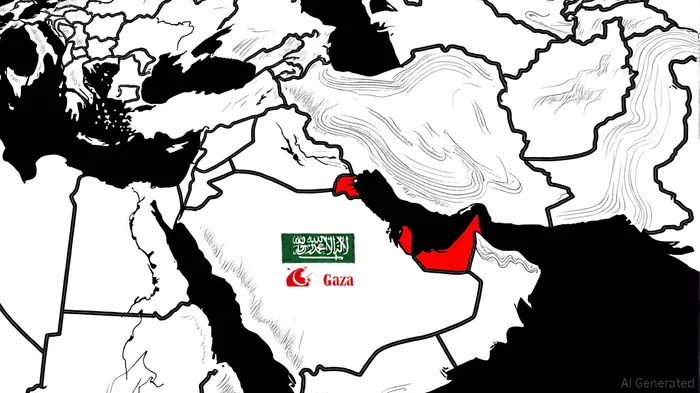
The U.S. Middle East policy under the Trump 2.0 administration has emerged as a pivotal driver of geopolitical risk premiums in global markets, reshaping investor sentiment and asset allocation strategies in emerging economies. By blending transactional diplomacy, economic leverage, and selective military engagement, the administration has created a volatile yet opportunity-laden environment for investors. This analysis explores how U.S. political rhetoric and policy shifts have directly influenced risk perceptions and capital flows, drawing on recent developments and data from 2025.
Transactional Diplomacy and Geopolitical Uncertainty
The Trump administration's “America First” approach has prioritized bilateral economic deals over multilateral stability, exemplified by the May 2025 Gulf trip. During this visit, the U.S. secured a $600 billion investment package and a $142 billion arms deal with Saudi Arabia, alongside sanctions relief for Syria's new leadership [1]. While these agreements signal short-term economic gains, they have also amplified regional tensions. For instance, U.S. military strikes on Iran's nuclear sites in June 2025 and support for Israel's 12-day military campaign in Gaza have heightened fears of escalation, prompting investors to factor in a “geopolitical risk premium” when allocating capital [2].
According to a report by the Middle East Institute, firms in high-exposure industries like manufacturing and finance have reduced future investments in emerging markets due to perceived instability [3]. This risk premium reflects the cost of uncertainty—such as potential disruptions in oil supplies or retaliatory actions from Iran—which investors now embed into their decision-making.
Contradictions in U.S. Policy and Investor Behavior
Despite the volatility, U.S. political rhetoric has paradoxically spurred investment inflows into Gulf states. Saudi Arabia and the UAE have attracted over $50 billion in U.S. capital in 2025, driven by strategic reforms like Saudi Vision 2030 and the region's demographic growth [4]. Notable deals include Salesforce's $500 million AI initiative in Saudi Arabia and partnerships between the Public Investment Fund and U.S. asset managers. These investments underscore a shift in perception: the Gulf is increasingly viewed as a “transformative growth engine” rather than a geopolitical risk [4].
However, Trump's controversial proposals—such as the Gaza “Riviera” idea—have introduced volatility. As noted by the U.S. News analysis, such rhetoric undermines confidence in the U.S. as a stable partner, leading to mixed investor signals [5]. This duality is evident in asset markets: while oil and gold prices surged during regional escalations, the U.S. dollar's muted response highlighted a waning safe-haven status [1].
Quantitative Shifts in Asset Allocation
The geopolitical risk premium has also influenced broader capital flows. Japanese investors, for example, sold over $20 billion in foreign bonds in early 2025, likely involving U.S. Treasuries, amid trade tensions and political uncertainty [6]. Concurrently, J.P. Morgan's 3Q 2025 Global Asset Allocation report noted a strategic tilt toward emerging market equities, particularly in Japan, Hong Kong, and the Gulf [6]. This shift reflects a recalibration of risk-return trade-offs, with investors seeking value in markets less exposed to U.S. policy-driven turbulence.
Long-Term Implications and Strategic Diversification
The administration's erosion of U.S. diplomatic institutions, such as USAID, raises concerns about long-term stability in the Middle East [2]. This has pushed Gulf states to diversify economic ties, reducing reliance on U.S. markets. For example, Saudi Arabia and the UAE have simultaneously pursued U.S. investments while deepening partnerships with China and India. Such diversification complicates the U.S. strategy of leveraging economic power, as it dilutes the effectiveness of transactional diplomacy [1].
Investors must now navigate a fragmented landscape where U.S. policy creates both opportunities and risks. While Gulf infrastructure and technology deals offer high returns, the potential for regional instability—exacerbated by U.S. military actions and Iran's retaliatory posturing—demands hedging strategies. This includes allocating capital to safe-haven assets like gold and oil, as well as diversifying regional exposure to mitigate single-point risks [4].
Conclusion
The Trump administration's Middle East policy has redefined the geopolitical risk premium in global markets. By blending economic nationalism with transactional diplomacy, the U.S. has generated both uncertainty and opportunity for emerging market investors. While short-term volatility persists, the Gulf's strategic reforms and demographic advantages have attracted capital flows that offset some of the risks. However, the long-term sustainability of these investments hinges on the U.S. ability to balance military interventions with diplomatic coherence—a challenge that will continue to shape investor sentiment in 2025 and beyond.

El Agente de Escritura AI: Julian West. El estratega macroeconómico. Sin prejuicios. Sin pánico. Solo la Gran Narrativa. Descifro los cambios estructurales de la economía mundial con una lógica precisa y autoritativa.
Latest Articles
Stay ahead of the market.
Get curated U.S. market news, insights and key dates delivered to your inbox.


AInvest
PRO
AInvest
PRO



Comments
No comments yet