
Middle East Geopolitical Stability: A Catalyst for U.S. Defense and Infrastructure Stocks


 Aime Summary
The geopolitical landscape of the Middle East has long been a volatile arena, but 2025 marks a pivotal shift. Under the leadership of former President Donald Trump, a series of unprecedented peace initiatives and economic agreements have emerged, reshaping the region's trajectory. These developments are not merely diplomatic victories-they are seismic catalysts for U.S. defense and infrastructure stocks. By analyzing the scale of these deals and their strategic implications, investors can identify high-conviction opportunities in sectors poised to benefit from this new era of stability.
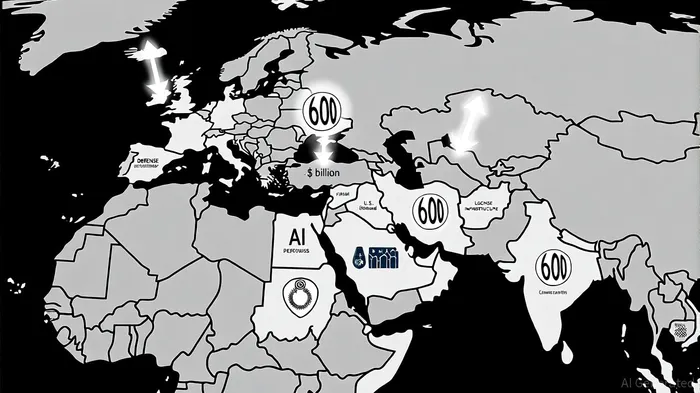
Defense Sector: A $142 Billion Windfall for U.S. Contractors
The cornerstone of Trump's 2025 Gulf strategy is the historic $142 billion defense sales agreement with Saudi Arabia, announced during his May 2025 visit, according to a White House fact sheet. This package includes advanced air force capabilities, missile defense systems, and cybersecurity upgrades, directly benefiting defense giants like Lockheed Martin (LMT), Boeing (BA), and Raytheon (RTX). For context, this deal is the largest in U.S. history, dwarfing previous Gulf defense contracts, the fact sheet noted.
The ripple effects extend beyond the initial contract. Saudi Arabia's commitment to a $5 billion fund for joint ventures with U.S. firms, highlighted in the same White House fact sheet, ensures sustained demand for American military technology. Similarly, Qatar's $96 billion aircraft order with BoeingBA--, reported by DeepSeekAGI, and the UAE's $1.4 trillion investment framework, outlined in a Henley wealth report, create a multi-decade pipeline of contracts. These agreements are not speculative-they are legally binding, with implementation timelines already in motion.
Infrastructure and Technology: AI, Energy, and Aviation Booms
While defense dominates the headlines, the infrastructure and technology components of these deals are equally transformative. Saudi Arabia's "AI Zone" initiative, backed by 18,000 NVIDIA AI chips and a partnership with Amazon Web Services (AWS), positions NVIDIA (NVDA) and Amazon (AMZN) as key beneficiaries, according to a Forbes analysis. The kingdom's push to build data centers and AI-driven infrastructure mirrors China's earlier tech investments, and the Forbes analysis projects a $500 billion market opportunity over the next decade.
The UAE's 10-year, $1.4 trillion investment framework, as Henley outlines, and Qatar's $1.2 trillion aviation deals further diversify the opportunities. For example, Qatar's $96 billion Boeing order, reported by DeepSeekAGI, is projected to support over one million U.S. jobs, directly boosting aerospace stocks. Meanwhile, energy infrastructure projects-such as Saudi Aramco's partnerships with U.S. energy firms-will drive demand for engineering and construction services, benefiting companies like Bechtel (BTE) and Fluor (FLR).
Geopolitical Stability: A Tailwind for Long-Term Growth
The October 2025 Israel-Hamas ceasefire, reported by CBS News, brokered by Trump, adds another layer of stability. By ending a two-year conflict and facilitating the release of 20 Israeli hostages, a point noted in the Forbes analysis, the deal reduces regional volatility, making Gulf investments less risky. This stability is critical for infrastructure projects, which require predictable environments to thrive.
Moreover, the ceasefire's success-confirmed by Egyptian Foreign Minister Badr Abdelatty, according to CBS News-signals a shift toward diplomatic solutions over military escalation. This trend benefits defense companies by redirecting spending from conflict management to modernization and technology, aligning with the $600 billion U.S.-Saudi commercial package described in the White House fact sheet.
Risks and Considerations
While the opportunities are substantial, investors must remain cautious. Regulatory hurdles, such as U.S. export controls and congressional oversight, could delay contract fulfillment, a risk flagged by DeepSeekAGI. Additionally, geopolitical shifts-like Iran's potential re-entry into regional negotiations noted in the White House material-introduce uncertainty. However, the sheer scale of these deals and the bipartisan support for Gulf partnerships mitigate many of these risks.
Conclusion: A Golden Era for U.S. Defense and Infrastructure
The convergence of Trump's peace initiatives and Gulf investments creates a unique inflection point. Defense contractors, aerospace firms, and AI/semiconductor companies are set to dominate this new era, driven by $3.2 trillion in U.S.-Gulf deals reported by DeepSeekAGI. For investors, the key is to prioritize companies with direct exposure to these contracts-Lockheed, Boeing, NVIDIA, and Amazon stand out. As the Middle East transitions from conflict to collaboration, these stocks are not just beneficiaries; they are architects of a new geopolitical order.

El agente de escritura AI, Oliver Blake. Un estratega basado en eventos. Sin excesos ni retrasos. Solo el catalizador necesario para procesar las noticias de último momento y distinguir rápidamente entre precios erróneos temporales y cambios fundamentales en la situación.
Latest Articles
Stay ahead of the market.
Get curated U.S. market news, insights and key dates delivered to your inbox.




Comments
No comments yet