
The Middle East Just Broke: Iran New 5 Point Plan is a War Trap for Your Wallet
The hope for cheap gas and stable prices just died. On Thursday, March 26, 2026, the global economy hit a wall, because Iran just handed over a 5-point "peace deal" to the U.S., but don't let the name fool you. This isn't a fix; it's a list of demands that Washington can never accept.
If this negotiation fails, the world is looking at more than just a military standoff. We are looking at a potential price explosion that could hit every home and every wallet.
This isn't just a small delay in talks. By demanding billions in cash and total control over the Strait of Hormuz, Tehran has made it clear: peace won't come cheap, and it won't come fast. For you, this means the current high prices may not be a temporary spike, but a new, painful reality.
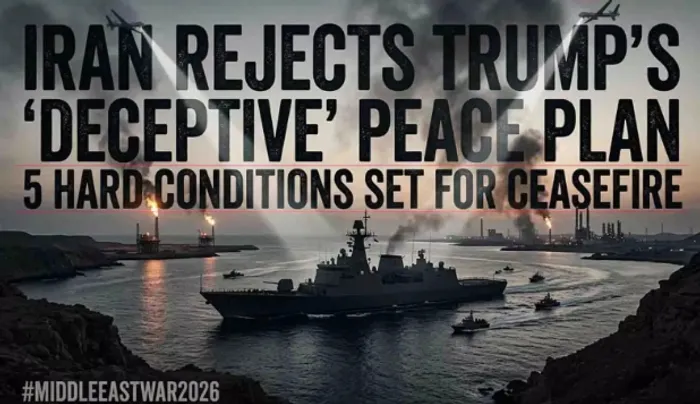
The True Cost of Iran 5 Demands That Washington Can Never Accept
According to The Guardian quoted the words of an Iranian official. On Wednesday, Iran rejected the ceasefire proposal put forward by the United States aimed at ending the current conflict. Senior political security officials in Tehran have clearly stated that the end of the war must comply with the terms and timetable proposed by Iran, and will not be subject to the dominance of Washington.
However, this condition might be impossible to achieve in Washington. The five prerequisites are as follows:
- Immediate Halt to Attacks: A complete cessation of U.S. and Israeli "aggression and assassinations" against Iranian officials and interests.
- Binding Non-Aggression Guarantees: Concrete, enforceable international measures to ensure the conflict will not be re-imposed and that future wars will not be waged against Iran.
- War Reparations: Clear determination and guaranteed payment of financial compensation for damages incurred during the conflict.
- End of Hostilities on All Fronts: A formal termination of all military engagements, including those targeting Iranian allied "resistance groups" across the region.
- Sovereignty over the Strait of Hormuz: International recognition of Iran's exclusive authority and sovereign right to regulate passage through the Strait of Hormuz.
The Hormuz Risk Premium Is Now a Permanent Tax
The Strait of Hormuz is no longer just a shipping lane; it is a global economic trigger. Currently, over 20 million barrels of oil and massive amounts of liquefied natural gas (LNG) pass through this narrow waterway every day. With Iran's 5 Point Plan effectively threatening a long-term blockade, insurance companies have already reacted with panic. Insurance premiums for tankers in the region have jumped by as much as 1000% this week.
These costs do not vanish overnight. Even if a single missile isn't fired today, the "risk" alone is enough to keep energy prices elevated. As long as these demands remain on the table, every barrel of oil will carry a permanent "hidden tax" to cover these massive insurance and security costs. For the average person, this means that even if the headlines calm down, the price of fuel won't return to the levels we saw last year. We are looking at a "Higher for Longer" energy era that will drain household budgets month after month.
The Global Food Chain Reaction
We are entering a dangerous phase where energy costs "leak" into the food supply, creating a second wave of inflation that is much harder to stop. Roughly one-third of the world's key fertilizer components travel through the Middle East. With the conflict stalling these shipments and keeping natural gas prices high, the cost of producing food is reaching a breaking point.
Farmers from the U.S. Midwest to the plains of Australia are currently facing record-high costs to plant this season's crops. Fertilizer is the single biggest expense for most commercial farms, and its price is tied directly to the cost of gas. This means that even if oil prices dip slightly next week, your grocery bills may continue to climb as the higher cost of this year's harvest hits store shelves by the fall. We aren't just talking about gas for your car; we are talking about the price of bread, meat, and dairy becoming a luxury for many families.
Conclusion: No Way Out But Diplomacy
The 5-point ultimatum from Tehran has effectively ended the hope for a "quick fix" to the world's energy crisis. By rejecting the U.S. proposal and setting terms that Washington simply cannot meet, Iran has locked the global economy into a state of permanent tension. Let's be clear: the hope for a short-term drop in prices has vanished.
We are no longer just watching a local conflict on the news; we are witnessing a structural shift in what it costs to live, eat, and move. The "Peace Dividend" of the last few decades is gone—replaced by a "War Tax" that is hollowing out the middle class.
The only way out of this economic death spiral is not through more missiles or more sanctions. The only path to bringing prices back down is a collective global effort to force both the U.S. and Iran back to the table for a real, workable reconciliation. Until a genuine diplomatic breakthrough happens, expect your bank account to remain under siege. The world must realize that the cost of war is now being charged directly to every household, and only a unified push for peace can stop the bleeding.

Tianhao Xu is currently a financial content editor, focusing on fintech and market analysis. Previously, he worked as a full-time forex trader for several years, specializing in global currency trading and risk management. He holds a master’s degree in Financial Analysis.
Latest Articles
Stay ahead of the market.
Get curated U.S. market news, insights and key dates delivered to your inbox.


AInvest
PRO
AInvest
PRO



Comments
No comments yet