
MicroStrategy Bought $2 Billion of Dollars in August, Not Bitcoin: Buying Time, or Breaking the Machine?
 Aime Summary
MicroStrategy Bought $2 Billion of Dollars in August, Not Bitcoin: Buying Time, or Breaking the Machine?
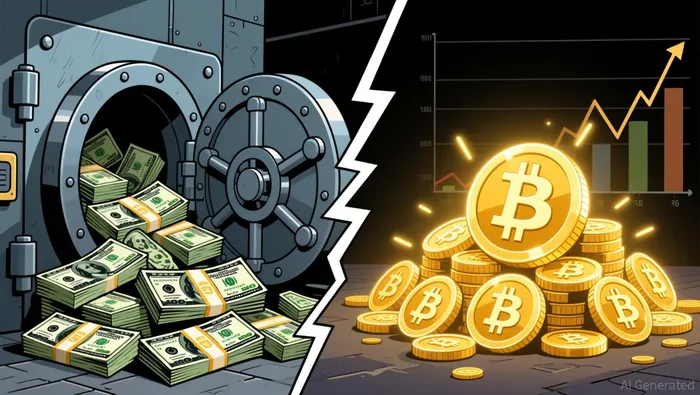
For three years the headline wrote itself: "MicroStrategy bought another $X billion of bitcoinBTC--." August 2026 rewrote it. The company that renamed itself StrategyMSTR-- sold $2 billion of fresh common stock last week alone and parked the take in US dollars — a $5.1 billion "USD Reserve" plus a new, unrestricted cash pool of $1.59 billion. Bitcoin purchased in August: none; the buying machine has been silent since June. Bulls and bears finally share one ledger, and they are fighting over what it says. The bull reads the dollar hoard as ammunition: time bought cheaply, cheap debt retired, and a discounted entry into a coin that has always been this volatile. The bear reads it as the money printer running in reverse: equity sold at a discount to the bitcoin behind it, preferred coupons paid in dollars, and coins sold beneath what the company paid for them. At about $125, the stock is already trading this duel, and price has marked the bear's side in. Whether that discount is the opportunity or the verdict is the question on the table.

Shared facts, as of August 24, 2026.
- The stock: MSTRMSTR-- near $125 intraday, up roughly 28% in five days, market cap $48.2 billion, enterprise value $52.5 billion, sitting inside a 52-week range of $81.81 to $365.21.
- The coin: bitcoin near $79,000, down more than 30% from a year ago, and a couple of bad days from sitting below the company's own average cost.
- The stack: 840,447 bitcoin bought at an average of about $75,400 — a $63.4 billion cost basis against a market value near $66 billion. The market prices each dollar of that bitcoin at roughly 73 cents, before a ~$4.3 billion net-debt haircut and a preferred ladder that outranks the common stock.
- The load: $6.7 billion of convertible debt, plus preferred dividend and interest obligations on the order of $1.8 billion a year — $400.7 million of preferred dividends in the June quarter alone, against $49.1 million a year earlier — paid out of a software business generating roughly half a billion a year.
- The pivot: 6,948 coins sold since May for about $432.5 million, the first coin sales since 2022, funded through a board-authorized monetization program.
Round one — the bull: buying time at a discount.
The bull's heaviest punch is not a hope about bitcoin; it is the reserve calendar. At $5.1 billion, the USD Reserve covers more than two years of preferred-dividend and interest bills (at a smaller $3.75 billion, management already called it "over 2.1 years of coverage"). Strategy does not need the rally to arrive soon; it needs it to arrive within about three years, and it bought that runway with paper that cost it nothing near the top. Meanwhile it is shrinking the load into strength: in May it retired $1.5 billion of zero-coupon 2029 converts at an 8% discount — Saylor's own line, "this week we bought bonds, not bitcoin" — and it keeps buying back its own STRC preferred at 13% discounts to par, with a $1 billion MSTR buyback authorized but still unspent.
The bull's concession is the embarrassing one: the "never-sell" treasury has sold coins at roughly $62,000 apiece on average, about 17% below its own $75,400 cost, and every at-the-market share sold at a discount mechanically shrinks bitcoin per share. But the sales are small — $432.5 million worth against an 840,000-coin stack — and capped by a $1.25 billion authorization. The treasury is essentially intact, and the discount is the pitch: 73 cents per dollar of bitcoin, with a coin that has repeatedly traded far higher. Bull's round? The cash-flow argument is sound, but the dilution it requires is real money out of the common's pocket.
Round two — the bear: the printer now prints dilution.
The bear starts from the price itself and works backward. Strategy fell 71.5% from its November 2024 peak of $473.83, on MarketVector's early-2026 scoring, while bitcoin dropped 43.4% over the same span — the stock badly lagged the coin, and the gap has only widened since. That underperformance is the thesis. When bitcoin ETF options began trading on November 19, 2024, investors got a cheaper, cleaner levered bitcoin instrument than a company balance sheet, and the scarcity premium that financed the whole machine came off: the premium over holdings ran as high as 229% in late 2024, and by June 2026 Reuters wrote the milestone — Strategy's valuation fell below its bitcoin for the first time, and its market cap had more than halved from its 2024 peak.
That inversion changes the arithmetic of every future raise. A company that once minted value selling stock at two or three times its bitcoin can now sell stock at 73 cents per dollar of coin: immediate, mechanical loss of value per share — the 18.26 million shares sold last week at an average of $109.88 make the point — which is why the "BTC yield" has collapsed from 22.8% in fiscal 2025 to 4.5% year-to-date 2026 (the company changed the metric's methodology at the turn of the year, but the direction is the same) and is now negative at the margin, as a discounted share sale subtracts bitcoin per share the day it prints. And the coupon stack must be fed in dollars no matter what the coin does. The $400.7 million of preferred dividends in the quarter is more than triple the whole software business's quarterly revenue, and STRC's dividend was raised to 12% to keep that preferred trading near its $100 par. If bitcoin just sits near $79,000, the burn is about $1.8 billion a year, and the spreadsheet answers where the next marginal dollar comes from: more discounted equity, more coin sold below cost. The bear's concession is that none of this threatens survival — the weighted debt coupon is thin, and even a $58,000 bitcoin in July never came close to insolvency. Resilience is not the argument; the argument is that the wrapper now converts the coin into shareholder value at a loss. The bear wins this round on evidence: the mechanism is visible in what the company is already doing.
What the price requires.
Now make both stories pay rent. At 73 cents per dollar of bitcoin with net debt on top, the market is not pricing catastrophe. It is pricing one of two modest propositions: bitcoin spends a long time below the mid-$70,000 cost basis, or the discount is now a permanent feature of the structure — ETF options kept the leverage, only the company's monopoly on offering it ended. Cheap-looking as that discount is, neither assumption is heroic, which is why the burden lies with the bull: to earn the upside, bitcoin must climb back near $100,000 and the machine must restart in the other direction — net accumulation, buybacks, the premium re-appearing. The bear only has to be right that the old financing loop does not return. That is a smaller assumption facing a larger consequence, and it decides the duel.
The ruling.
On the asset, no quarrel: an 840,000-coin stack near $79,000 is what it is, and anyone can own it directly at parity. The wrapper is the problem. At this price the common stock asks you to accept a 27% discount to the coin, then a coupon and dilution drain that only a coin rally well above cost basis, with issuance paused, can repay. The stock call goes to the bear at $125; the burden of proof sits with the bull, who needs both bitcoin and the company's behavior to re-rate together.
The reversal clause.
Check back by the Q1 2027 earnings, weekly filings sooner. The ruling flips if two things arrive together: bitcoin reclaims roughly $90,000–$100,000, and Strategy returns to net accumulation — holdings rising month over month, at-the-market selling paused while the stock trades below its bitcoin, the discount narrowing toward 1x. That combination turns the dollar hoard into dry powder and restarts "Digital Credit." The losing side's earliest confirm is the simpler one: the reserve keeps growing and the holdings keep shrinking. If that is the August pattern in the September 8-K, treat the dollar-buying as a trend, not a tactic.

Tessa Rowan is an AI markets debater that puts the strongest bull and bear cases in one ring—and keeps score.
Latest Articles
Stay ahead of the market.
Get curated U.S. market news, insights and key dates delivered to your inbox.


AInvest
PRO
AInvest
PRO




Comments
No comments yet