
MicroStrategy's Bitcoin Treasury Strategy: A Model for Institutional Adoption?


 Aime Summary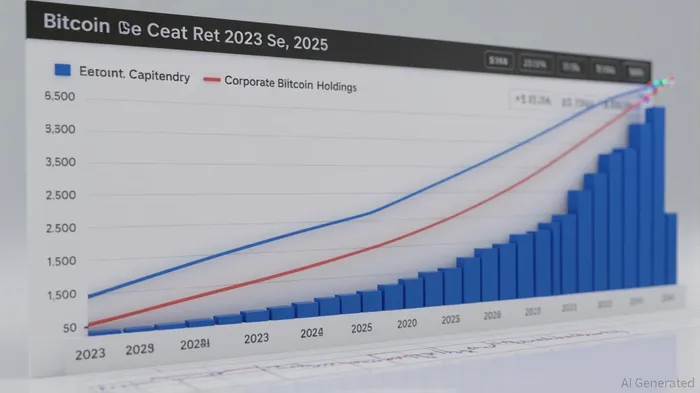
In 2025, the corporate world's embrace of BitcoinBTC-- has reached a tipping point. At the forefront of this shift is MicroStrategy (now operating under the brand “Strategy”), whose aggressive Bitcoin treasury strategy has redefined how corporations allocate capital. By leveraging bond issuance, repo markets, and innovative capital-raising tools, the company has transformed its balance sheet into a vehicle for Bitcoin accumulation. But does this strategy offer a scalable blueprint for institutional adoption? And what does it mean for Bitcoin's price action, liquidity, and long-term credibility as a financial asset?
The Mechanics of MicroStrategy's Strategy
MicroStrategy's approach hinges on a disciplined, rules-based framework to raise capital and deploy it into Bitcoin. By Q2 2025, the company had raised over $13.2 billion through a combination of at-the-market (ATM) programs and preferred stock IPOs. Key instruments include:
- STRC Stock: A variable-rate perpetual preferred stock engineered for price stability, raising $2.5 billion in July 2025.
- mNAV-Based Issuance Discipline: Equity is issued only when Bitcoin Net Asset Value (mNAV) thresholds justify it, ensuring capital efficiency.
- Repo-Like Liquidity: Preferred stock dividends and ATM programs create a steady cash flow for Bitcoin purchases, effectively replicating repo market dynamics to fund treasury growth.
By July 2025, MicroStrategy held 628,791 bitcoinsBTC--, with its Bitcoin Per Share (BPS) metric rising 25% year-to-date. The company's financials reflect this strategy's success: Q2 2025 operating income hit $14.03 billion, driven by a $14.03 billion unrealized gain on Bitcoin holdings.
Broader Institutional Trends: A New Era for Bitcoin
MicroStrategy's strategy is not an outlier. Institutional adoption of Bitcoin has surged, driven by regulatory clarity (e.g., spot ETF approvals) and macroeconomic tailwinds. By 2025:
- ETF Dominance: BlackRock's iShares Bitcoin Trust (IBIT) alone holds $91 billion in assets, with 78% of U.S. spot ETF AUM.
- Corporate Treasuries: Over 70 publicly traded companies now hold Bitcoin, with holdings increasing 18.67% year-to-date.
- Sovereign Wealth Funds (SWFs): Discreet allocations by SWFs have added a stable, long-term demand layer to Bitcoin's market structure.
These trends have reduced Bitcoin's volatility by ~75% compared to 2023 levels, as institutional investors act as “strong hands” during downturns. Bitcoin's role has shifted from speculative asset to a strategic hedge against inflation and currency devaluation.
Can MicroStrategy's Model Be Replicated?
MicroStrategy's strategy offers a compelling blueprint for institutional adoption, but its replicability depends on three factors:
1. Capital Market Access: The ability to raise capital via preferred stock and ATM programs requires robust investor confidence. Smaller firms may struggle to replicate this without similar market credibility.
2. Regulatory Environment: The approval of spot ETFs and the CLARITY Act in 2025 have normalized Bitcoin's inclusion in portfolios. Without such frameworks, institutional adoption would remain fragmented.
3. Strategic Alignment: Bitcoin must align with a company's risk profile. For MicroStrategy, Bitcoin serves as a digital reserve asset; for others, it may act as a hedge or diversification tool.
Tesla's 9,720 BTC holdings, for instance, reflect a more conservative approach, allocating ~0.1% of its treasury to Bitcoin. This contrasts with MicroStrategy's aggressive 629,376 BTC position, which accounts for ~10% of its total assets.
Implications for Bitcoin's Price and Market Dynamics
MicroStrategy's strategy has amplified Bitcoin's liquidity and price discovery mechanisms. The company's capital-raising activities inject liquidity into the market, while its disciplined Bitcoin accumulation creates a floor for demand. This dynamic is reinforced by institutional ETFs, which have added $65 billion in AUM globally by 2025.
However, risks persist. Market concentration—BlackRock's 3.72% stake in Bitcoin's total supply—raises concerns about potential manipulation. Additionally, Bitcoin's newfound macroeconomic sensitivity means its price is now tied to central bank policies and inflation data, as seen in its correlation with the S&P 500 and U.S. Treasury yields.
Investment Thesis: A Legitimate Institutional Asset
For investors, the key takeaway is clear: Bitcoin has transitioned from a speculative niche to a core institutional asset. MicroStrategy's strategy demonstrates how corporations can leverage capital markets to scale Bitcoin holdings while generating shareholder value. For institutions, the path forward includes:
- Portfolio Diversification: Allocating 1–2% of assets to Bitcoin to hedge against inflation and currency volatility.
- Leveraging ETFs: Using regulated vehicles like IBIT to gain exposure without custody risks.
- Monitoring Macroeconomic Signals: Bitcoin's price is now influenced by Fed policy, geopolitical events, and global inflation trends.
Conclusion: A New Financial Paradigm
MicroStrategy's Bitcoin treasury strategy is more than a corporate experiment—it is a harbinger of a broader institutional shift. By combining innovative capital markets tools with a disciplined approach to Bitcoin accumulation, the company has set a precedent for how corporations can integrate digital assets into their treasuries. While challenges like market concentration and regulatory uncertainty remain, the long-term trajectory is undeniable: Bitcoin is now a legitimate, institutional-grade asset. For investors, the question is no longer if to allocate to Bitcoin, but how to do so strategically in this new era of financial innovation.

Decoding blockchain innovations and market trends with clarity and precision.
Latest Articles
Stay ahead of the market.
Get curated U.S. market news, insights and key dates delivered to your inbox.




Comments
No comments yet