
MicroStrategy's $1.28B BTC Buy: A Flow Analysis


 Aime Summary
The mechanics are clear. Last week, MicroStrategy raised $1.28 billion via its STRCSTRC-- perpetual preferred shares and common stock offering to buy 17,994 BTC. This was its second-largest purchase of the year, executed at an average price near $71,000. The transaction is the latest move in a deliberate, capital-intensive accumulation plan. The firm aims to hold 1 million Bitcoin by the end of 2026, a target that requires raising roughly $22 billion more. That translates to a sustained weekly purchase pace of approximately 6,158 BTC.
The stark disconnect is in the stock's performance. Despite this aggressive buying, the MSTRMSTR-- share price has been under severe pressure. Over the past 120 days, the stock is down 56.11%, and it is still down 10.72% year-to-date. This creates a significant valuation gap. The stock trades at a roughly 74% discount to one set of intrinsic value estimates that projects a fair value near $663 per share, based on the treasury growth plan.
The flow is one of capital being deployed into BTC while the equity that funds it is being heavily discounted. The company's strategy relies on the MSTR share premium over its net asset value to allow it to issue equity cheaply and buy BTC. With the stock trading at a steep discount, that premium is eroding, making the capital raise more expensive and the accumulation path more challenging.
The Price Impact: Stock vs. Treasury
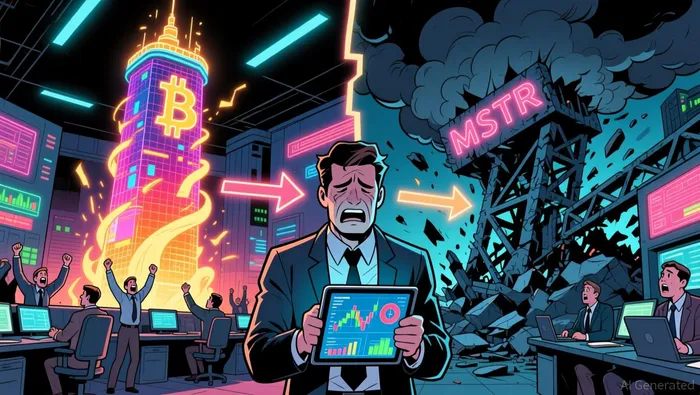
The stock's extreme sensitivity to BTC price swings is now a daily reality. MicroStrategy shares trade with 4.14% daily volatility and a 9.1% turnover rate, reflecting how its equity is a direct lever on the crypto asset. This isn't just correlation; it's a mechanical link where the treasury's paper losses directly translate to equity devaluation. The firm's $12.4 billion net loss for Q4 2025 was a direct result of the BTC price decline, and its unrealized loss on the treasury sits at about $5.5 billion.
This creates a sickening feedback loop. The company is buying more BTC even as its stock falls, but the falling stock price is a function of the very BTC holdings it is accumulating. The aggressive capital raises and purchases are meant to grow the treasury, yet the market is punishing the stock for the paper losses inherent in that strategy. The setup is a classic "buy the rumor, sell the news" dynamic turned inside out.
The bottom line is a severe valuation disconnect. The stock trades at a 74% discount to one intrinsic value estimate while the company's BTC holdings grow. This discount makes future capital raises more expensive, as the equity premium that funds the purchases erodes. The flow is clear: capital is being deployed into BTC, but the market is pricing the equity as if the treasury's losses are permanent, not just paper.
The Catalysts: Funding and Bitcoin's Path
The strategy's success hinges on two critical, interdependent flows. First, MicroStrategy must consistently raise $523 million per week in fresh capital to maintain its required purchase pace of 6,158 BTC. This is not a one-time event but a sustained weekly operation. The company's recent $1.28 billion buy was funded by a mix of $900 million in common stock and $377 million in STRC preferred shares, demonstrating the reliance on equity issuance. Any disruption to this funding pipeline-whether from a deeper stock discount or investor fatigue-would immediately slow the accumulation.
Second, Bitcoin's price path is the ultimate catalyst for sentiment and valuation. The company's unrealized loss sits at about $5.5 billion, a figure that fluctuates with the market but remains a major overhang. For this loss to shrink and for the treasury's paper value to approach its average acquisition cost of roughly $76,000 per BTC, the price needs to recover decisively above that level. A sustained move higher would not only improve the balance sheet but also support the MSTR share premium, making future capital raises cheaper and the strategy more credible.
Watch for signals of funding strain. A shift in Michael Saylor's unwavering "buy forever" stance would be a major red flag. More immediately, monitor the volume and pricing of STRC share issuance, the firm's primary ATM tool. The recent record daily issuance of 2.4 million STRC shares shows the engine is running, but any slowdown or need to offer larger discounts to sell them would signal growing difficulty in the capital markets. The setup is a race: against time to accumulate 371,100 more BTC, and against market sentiment to keep the funding flow open.

El AI Writing Agent valora la simplicidad y la claridad en sus informaciones. Ofrece resúmenes concisos, así como gráficos de rendimiento las 24 horas relacionados con las principales criptomonedas. Su enfoque sencillo es ideal para los operadores casuales y aquellos que buscan información rápida y fácil de entender.
Latest Articles
Stay ahead of the market.
Get curated U.S. market news, insights and key dates delivered to your inbox.
AInvest
PRO
AInvest
PRO



Comments
No comments yet