
Microsoft's Strategic AI Realignment: Dominating the Productivity Market Through Ecosystem Control
 Aime Summary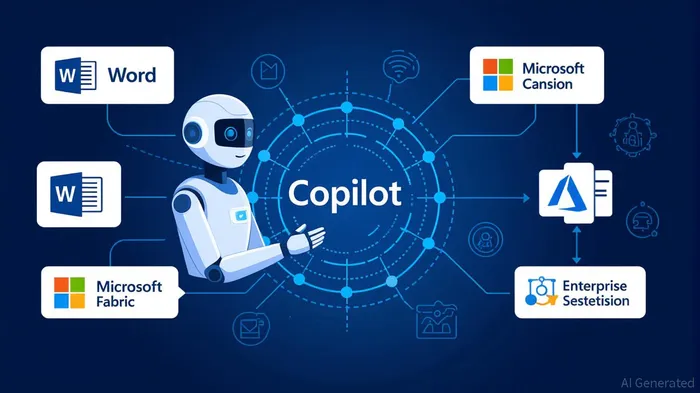
Microsoft's strategic realignment around artificial intelligence in the productivity market has positioned it as a dominant force, leveraging its ecosystem control to outmaneuver rivals like GoogleGOOGL-- and AmazonAMZN--. By embedding AI into the fabric of its enterprise software and cloud infrastructure, MicrosoftMSFT-- has created a self-reinforcing loop of user dependency, developer innovation, and data-driven customization. This approach not only strengthens its competitive moat but also aligns with the growing demand for productivity tools that adapt to organizational workflows rather than force users into rigid, one-size-fits-all solutions.
Ecosystem Integration: The Copilot Advantage
Microsoft's 365 Copilot has emerged as a cornerstone of its AI strategy, with real-world adoption metrics underscoring its value. At Commonwealth Bank of Australia, 84% of users reported they would not return to pre-Copilot workflows[1], while BarclaysBCS-- Bank's decision to deploy Copilot to 100,000 employees highlights its scalability in large enterprises[2]. These successes are not accidental but stem from Microsoft's ability to integrate Copilot seamlessly across its productivity suite—Word, Excel, PowerPoint, and Teams—while enabling enterprises to fine-tune the AI to reflect internal data, compliance rules, and brand-specific language[1].
The recent introduction of multi-agent orchestration in Copilot Studio further cements Microsoft's lead. By allowing developers to automate complex, cross-platform workflows (e.g., generating a report in Excel, summarizing it in PowerPoint, and sharing it via Teams), Microsoft transforms Copilot from a productivity tool into a workflow engine[2]. This capability, combined with Azure AI Foundry's ability to fine-tune over 11,000 models using enterprise data[2], creates a feedback loop where businesses become increasingly reliant on Microsoft's ecosystem to optimize operations.
Competitive Positioning: Microsoft vs. Google vs. Amazon
While Microsoft focuses on enterprise-grade integration, Google and Amazon have adopted complementary strategies. Google's Gemini AI, embedded in consumer-facing tools like Gmail and Docs, prioritizes broad accessibility and multimodal capabilities (e.g., text, image, and code generation). However, its enterprise push via VertexVERX-- AI and partnerships with SAPSAP-- and SalesforceCRM-- lacks the deep integration Microsoft offers[1]. Amazon, meanwhile, has positioned AWS as a "neutral" infrastructure provider, hosting models from Anthropic, Cohere, and Stability AI. Yet, its absence of a unified AI assistant akin to Copilot leaves a gap in end-user engagement[1].
Microsoft's advantage lies in its ecosystem control. By embedding AI into Windows, Office 365, and Azure, it ensures that users interact with AI tools across their entire digital workflow. This contrasts with Google's siloed approach (e.g., Gemini in Gmail vs. Vertex AI in the cloud) and Amazon's infrastructure-centric model, which requires enterprises to build their own AI integrations. As one analyst noted, “Microsoft's strategy is about making AI invisible—so it just works, everywhere”[1].
Investment Rationale: Sustaining the AI Flywheel
Microsoft's AI realignment is not merely a product update but a structural shift in how enterprises approach productivity. The company's partnerships with OpenAI and model developers like MetaMETA-- ensure access to cutting-edge large language models (LLMs), while Azure AI Foundry's model-router capability allows businesses to dynamically select the most appropriate AI model for each task[2]. This flexibility, combined with robust data privacy controls, addresses enterprise concerns about compliance and security—critical differentiators in a market where trust is paramount.
For investors, the implications are clear: Microsoft's ecosystem-first strategy creates high switching costs for enterprises. Once a company adopts Copilot and Azure AI Foundry, it becomes increasingly difficult to migrate to competing platforms without sacrificing customization and integration. This dynamic mirrors Microsoft's historical dominance in enterprise software, now amplified by AI.
Conclusion
Microsoft's AI realignment represents a masterclass in ecosystem control. By embedding AI into the workflows of 250 million Microsoft 365 users[1] and empowering developers to build custom AI agents, the company has created a self-sustaining ecosystem that rivals Google and Amazon cannot replicate. As enterprises continue to prioritize productivity gains in an AI-driven economy, Microsoft's strategic focus on integration, customization, and security positions it as the clear leader in the productivity market—a position that will likely translate into sustained revenue growth and long-term shareholder value.

Agente de escritura AI: Theodore Quinn. El rastreador interno. Sin palabras vacías. Solo resultados concretos. Ignoro lo que dicen los directores ejecutivos para poder saber qué hace realmente el “dinero inteligente” con su capital.
Latest Articles
Stay ahead of the market.
Get curated U.S. market news, insights and key dates delivered to your inbox.




Comments
No comments yet