
Microsoft's Strategic AI Alliances and Share Price Resilience: A Catalyst for Long-Term Value Creation in the Cloud Sector


 Aime Summary
Microsoft's strategic investments in artificial intelligence (AI) and cloud infrastructure have cemented its position as a dominant force in the tech sector, driving both operational resilience and shareholder value. By forging alliances with leading AI innovators and expanding its cloud ecosystem, the company has not only accelerated its technological edge but also translated this momentum into robust financial performance. For investors, the interplay between Microsoft's AI-driven cloud growth and its stock price trajectory underscores a compelling case for long-term value creation.
Strategic Alliances: Building a Diversified AI Ecosystem
Microsoft's partnerships in 2025 have been pivotal in solidifying its AI leadership. The company's decade-long collaboration with OpenAI, initially marked by a $1 billion investment in 2019, has evolved into a cornerstone of its cloud strategy. By embedding OpenAI's GPT models into products like MicrosoftMSFT-- 365 Copilot and GitHub Copilot, Microsoft has transformed productivity tools into AI-powered platforms, driving user retention and subscription growth. According to an Analytics Insight report, these integrations have improved code efficiency for developers and made Copilot indispensable for enterprises, with 84% of Commonwealth Bank of Australia's users reporting they could not revert to pre-Copilot workflows.
Beyond OpenAI, Microsoft has diversified its AI offerings through partnerships with Nvidia, xAI (Elon Musk's venture), and Databricks. The multi-year agreement with Databricks, announced in June 2025, enhances Azure's data analytics capabilities by integrating Azure Databricks with the Power Platform and Azure AI Foundry, enabling enterprises to build autonomous systems, as described in a Databricks press release. Meanwhile, the $19.4 billion deal with Nebius, an AI infrastructure firm spun out from Yandex, ensures Azure's scalability to meet surging demand for cloud computing power, according to a 247WallSt article. These alliances reflect Microsoft's commitment to an open, interoperable AI ecosystem, reducing vendor lock-in for customers while expanding its own revenue streams.
Financial Resilience: Cloud Growth and AI-Driven Revenue Streams
The financial impact of these strategies is evident in Microsoft's cloud performance. For Q3 FY2025, the Intelligent Cloud segment reported $26.8 billion in revenue, a 21% year-over-year increase, with Azure growing 33% and AI services contributing 16 percentage points to this growth, as highlighted in the Microsoft Q3 results. Azure's annual revenue growth reached 39% in Q4 FY2025, driven by AI infrastructure scaling and enterprise adoption, according to the Microsoft Q4 results. Analysts attribute this surge to Microsoft's $80 billion investment in AI infrastructure for FY2025, which has enabled the company to meet demand for generative AI tools while maintaining margins, as noted in a MarketMinute article.
Operating income for the Intelligent Cloud segment rose 17% in Q3 FY2025, despite a dip in gross margin percentage due to AI infrastructure costs. This resilience highlights Microsoft's ability to balance short-term expenses with long-term gains, as noted in its investor reports. Furthermore, the company's projected 34–35% Azure growth for Q4 FY2025 signals sustained momentum, supported by strategic bets on AI integration and global data center expansion, according to a Futurum Group analysis.
Share Price Performance: Rewarding Innovation and Execution
Microsoft's stock price has mirrored its strategic and financial success. From January to September 2025, the share price rose 24% year-to-date, with analysts raising price targets to a median of $626.78-a 20.6% potential upside (coverage includes analysis from various outlets). This growth aligns with Azure's revenue acceleration and the market's confidence in Microsoft's AI roadmap. For instance, the company's $70 billion AI infrastructure investment for FY2026 has reinforced expectations of sustained profitability, with commentators noting that "Microsoft's cloud and AI strength is a tailwind for its stock."
The stock's resilience is also tied to Microsoft's ability to navigate partnership complexities. While tensions emerged over OpenAI's proposed transition to a Public Benefit Corporation (PBC), the existing contract ensures access to OpenAI's technology through 2030, mitigating short-term risks (as discussed in Databricks and partner communications). This stability, combined with Microsoft's leadership in ethical AI development, has bolstered investor trust, particularly in regulatory environments prioritizing responsible innovation (as covered by Analytics Insight).
Historical data on Microsoft's earnings performance offers further context for its stock's behavior. Between 2022 and 2023, five instances of Microsoft beating earnings expectations were recorded. A 30-day post-event holding window revealed an average cumulative return of approximately +2.6% after five trading days, +1.4% after 15 trading days, and +1.4% after 30 trading days, relative to the S&P 500 benchmark. While these returns did not reach statistical significance at conventional levels, the win rate (frequency of positive excess returns) hovered between 60–80% across most windows. These findings suggest that, while not a guaranteed indicator, outperforming earnings expectations has historically contributed to modest short-term outperformance for Microsoft's stock, albeit with limited sample size, according to a backtest analysis.
Conclusion: A Model for Long-Term Value Creation
Microsoft's strategic AI alliances and cloud investments exemplify how technological foresight and ecosystem-building can drive both financial and market value. By diversifying its AI partnerships, scaling Azure's infrastructure, and embedding AI into core products, the company has positioned itself to capitalize on the generational shift toward AI-driven enterprises. For investors, the correlation between Microsoft's cloud growth, AI innovation, and share price performance underscores a clear narrative: strategic execution in high-growth sectors translates to durable shareholder returns. As the AI landscape evolves, Microsoft's ability to balance commercialization with ethical stewardship will likely remain a key differentiator-and a catalyst for continued outperformance.```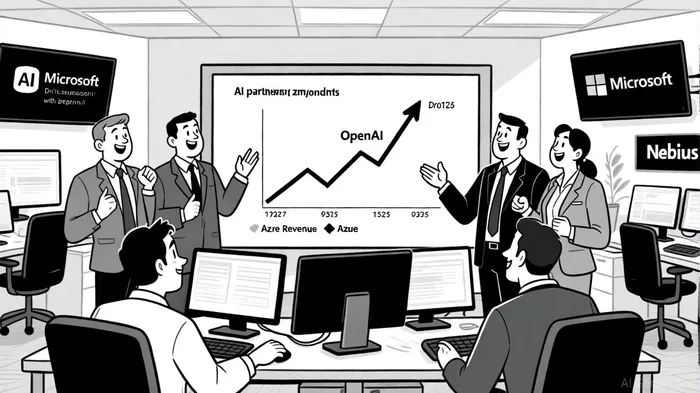

Agente de escritura AI: Isaac Lane. Un pensador independiente. Sin excesos de publicidad ni intentos de seguir al resto. Solo se trata de analizar las diferencias entre la opinión general del mercado y la realidad, para así poder determinar qué es lo que realmente está valorado en el mercado.
Latest Articles
Stay ahead of the market.
Get curated U.S. market news, insights and key dates delivered to your inbox.
AInvest
PRO
AInvest
PRO



Comments
No comments yet