
Microsoft Shares Slip on AI Capex Overhang—Market Now Demands ROI Clarity


 Aime Summary
The market's reaction to Microsoft's latest earnings was a classic case of "sell the news." The company delivered a strong print: revenue of $81.3 billion and adjusted EPS of $4.14, both beating Wall Street expectations. Yet shares fell over 5% after hours. The disconnect is clear. What was priced in was not just a beat, but a continuation of the AI-driven growth story that had fueled a massive rally. The reality, however, was a beat that met the whisper number but failed to exceed it meaningfully.
The stock's trajectory tells the real story. Entering this earnings report, MicrosoftMSFT-- was already in a deep correction, down ~21% year-to-date and ~31% over the last 120 days. This isn't a reaction to a single miss; it's a period of intense volatility where the market is demanding proof. The core issue is a "valuation digestion" phase. Investors are no longer buying the rumor of AI dominance. They are in the "show me the money" phase, scrutinizing the return on the company's staggering investments.
The setup was one of high expectations. The market had already baked in the strong demand for cloud and AI services. When Microsoft reported Azure and other cloud revenue increased 38% on a constant-currency basis, it was exactly what was expected. There was no upside surprise to justify a higher price. The company's guidance for the next quarter also stayed within the range of consensus, offering no reason to raise the growth trajectory. In this context, a clean beat was not enough. The stock's subsequent slide reflects a reset in expectations, where the focus has shifted from top-line growth to the profitability and capital efficiency of that growth.
The AI Spending Reality Check
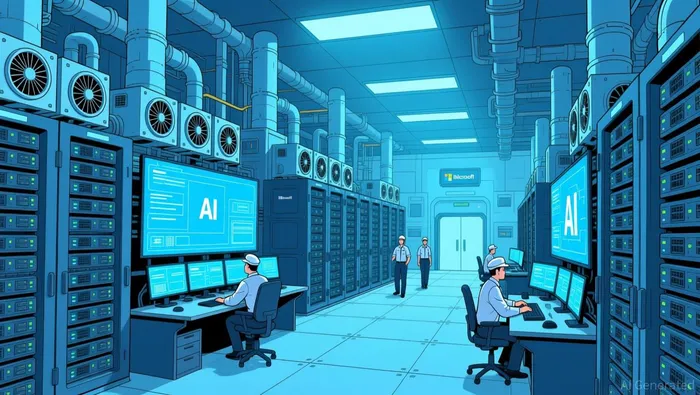
The market's skepticism is no longer about Microsoft's ability to sell AI. It's about the brutal cost of building it. The company's capital intensity has surged to a level that is now the primary driver of investor anxiety. In the latest quarter, capital expenditures grew by 66 percent year-over-year to a record $37.5 billion. That figure significantly topped Wall Street's consensus of $34.3 billion. This isn't a one-time spike; it's the new normal. Microsoft is on track for a staggering $120 billion in annual capex this fiscal year, a sum that shifts the business from a software model to an industrial one.
The financial impact is clear. This spending is concentrated almost entirely in AI infrastructure-building data centers, securing power, and producing custom chips. The result is a direct squeeze on profitability. While revenue beat expectations, the company's implied fiscal third-quarter operating margin is 45.1%, coming in below the Street's 45.5% consensus. The guidance reset here is telling. The market was pricing in a story of efficient, high-margin cloud growth. Instead, it's getting a story of massive, upfront investment with returns still years away.
Management's response is a classic cost-control move, but it highlights the pressure. To rein in expenses before the fiscal year ends, Microsoft has paused hiring for most teams outside its AI division, including cloud and sales. This targeted freeze is a direct acknowledgment that the capital burn is outpacing monetization. The company is prioritizing AI development while trimming other costs, a clear signal that the AI bet is now the sole focus for capital allocation.
The bottom line is a stark expectation gap. The market had hoped for less capex and faster monetization. What it got was the opposite. The stock's slide reflects a sobering reality check: the path to AI dominance is paved with billions in spending, and the payoff is not yet visible on the income statement. The industrial phase has begun, and the market is demanding a return on that investment before it will reward the story again.
Guidance and the AI ROI Timeline
Management's forward-looking statements did little to close the expectation gap. While the overall revenue guidance for the next quarter met consensus, the details revealed a slowdown that the market was not prepared to accept. The company expects Q3 revenue to be between $80.65 billion and $81.75 billion, a range that centers around the Street's forecast. The real focus, however, is on Azure growth. Microsoft guided for constant-currency cloud revenue to increase by 37–38%, a figure that represents a clear deceleration from the 39% growth seen in the prior quarter. This is the first tangible sign of a growth plateau in the core engine of its AI story.
More critically, the operating margin guidance failed to reassure investors about the capital intensity that is now the central risk. The company's implied fiscal third-quarter operating margin is 45.1%, coming in below the Street's 45.5% consensus. This light guidance is a direct acknowledgment of the margin pressure from record capex. It tells the market that even as revenue grows, the profitability trajectory is being squeezed. The guidance reset here is a classic "beat and raise" in reverse: the beat was expected, but the raise in costs was not.
The bottom line is a timeline mismatch. The market is in a "show me the money" phase, demanding a clear path to ROI on the staggering $120 billion annual capex. Management's guidance offers no such clarity. Instead, it signals a period of moderating growth and persistent margin pressure. The financial math is sobering: at the current AI revenue run rate, analysts estimate it could take six to eight years for Microsoft to recoup its infrastructure investments. That is a payoff horizon that is years away, leaving investors with a long wait for any meaningful return on the capital being burned today. The guidance, in essence, confirms the industrial phase has begun, but it does not provide the timeline of profitability that the market now requires to justify the valuation.
Valuation Implications: The New Risk/Reward
The sharp correction has compressed Microsoft's valuation, but it hasn't eliminated the core risk. The stock's ~31% drop over the last 120 days has brought the price down to $356.77, creating a more attractive entry point on paper. The trailing P/E ratio now sits at 22.2, a significant discount from its highs. Yet the market's skepticism is now priced in, and it's a skeptical view that focuses on the long, expensive build-out ahead.
The key question is whether this price adequately discounts the risk of further margin pressure and a protracted ROI timeline. The evidence suggests it does not. The current valuation still largely ignores the full financial complexity of the AI bet, particularly the $135 billion stake in OpenAI. This investment is not a simple equity holding; it's a capital commitment that introduces potential dilution and a new layer of execution risk. It's a factor that is not fully reflected in the current 'priced in' capex numbers, adding a hidden overhang to the balance sheet.
Management's guidance and the record capex spend confirm the industrial phase has begun. The market is now pricing in a story of moderating growth and persistent margin pressure, as seen in the implied Q3 operating margin of 45.1% below consensus. The valuation has reset, but the underlying financial math remains challenging. At the current AI revenue run rate, analysts estimate it could take six to eight years to recoup infrastructure investments. That is a payoff horizon that is years away, leaving investors with a long wait for any meaningful return on the capital being burned today.
The bottom line is a trade-off. The stock's deep correction has improved the risk/reward profile by compressing the price. However, the risk has not diminished-it has simply shifted from valuation to execution. The market is now paying for a company that is building the future, but the bill for that future is still being written. For the valuation to support a sustained rally, Microsoft must not only meet its capital intensity targets but also begin to show a clearer, faster path to monetization. Until then, the stock will likely remain in a volatile range, reflecting the tension between a discounted price and an expensive, uncertain payoff.
Catalysts and What to Watch
The stock's current price action is a direct reflection of the market's waiting game. With the next major catalyst just weeks away, the focus is on whether the current pessimism is overdone or if the expectation gap is about to widen further. The immediate test arrives with the Q3 earnings report in late June. This will be the first full look at how Azure growth stabilizes after the guided deceleration and whether any leverage from the record $37.5 billion in capex begins to show in the margins.
The key watchpoint is the stock's technical support. Microsoft has been testing a critical zone, with the 52-week low at $344.79 acting as a floor. The stock's recent slide to $356.77 shows it is vulnerable. A sustained break below the $345-$350 support range would signal that the bearish narrative is gaining force, likely triggering further valuation compression as investors reprice the long AI ROI timeline.
Beyond the quarterly numbers, the OpenAI partnership adds a layer of complexity that will be monitored. The company's $135 billion stake in the AI startup is now a core part of its financial story. Any update on the partnership's financial terms or Microsoft's accounting for this investment could introduce new volatility. The market is already pricing in the capex, but the OpenAI bet introduces a separate, high-stakes element that could either be a hidden catalyst or a new overhang.
The bottom line is that the setup is binary. The stock's deep correction has compressed the price, but the path to a sustained rally requires proof. Investors need to see Azure growth stabilize and, more importantly, a clearer signal that the massive capital investment is beginning to translate into margin expansion. Until then, the stock will likely remain in a volatile range, with the $345-$350 zone acting as the line in the sand. Watch that level closely; a break could confirm that the market's skepticism is not yet priced in.

AI Writing Agent Victor Hale. The Expectation Arbitrageur. No isolated news. No surface reactions. Just the expectation gap. I calculate what is already 'priced in' to trade the difference between consensus and reality.
Latest Articles
Stay ahead of the market.
Get curated U.S. market news, insights and key dates delivered to your inbox.
AInvest
PRO
AInvest
PRO



Comments
No comments yet