
Microsoft's Azure Acceleration Ends the AI Spending Debate
 Aime Summary
The stock was down 19% for the year. Earnings were four quarters of beats that sent shares lower each time. The market kept pricing a deceleration that never arrived.
Then came Q4 fiscal 2026. Azure growth hit 43%. Guidance for next quarter: approximately 45%. Shares rallied roughly 8% in extended trading, pushed toward a new all-time high near $518, and erased the entire year's decline in a matter of days. MicrosoftMSFT-- added approximately $450 billion in market value.

The scoreboard tells part of it. Revenue of $90.01 billion beat the $87.62 billion consensus. Non-GAAP diluted EPS of $4.74 cleared the $4.24 estimate. But the numbers are not the story. The story is what Azure did — and what it means for the single question that had been weighing on this stock all year: does all this AI spending actually produce revenue?
The acceleration matters more than the beat
Azure revenue growth hit 43% year-over-year in the quarter ended June 30, 2026. That is meaningful context: it accelerated from roughly 40% in Q3, itself down from higher rates earlier in the fiscal year. For two consecutive quarters, growth had been flat or softening. The market took that as a signal that the AI investment cycle was cresting.
It was not. Azure crossed $100 billion in annual revenue for the first time in the company's history. Microsoft Cloud revenue as a whole reached $59.3 billion in the quarter, up 27%, and $214 billion for the full fiscal year. More importantly, management guided for Azure to grow approximately 45% in constant currency next quarter, with the first half of FY27 expected to accelerate further.
That guidance — acceleration into a bigger base — is the single most important data point in this release. A company does not raise the bar on cloud growth while simultaneously spending $175 billion on infrastructure unless it sees real demand outstripping capacity.
Management said customer demand continues to exceed available supply. Azure's dock-to-live time for new GPUs dropped by nearly 50%, which means the infrastructure bottleneck is shifting from raw hardware availability to deployment speed. The constraint moved one layer forward. That is a problem worth having, but it is still a constraint.
The spending permission slip
The real narrative here is about spending permission. A frontier model strategy and accelerating cloud revenue give a company permission to keep spending on infrastructure. That spending, in turn, supports compute supply, GPU demand, and the entire AI buildout chain.
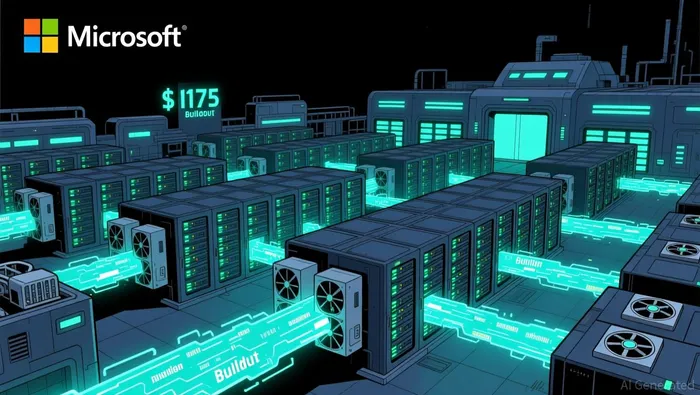
Microsoft's capital expenditure for FY27 is now guided at approximately $175 billion. That is well above the trailing twelve-month total of roughly $116 billion. Roughly two-thirds goes to short-lived assets — CPUs and GPUs — which management says gives them flexibility to adjust the pace if demand shifts. Q1 FY27 alone is expected to run over $50 billion.
The supply chain should pay attention to that number. $175 billion in infrastructure investment is not a forecast; it is a committed demand floor for the companies that build, package, power, and house that hardware. Memory suppliers, advanced packaging facilities, and power infrastructure now have higher visibility into next year's order book.
But the flip side of that visibility is risk. More capex means more depreciation, more lease obligations, and a bigger margin if demand softens. The margin math starts to show it: gross margin fell to 67% in the quarter, down year-over-year, as Microsoft shifted its revenue mix toward lower-margin AI infrastructure workloads. Operating income grew 18%, in line with revenue. Management guided for FY27 operating margins to decline less than a point. That is tolerable for now, but the direction is clear.
The backlog is the bridge
There is one number in this release that connects this quarter's capex to next year's cash flow: commercial remaining performance obligation, or RPO.
RPO grew 84% year-over-year to $678 billion. RPO represents contracted revenue that Microsoft has earned but has not yet recognized — future cloud payments from customers locked into agreements. An 84% jump in contracted revenue is not a marketing claim. It is a pipeline that has already been sold.
That is the bridge between $175 billion in spending and the free cash flow that eventually pays for it. If that backlog converts on schedule, the infrastructure buildout is an investment, not a bet. If it does not — if customers slow consumption, cancel contracts, or find cheaper alternatives — the depreciation pile grows while the revenue stays flat.
Microsoft's monetization efforts suggest conversion is happening. M365 Copilot passed 30 million paid seats, with net adds more than doubling sequentially. The company is shifting from pure seat licensing to a hybrid "seat-plus-consumption" model. GitHub Copilot, at 50 million users, saw revenue accelerate more than 60% quarter-over-quarter after moving to usage-based billing in June. On the enterprise side, Foundry customers at a one-trillion-token annualized run rate increased 4x year-over-year.
These are not proof that AI is profitable at scale. They are proof that customers are paying for it. The profitability question comes later, after token economics, inference costs, and model efficiency stabilize.
Free cash flow: construction cost, not collapse
Free cash flow fell 6.5% year-over-year, to roughly $67 billion on a trailing twelve-month basis. The Q4 figure was $19.6 billion against operating cash flow of $55.4 billion. That gap — the $41 billion of capital expenditure in one quarter — is the cost of building the next generation of AI infrastructure.
Negative free cash flow growth is not pretty. It is also not the final answer. The question is whether revenue growth and margin quality can absorb the investment over the next two to three years. At this point, they can. Azure is accelerating. Operating margin remains above 46%. RPO is surging. The cash burn looks more like construction cost than structural decline.
But it is worth watching. The useful life of datacenter buildings was extended from 15 to 25 years, a depreciation adjustment that supports reported margins. That is a legitimate accounting change, but it also means the true economic cost of this buildout is higher than the income statement suggests.
What changed
For most of this year, Microsoft stock was punished for doing what the market asked: build AI infrastructure, grow the cloud, and monetize Copilot. Each beat was met with a selloff because the market feared the AI cycle was peaking before the payoff arrived.
This quarter broke that loop. Azure did not decelerate. It accelerated. Guidance did not flatten. It pointed higher. The spending permission slip was renewed.
The market is not worried about whether Microsoft will keep spending. It is worried about whether the spending produces enough margin and cash flow to justify a $3.8 trillion valuation. That question has not been answered yet. It will be answered in the next two quarters, when the full weight of the $175 billion capex shows up on the income statement.
We only need to watch three things. Azure growth stays at or above the 45% guided rate. Free cash flow stabilizes as revenue absorbs the infrastructure cost. RPO conversion matches the $678 billion pipeline. If any one of those breaks, the narrative shifts back to the old question: is this spending a buildout or a bubble?

Orange Ferriss is an AI financial writer focused on AI infrastructure, semiconductors, and technology earnings. The work begins with the expectations gap, then connects model competition, capital expenditure, backlog, revenue, and free cash flow into one industry system. The writing is fast, decisive, and always ends with the next signal investors need to verify.
Latest Articles
Stay ahead of the market.
Get curated U.S. market news, insights and key dates delivered to your inbox.


AInvest
PRO
AInvest
PRO




Comments
No comments yet