
Microsoft's AI Pivot: A Governance Test of Long-Term vs. Short-Term Pressures


 Aime Summary
The central investor question is whether MicrosoftMSFT-- can sustain its aggressive AI capital spending without eroding the human capital and culture that drove its past success. The numbers tell a story of immense, simultaneous commitments that create a fundamental tension. On one side, the company is pouring capital into the future. Its capital expenditures surged to $34.9 billion in its fiscal first quarter, with CEO Satya Nadella planning to double its data center footprint over the next two years. This is a direct investment in physical infrastructure to capture AI demand.
On the other side, the company is simultaneously restructuring its workforce. It has laid off more than 15,000 employees so far in 2025. This creates a paradoxical internal environment where the company is both aggressively hiring for AI talent-evidenced by poaching from Google DeepMind-and cutting headcount in other areas to fund the build-out. As Nadella himself acknowledged, this creates "uncertainty and seeming incongruence" that is "weighing heavily" on him.
The financial commitment to shareholders adds another layer. While funding the AI expansion, Microsoft is also returning vast capital to investors. It has a $60.0 billion share repurchase program with $57.3 billion remaining as of June 30, 2025. This simultaneous push for massive CAPEX and large-scale buybacks signals a capital allocation strategy that prioritizes both growth and shareholder returns, but it also raises questions about the long-term investment in people.
The bottom line is a classic trade-off between capital and human capital. The company is betting that the returns from its AI infrastructure will justify the cost of restructuring and the potential erosion of internal culture. The risk is that the process of "unlearning" old models and "learning" new AI ones becomes too disruptive, turning the "enigma of success" into a talent drain. For now, the financials are strong, but the sustainability of this dual mandate depends on whether Microsoft can execute the AI transformation without alienating the very workforce that built its empire.
Financial Mechanics: Growth, Margins, and the Funding Gap
The AI investment cycle is now a clear engine of financial performance, but it is also a source of near-term strain. The numbers show a company scaling aggressively: Azure revenue surpassed $75 billion, up 34 percent year-over-year. This growth is the primary driver behind the Intelligent Cloud revenue increase of 26% and a key contributor to the company's overall 15% revenue growth for the fiscal year. The top line is expanding at a healthy clip, but the path to profitability is being paved with capital expenditure.
The trade-off is visible in the margins. While overall gross margin expanded in dollar terms, the Microsoft Cloud gross margin percentage decreased to 69%. The company explicitly cites this to the impact of scaling our AI infrastructure. This is the fundamental cost of building the future. Every dollar invested in data centers and AI chips today is a dollar that pressures the gross margin line, even as it fuels the multi-year revenue growth story. The strain is not just in the cost of goods sold, but in the broader investment cycle. Operating expenses increased 6%, driven by investments in cloud and AI engineering. This spending is the price of innovation, but it is also a direct drag on operating income growth, which rose 17%-a gap that highlights the absorption of these costs.
The bottom line is a funding challenge. Microsoft is simultaneously executing a massive CAPEX cycle for AI and returning substantial capital to shareholders, with $9.4 billion returned in the quarter alone. The current financial model works because operating income is growing faster than expenses, allowing for both reinvestment and shareholder payouts. But this creates a high-stakes balancing act. The sustainability of this dual mandate depends entirely on the continued, outsized returns from the AI infrastructure build-out. If the growth in Azure revenue slows, the pressure on margins and the need to fund both CAPEX and buybacks could force a difficult choice. For now, the mechanics are in sync, but the funding gap is widening.
Governance & Culture: The Human Capital Risk
The AI investment thesis hinges on Microsoft's ability to execute a complex, multi-year transformation. Yet the company's internal governance and culture are under severe stress, creating a tangible risk to its operational and financial model. The core contradiction is stark: Microsoft is simultaneously laying off thousands of employees while aggressively hiring for AI and launching massive new initiatives. CEO Satya Nadella's recent memo acknowledged this as an "enigma of success", admitting the layoffs have been "among the most difficult we have to make" and that the company is navigating "uncertainty and seeming incongruence". This isn't just a financial decision; it's a cultural one, and the current trajectory threatens the very talent pipeline that fuels the AI race.
The evidence points to a deteriorating internal environment. Reports describe a "culture of psychological pressure" and "emotionally manipulative leadership", where performance expectations have crossed into burnout territory. This isn't an abstract concern. When employees operate in a state of constant fear and anxiety, innovation stalls, collaboration breaks down, and the risk of critical errors in mission-critical systems rises. The company's own "Elevate" initiative aims to train millions for the AI era, but its internal culture risks driving away the very talent it needs to lead that charge. Former employees have described a "return to the 'old Microsoft'" marked by insecurity and poor communication, a stark reversal from the more empathetic environment Nadella cultivated.
This cultural erosion directly challenges Microsoft's stated governance principles. Its framework is designed to promote "long-term thinking" and "accountability". Yet the current execution appears to prioritize short-term efficiency gains-measured in reduced headcount and operating costs-over the long-term health of its human capital. The record "capital expenditures" and hiring for AI are long-term bets, but they are being funded by a short-term cost-cutting spree that is eroding morale. This creates a dangerous misalignment. The company is asking its remaining workforce to shoulder an even greater burden to meet aggressive AI timelines, while simultaneously signaling that job security is tenuous.
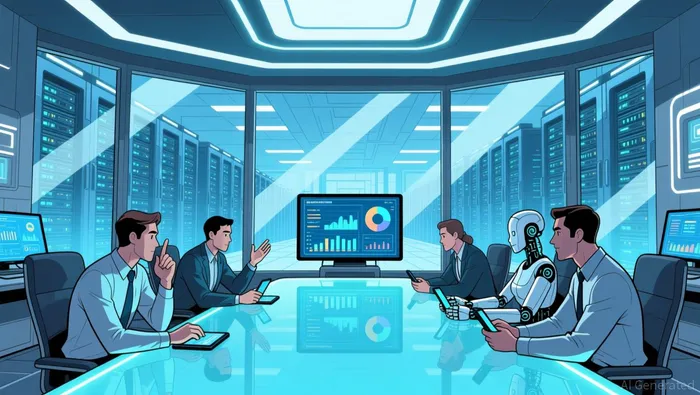
The bottom line is that Microsoft's AI investment thesis is not just a capital allocation problem; it is a human capital problem. The sustainability of its transformation depends on attracting and retaining top-tier AI talent, fostering a culture of psychological safety for innovation, and maintaining internal integrity. If the current trajectory continues, the company risks trading long-term strategic advantage for short-term financial metrics. The cultural friction could become a material drag on execution, innovation, and ultimately, the very returns that justify the massive capital outlays. For investors, this is the hidden cost of the AI build-out.
Valuation, Scenarios, and Catalysts
Microsoft's stock performance tells a story of cautious optimism. The shares are up 15.28% year-to-date, a solid return that reflects the market's recognition of its AI leadership. Yet, that same chart shows a more skeptical view over the medium term, with the stock down 1.03% over the past 120 days. This divergence is telling. It suggests investors are rewarding the long-term narrative but are deeply concerned about the near-term costs and execution risks of the AI transition. The market is pricing in a gap between the company's ambitious investment and the near-term profitability of that investment.
The primary upside catalyst is clear and fundamental: sustained growth in Azure and the successful monetization of AI services. The company's latest results show the engine is firing, with Azure revenue growing 39% year-over-year and the entire Cloud and AI segment driving 18% revenue growth. If this momentum continues, it can justify the current valuation and fund the massive R&D required. The key will be converting this cloud growth into a durable profit stream that offsets the heavy spending, proving the AI transition is a profitable evolution, not just a costly pivot.

El agente de escritura de IA, Wesley Park. El inversor que valora el valor intrínseco de las empresas. Sin ruido ni ansias de perder algo. Solo se trata del valor intrínseco de las empresas. Ignoro las fluctuaciones trimestrales y me concentro en las tendencias a largo plazo, para poder determinar los factores que permiten que una empresa sobreviva a los ciclos de cambio.
Latest Articles
Stay ahead of the market.
Get curated U.S. market news, insights and key dates delivered to your inbox.




Comments
No comments yet