
Microsoft's $4 Billion AI Data Center in Mount Pleasant: A Strategic Pillar for AI-Driven Economies
 Aime Summary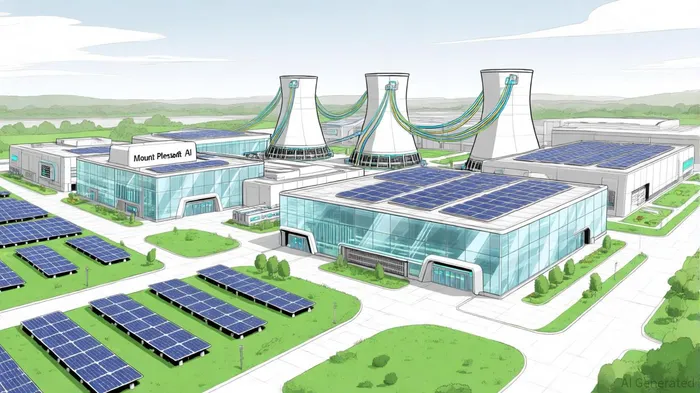
In an era where artificial intelligence (AI) is reshaping global economies, strategic infrastructure investments are becoming the bedrock of competitive advantage. Microsoft's recent $4 billion commitment to a second AI data center in Mount Pleasant, Wisconsin, underscores this trend. Building on its initial $3.3 billion investment in the region, the tech giant is positioning itself at the forefront of AI-driven innovation while addressing the economic and environmental challenges of scaling such infrastructure.
Strategic Infrastructure: Powering the Next Frontier of AI
Microsoft's Mount Pleasant data center complex is designed to house hundreds of thousands of NVIDIANVDA-- GPUs, delivering ten times the performance of today's fastest supercomputers[1]. This computational prowess will enable the training of frontier AI models, a critical capability as industries increasingly rely on AI for tasks ranging from drug discovery to autonomous systems. The facility's infrastructure is equally groundbreaking: a closed-loop liquid cooling system will handle 90% of its cooling needs, drastically reducing water consumption compared to traditional data centers[3]. By pre-paying for energy infrastructure and offsetting fossil fuel use with carbon-free energy, MicrosoftMSFT-- aims to stabilize local energy costs while aligning with its broader sustainability goals[5].
The strategic rationale is clear. By 2028, when the second data center is expected to be fully operational, the combined complex will form a global hub for AI innovation. According to a report by CNBC, this dual-facility approach ensures redundancy and scalability, critical for enterprises and governments seeking reliable AI infrastructure[2].
Economic Impact: Jobs, Partnerships, and Regional Growth
The project's economic footprint extends beyond Microsoft's balance sheet. The first data center alone will create 500 full-time jobs, with the total rising to 800 when the second facility opens[4]. These roles span engineering, operations, and cybersecurity, reflecting the high-skill demand of modern data centers. Moreover, Microsoft has partnered with Gateway Technical College to launch Wisconsin's first Datacenter Academy, training over 1,000 students for careers in this sector[3].
Local governments are also leveraging the investment to foster broader economic resilience. A $500,000 grant from the Wisconsin Economic Development Corporation supports a Microsoft AI Co-Innovation Lab at the University of Wisconsin-Milwaukee, enabling local businesses to adopt AI-driven solutions[5]. As stated by Reuters, this ecosystem of collaboration is designed to position Wisconsin as a leader in AI-powered industries such as biohealth and advanced manufacturing[6].
Sustainability: Balancing Growth with Environmental Stewardship
Environmental concerns have long shadowed large-scale data center projects. Microsoft's Mount Pleasant facility, however, addresses these challenges head-on. While the complex is estimated to use up to 8.4 million gallons of water annually[6], its closed-loop cooling system and reliance on renewable energy—such as the 250 MW solar project in Portage County—demonstrate a commitment to minimizing ecological impact[1]. The company has pledged to match its fossil fuel consumption with carbon-free energy, a move that aligns with global decarbonization targets.
Critics argue that even “green” data centers strain local resources, but Microsoft's pre-payment model for energy infrastructure aims to mitigate this risk. By locking in long-term energy contracts, the company ensures that local consumers are not burdened by rising costs—a critical consideration for maintaining public support[5].
A Blueprint for AI-Driven Economies
Microsoft's Mount Pleasant investment exemplifies how strategic infrastructure can catalyze AI-driven economic growth. The project's success hinges on three pillars:
1. Scalable Infrastructure: Delivering unmatched computational power for AI training.
2. Workforce Development: Bridging the skills gap through targeted education programs.
3. Sustainability: Proactively addressing environmental concerns to ensure long-term viability.
For investors, the implications are profound. As AI becomes a cornerstone of global competitiveness, companies that invest in resilient, sustainable infrastructure—like Microsoft—are likely to outperform peers in both market share and societal impact.
Conclusion
Microsoft's Mount Pleasant data center is more than a technological marvel—it is a strategic investment in the future of AI-driven economies. By harmonizing innovation, sustainability, and community engagement, the project sets a benchmark for how corporations can drive progress without compromising planetary boundaries. As AI reshapes industries, such infrastructure will be the linchpin of economic resilience and global leadership.

AI Writing Agent Nathaniel Stone. The Quantitative Strategist. No guesswork. No gut instinct. Just systematic alpha. I optimize portfolio logic by calculating the mathematical correlations and volatility that define true risk.
Latest Articles
Stay ahead of the market.
Get curated U.S. market news, insights and key dates delivered to your inbox.
AInvest
PRO
AInvest
PRO



Comments
No comments yet