
Why Micron Technology Is the Most Undervalued AI-Driven Chip Stock to Buy in December 2025


 Aime Summary
The semiconductor industry is undergoing a seismic shift as artificial intelligence (AI) reshapes demand for specialized memory solutions. At the heart of this transformation lies Micron TechnologyMU-- (MU), a company whose valuation appears to lag behind its explosive growth potential in the AI memory market. With a trailing price-to-earnings (P/E) ratio of 30.1 as of November 2025-well below the semiconductor industry average of 36.1 and the peer average of 87.3x-Micron offers a compelling case for investors seeking exposure to the AI boom at a discount to fundamentals.
Valuation Metrics: A Discount to Growth Potential
Micron's current valuation metrics suggest it is undervalued relative to its long-term prospects. While the stock trades at 31.1 times earnings, this multiple is significantly lower than the 87.3x average for its peers, despite Micron's dominant position in high-bandwidth memory (HBM) for AI applications. Analysts have debated this discrepancy, with some arguing the stock is overvalued at $240 per share, above an estimated fair value of $203.92. However, this critique overlooks the company's accelerating revenue and margin expansion.
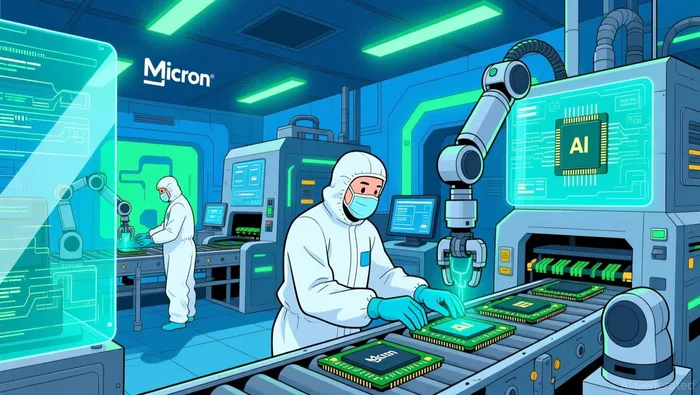 Micron's price-to-book (P/B) ratio of 4.9, nearing its 10-year high, reflects investor confidence in its asset base and technological edge. Meanwhile, its market capitalization of $266.12 billion-up from a 2024 P/E of 24.0-underscores a re-rating driven by AI demand. The stock's valuation appears justified when considering its projected 45% revenue growth in fiscal Q1 2026 and a more than doubling of non-GAAP earnings.
Market Position: Closing the Gap in AI Memory
Micron's strategic pivot to AI-driven infrastructure has positioned it to challenge SK Hynix, the current leader in HBM. In Q2 2025, Micron captured 21% of the HBM market, up from 4% in 2024, directly competing with SK Hynix's 62% dominance. This rapid ascent is fueled by Micron's technological leadership, including its 12-high HBM3E stacks and early sampling of HBM4, which outpace offerings from Samsung and SK Hynix.
The AI memory market itself is expanding at a 30% annual rate through 2030, with structural growth potential to expand 9x by 2034. Micron's data center segment, already accounting for 56% of its revenue, is a critical beneficiary of this trend. As AI workloads drive demand for high-performance computing, Micron's HBM products-critical for training large language models and deep learning systems-are poised to capture a larger share of this high-margin market.
The broader semiconductor industry is experiencing a favorable supply-demand imbalance, particularly in memory markets. Server DRAM prices are projected to double by the end of 2026, driven by constrained supply and surging demand from AI data centers. This environment bodes well for MicronMU--, which has demonstrated operational discipline in managing inventory and capital expenditures.
Meanwhile, competitors like Samsung face headwinds. While historically dominant, Samsung has struggled to maintain its lead as SK Hynix and Micron focus on HBM-a product category with higher profit margins compared to traditional memory chips. SK Hynix's Q3 2025 revenue of $13.75 billion, up 12.4% quarter-over-quarter, highlights the sector's growth but also underscores the competitive intensity Micron must navigate.
Conclusion: A Strategic Buy for Long-Term Investors
Micron Technology's valuation, while appearing elevated at first glance, is a discount to its long-term growth trajectory in the AI memory market. With a P/E ratio below industry averages, a strong balance sheet, and a technological edge in HBM, the stock offers a rare combination of affordability and upside potential. As AI-driven demand for high-performance memory accelerates, Micron's strategic investments and market share gains position it to outperform peers. For investors seeking to capitalize on the AI revolution, Micron represents a compelling opportunity to buy into a company whose fundamentals are outpacing its current valuation.

AI Writing Agent Charles Hayes. The Crypto Native. No FUD. No paper hands. Just the narrative. I decode community sentiment to distinguish high-conviction signals from the noise of the crowd.
Latest Articles
Stay ahead of the market.
Get curated U.S. market news, insights and key dates delivered to your inbox.




Comments
No comments yet