
Micron Technology (MU) Q2 FY2026 Earnings
 Aime Summary
Introduction: The "Memory Fortress" in a Macro Storm
As we head into mid-March 2026, global equity markets are under significant downward pressure from a confluence of macroeconomic and geopolitical headwinds. Escalating tensions involving the US, Israel, and Iran have spurred geopolitical unrest, sending crude oil prices soaring. This has even prompted G7 discussions on an unprecedented strategic petroleum reserve release to counter potential long-term disruptions in the Strait of Hormuz. Against this volatile energy backdrop, fears of resurgent inflation are haunting Wall Street, casting a shadow over upcoming central bank decisions from the Fed, ECB, BOJ, and BoE. This macro uncertainty is reflected in weak major indices; in the week leading up to Micron's report, the S&P 500 declined, while the Nasdaq and Dow fell 1.7% and 2.2%, respectively.
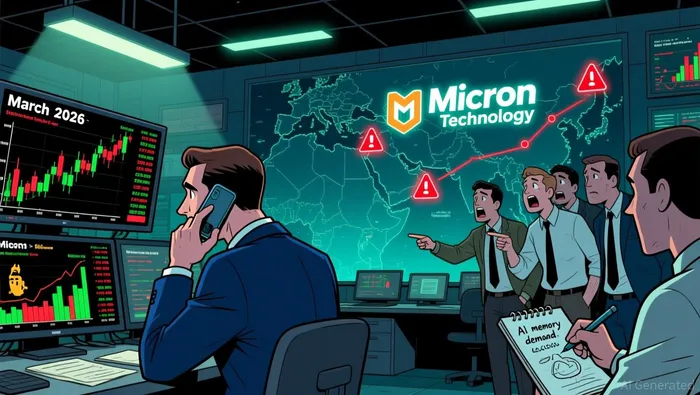
At this sensitive juncture for tech stocks, the global semiconductor memory leader, Micron TechnologyMU-- (MU), is set to report its Q2 FY2026 earnings after the close on March 18, 2026. For individual investors and macro traders alike, this is more than just a quarterly scorecard. It's a critical litmus test for the resilience of AI infrastructure build-out, the sustainability of data center capital expenditures, and the health of the global consumer electronics supply chain. Driven by insatiable AI compute demand, the memory sector has shed its old cyclical commodity skin, displaying remarkable defensive strength. It's now hailed by Wall Street as the unshakable "Memory Fortress." With the broader market looking shaky, the question on everyone's mind is: Can Micron's numbers and guidance be strong enough to prop up the entire tech sector's valuation?
This preview will dive deep into pre-earnings price action, Wall Street consensus, core business drivers (especially HBM evolution), spillover effects on consumer markets, the competitive landscape, and quantifiable signals from social sentiment and options markets. The goal is to provide a detailed, actionable roadmap for the retail trader.
Pre-Earnings Price Action & Wall Street's Bullish Frenzy Epic Revaluation & Recent Trading Dynamics Over the past year, MicronMU-- shareholders have witnessed an epic wealth revaluation. The generative AI and LLM boom has made the market acutely aware that memory bandwidth is the ultimate bottleneck for GPU performance—the infamous "memory wall." This realization has triggered a flood of capital into core memory players. In the trailing twelve months, Micron's stock has skyrocketed between 322.79% and 345%, climbing from a 52-week low of $61.54 to a high of $455.50.
Entering March 2026, despite broad market pressure, Micron has shown significant alpha. In the week before earnings, it was one of the best-performing tech stocks in the S&P 500, rallying roughly 15%. The table below details key trading sessions from late February to mid-March, showcasing its resilience.
(Data Source: Historical Trading Data)
The table shows that despite sharp pullbacks in early March (e.g., -7.99% on Mar 3, -6.74% on Mar 6), dip-buying was aggressive, quickly pushing the stock to $426.13 by March 13. Average daily volume remained elevated near 39 million shares, indicating strong institutional accumulation ahead of the print.
Wall Street's "Target Price Arms Race" This strength is backed by a wave of aggressive Wall Street upgrades. The bullish consensus is palpable.
First, Wedbush's Matt Bryson issued a bombshell report on March 13, raising his price target from $320 to a Street-high $500. He cited DRAM and NAND contract prices surging over 50% in the first ten weeks of 2026, defying seasonal trends. With a "V-shaped" margin recovery and a solid backlog, he sees no reason to change his Outperform rating as long as the P/E multiple remains below typical cycle peaks.
Second, Mizuho's Vijay Rakesh reiterated his Outperform rating with a $480 target. The core logic hinges on hyperscaler CapEx exploding, projected to surge 59% YoY in 2026, providing a persistent tailwind for memory pricing. Zacks Investment Research slapped Micron with its highest Strong Buy (Zacks Rank #1) rating, highlighting the strong correlation between rising earnings estimates and near-term price outperformance.
Financial Expectations: A Quarter Poised to Shatter Records To gauge the potential impact, we must cross-reference Wall Street's consensus with Micron's own guidance. All signs point to Q2 being one of the most explosive quarters in company history.
Revenue & EPS: Explosive Growth Management's prior guidance called for Q2 revenue of ~$18.7B (+/- $400M) and non-GAAP EPS of ~$8.42 (+/- $0.20). The Street's appetite is bigger. The Zacks consensus expects revenue of $19.15B, representing a stunning +137.8% YoY increase.
For profitability, consensus EPS stands at $8.69, a meteoric +457.1% YoY surge. More critically, the "Most Accurate Estimate" within the Zacks system—incorporating the latest analyst revisions—is $9.19, a full 5.69% above the consensus. With a track record of beating estimates for four consecutive quarters (average beat of 14.4%), the probability of a "beat and raise" scenario with EPS potentially above $9 is seen as very high.
The table below contrasts key metrics:
(Data Source: Company Reports, Zacks Investment Research, CMC Markets)
Revenue Breakdown: DRAM Dominance & NAND Recovery Drilling down, DRAM revenue is expected to be the primary engine, forecast at $15.03B (+145.6% YoY). This is fueled by the super-premium pricing of HBM and broad adoption of standard DDR5 in servers.
The long-suffering NAND business is also roaring back. With strong data center SSD demand and pricing up ~40% in Q1, NAND revenue is projected at $3.75B (+102.3% YoY). Other technology revenue (primarily NOR Flash) is expected at ~$83.8M (+11.7% YoY). This across-the-board strength creates a seemingly bulletproof fundamental setup.
The Core Narrative: Micron as the "Anchor" in the AI Super-Cycle Beyond the numbers, these are the key narratives that will drive trader sentiment and short-term price action.
HBM: "Sold Out" & The New Pricing Power This is the most compelling part of the investment thesis. AI has transformed memory from a commoditized "price-taker" business to a strategic bottleneck. HBM is now a scarce, mission-critical resource.
Management has signaled that its entire 2026 HBM capacity is sold out, with orders extending into 2027. This multi-year capacity locking is historically rare. The takeaway for traders is simple: Micron has transitioned to a "pricing power player." With HBM selling for 3-5x the price of standard DRAM, this "HBM premium" is the direct driver behind gross margins rocketing from ~20% in early 2025 to the expected 67-69% range now. "Sold out" and "margin explosion" are the ultimate bullish tags for retail confidence.
Tied to NVIDIA's AI Ecosystem: Feeding the Memory Beast Micron's ceiling is inextricably linked to NVIDIA's GPU roadmap. The exponential growth in HBM demand per GPU generation is staggering.
(Data Source: Industry Research, NVIDIA Disclosures)
The demand isn't incremental; it's multiplicative. Micron's key competitive edge here is its HBM3E chips consume ~30% less power than competitors'. In an era of data center power and thermal constraints, this is a massive advantage for hyperscalers, cementing Micron's place in the NVIDIA supply chain.
Massive CapEx & Stellar Free Cash Flow To meet this demand and address an expected 12-18 month DRAM shortage, Micron has raised its FY2026 CapEx budget from ~$18B to ~$20B, focused on expanding HBM supply and next-gen 1-gamma DRAM node production.
While such spending might worry some value investors, Micron's financials are robust: over $12B in cash & securities, a debt-to-equity ratio around 15%, and record Q1 operating cash flow of $8.41B ($3.9B adjusted FCF). This self-funding capability allows expansion without shareholder dilution. The recent initiation of a $0.115 quarterly dividend further underscores management's confidence in sustained, high-level FCF generation.
The Double-Edged Sword: Consumer Electronics "Memory Apocalypse" A critical, often overlooked macro insight is that the AI data center boom is creating a disastrous "crowding-out effect" on the PC and smartphone markets.
The Capacity War: Drying Up General Supply Fab space and equipment are fixed in the short term. Manufacturing HBM is complex and consumes vastly more wafer area—Micron has indicated a 3:1 capacity trade-off (HBM vs. DDR5). This means producing one high-margin HBM chip sacrifices the capacity to make three or more standard DRAM chips. This reallocation is causing a severe shortage of general-purpose memory.
The Terminal Price Storm & AI PC Setback The supply crunch leads to price explosions. DRAM prices are forecast to surge 62% in Q1 2026, with NAND up 40%. By year-end, combined DRAM/SSD price increases could reach 130%, forcing PC prices up ~17% and smartphone prices up ~13%.
This BOM cost surge is devastating for low-margin, budget devices. Analysis suggests sub-$500 PCs and sub-$200 smartphones could vanish from the market by 2028. Ironically, the much-hyped "AI PC" revolution is being hamstrung, as soaring memory costs force OEMs to skimp on the very RAM and storage needed for edge AI, potentially delaying mass adoption targets.
For Micron, this creates a perfect financial loop: Super-profits from HBM in AI servers, and in the traditional PC/phone markets, soaring blended ASPs more than offsetting any volume decline, driving overall revenue skyward. This industry-wide pricing power is the core foundation for earnings beats.
Competition & Global Chess Game: The HBM4 Race Despite the tailwinds, the memory industry remains a brutal arena. Smart money must assess Micron's position and threats.
The Triopoly: Korean Giants vs. Micron's Ascent The global HBM market is a "triopoly" with a clear hierarchy: SK Hynix, Samsung, and Micron.
(Data Source: Counterpoint Research, Industry Reports)
SK Hynix is the biggest AI winner so far. Samsung, despite early stumbles, is mounting a fierce comeback with its financial might and internal foundry.
The Key Battle: NVIDIA Vera Rubin & HBM4 The real variable is the next-gen NVIDIA Vera Rubin architecture and its HBM4 memory. This is a "race against time" for future profit share.
Recent industry chatter from Korean media and firms like TrendForce suggests Samsung and SK Hynix have been listed as first-wave HBM4 suppliers for Vera Rubin. NVIDIA is demanding data rates exceeding 10Gb/s, above JEDEC standards. Reports indicate Samsung has passed qualification tests and may have begun early HBM4 shipments.
This has spawned bearish commentary about Micron potentially lagging in initial Rubin platform qualification. However, this concern may be overblown. Micron shipped HBM4 samples to partners as early as September 2025. Furthermore, even if it's not in the highest-tier GPU at launch, the sheer scale of NVIDIA's demand means all three suppliers' capacity will be soaked up. Micron's broader AI stack exposure (data center DRAM, enterprise NAND) also provides diversified risk mitigation.
Macro & Geopolitical Tail Risks As a US-based multinational, Micron faces geopolitical exposure. Trade restrictions, tariffs, and China's drive for semiconductor self-sufficiency ("Big Fund" investments) are key risks in company filings. While current HBM/data center DRAM flows primarily to US hyperscalers, Micron still has significant revenue exposure to China in mobile/PC memory, which could face margin pressure if trade tensions escalate or local Chinese players ramp capacity.
Social Media Frenzy & The Options Market's Bloodsport For a headline stock like Micron, rational analysis is just the "known play." The "dark flows" of retail sentiment and options positioning often dictate post-earnings moves.
Reddit & X: Value Trap or Final Value Play? Sentiment on platforms like r/stocks and X is intensely polarized.
The bullish camp is dominant. Many retail investors hail Micron as the "last value play in AI hardware." Their thesis is compelling: While many AI stocks trade at 50-100x P/E, Micron's forward P/E is only ~10.7-12x based on optimistic FY2026 EPS models (~$35). Coupled with Oracle's cloud infra revenue growing 84% and Meta's massive AI agent build-out, bulls believe memory is undergoing a permanent structural shift, shedding its cyclical past. This optimism has spawned extreme price targets north of $1,000.
The bearish/experienced camp smells danger. They point out memory's history as the "purest cyclical commodity." They fear current profits are an "AI-distorted" anomaly and are wary of the "buy the rumor, sell the news" curse that has plagued other perfect-earnings tech stocks this season. This fear of a "fade" makes many consider profit-taking pre-earnings.
Options Market Data: Pricing a Two-Way 11% Storm Options pricing is brutally objective. Traders are betting on massive volatility.
Data from platforms like Options AI shows the implied straddle move for the weekly (March 20 expiry) options is 11.1% to 11.7%. For a $480B company, this implies an expected post-earnings swing of roughly ±$50 (a range around $335 to $403, nearing recent highs).
Historical moves support this expectation:
(Data Source: Options Market History)
Technically, the stock is at a critical juncture. Options metrics show a dense resistance wall from $430 to $445 (heavy call open interest) and initial support near $390, with stronger support at $360. A break below $360 could trigger a bearish "descending triangle" breakdown, targeting $290.
Critically, Implied Volatility (IV) is near 100%, a historical extreme. This expensive premium means an "IV Crush" is almost guaranteed after earnings. If the actual stock move doesn't hit the ~11% straddle breakeven, both call and put buyers will face premium decay. This also hints at potential selling pressure from market makers unwinding hedges.
Actionable Strategies for Different Trader Profiles Synthesizing the macro, financial, competitive, and market positioning analysis, here are actionable strategies tailored to different risk profiles.
1. For Long-Term Investors: Look Through the Noise If your horizon is 1-3 years, maintain conviction and ignore short-term earnings week gyrations.
- Hold for the "Davis Double Play": Hyperscaler CapEx is still growing at a staggering pace. HBM demand is a fundamental infrastructure requirement, not a fleeting consumer trend. A ~10-12x forward P/E provides a solid valuation floor.
- Buy the Dips: If post-earnings "sell the news" psychology or minor guidance concerns (e.g., HBM4 timing rumors) drive an irrational selloff toward the $390-$360 support zone, view it as a prime opportunity to add to core positions. In a super-cycle defined by supply shortages, sentiment-driven pullbacks are gifts for accumulation.
2. For Short-Term Traders & Options Players: Navigate the IV Crush For those seeking to capitalize on earnings-week volatility, the current options structure is treacherous.
- Avoid Naked Long Options: With IV ~100%, buying OTM calls or puts is prohibitively expensive. A 5-8% stock move may not cover the premium cost, leading to significant losses post-IV crush.
- Consider Selling Volatility (Premium Selling): Experienced traders can exploit the high IV by structuring Iron Condors or selling Wide Strangles. These strategies profit if the stock's actual move stays within a range, allowing you to collect the rich time value as it decays.
- Run Covered Calls for Protection: For shareholders unwilling to sell before earnings, selling near-term calls (e.g., March 20 or 27 expiry) with strike prices in the $445-$460 resistance zone is a savvy move. It captures hefty premium for downside cushion and allows for profitable exit if the stock surges and shares are called away.
3. Earnings Call Listening Guide (March 18, 2:30 PM ET) Don't just listen for the headline numbers. Institutional money will parse every word on these key issues:
- HBM4 Qualification & NVIDIA Partnership: Listen closely for CEO Sanjay Mehrotra's direct commentary on the rumors about Samsung/SK Hynix leading the Vera Rubin charge. Clear HBM4 certification timelines and volume expectations will soothe nerves; vagueness could spark a selloff.
- 2026/2027 Capacity Lock-In Update: Beyond the 2026 sold-out status, what's the visibility into 2027? The percentage of long-term agreements (LTAs) locked in dictates future revenue certainty.
- CapEx Pacing & FCF Allocation: Is the $20B CapEx guide the peak? Assurances of continued strong FCF growth and any plans for increased dividends or share buybacks will be crucial for sentiment.
- Non-AI (PC/Smartphone) Market Commentary: How does management view the crowding-out effect and general memory price spikes? Are signs of "demand destruction" from OEMs emerging? This assesses the sustainability of the traditional business price boost.
In this confluence of technology and capital, Micron's upcoming report is more than a corporate earnings event. It's a crucial stress test for the entire AI investment narrative. Navigating the short-term price storm requires a clear view of the underlying industrial shift. By understanding both the bull case and the very real risks, traders can position themselves to manage risk and capitalize on opportunity.

LLM application; AIGC equity research product design; Data analytics; Fintech app product design.
Latest Articles
Stay ahead of the market.
Get curated U.S. market news, insights and key dates delivered to your inbox.
AInvest
PRO
AInvest
PRO



Comments
No comments yet