
Micron Technology (MU): Leading the Memory Revolution in the AI Era
The semiconductor industry is undergoing a seismic shift as artificial intelligence (AI) drives unprecedented demand for advanced memory and storage solutions. At the epicenter of this transformation is Micron Technology (MU), a company positioned to capitalize on its cutting-edge memory chip innovations and strategic market moves. With AI workloads requiring exponentially more data processing power, Micron's high-bandwidth memory (HBM) and advanced DRAM/NAND technologies are becoming critical enablers for the next generation of AI infrastructure.
The AI Memory Tsunami: Why HBM Matters
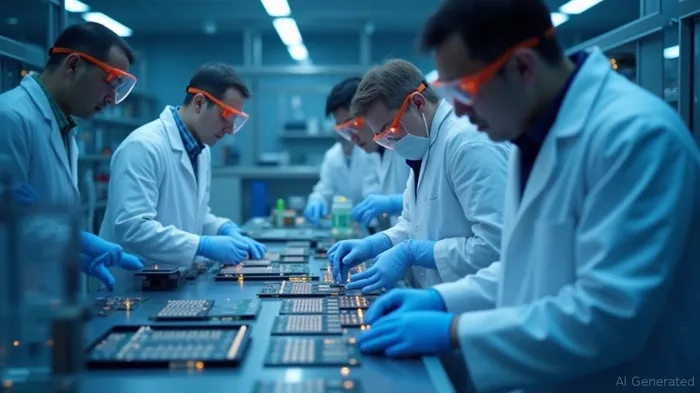
AI training and inference require massive parallel data processing, which traditional DRAM cannot handle efficiently. This is where HBM shines. By stacking memory chips vertically and connecting them via through-silicon vias (TSVs), HBM delivers staggering bandwidth—50% higher capacity and 20% better power efficiency compared to rival 8-high HBM solutions. Micron's HBM3E 12-High 36GB is now in high-volume shipments to NVIDIA for its Blackwell B200 GPUs, with plans to onboard a third major customer by early 2025.
The HBM market is exploding: its total addressable market (TAM) grew from $4 billion in 2023 to over $25 billion by 2025, and could surpass $100 billion by 2030. Micron aims to capture 20–25% of this TAM by 2026, up from 10% in 2024. CEO Sanjay Mehrotra's assertion that HBM is “sold out for 2025” underscores its strategic importance.
Market Positioning: Outpacing Competitors in Critical Segments
While Samsung (36.9% DRAM share) and SK Hynix (22.1% DRAM share) dominate overall memory markets, Micron is carving out leadership in high-margin niches:
- HBM: Micron's HBM3E technology is already outperforming competitors, and it is transitioning to HBM4/HBM4E, which will offer a trade ratio exceeding 4-to-1.
- Advanced DRAM: Its 1-gamma DRAM node, incorporating extreme ultraviolet (EUV) lithography, reduces power consumption and boosts density, critical for data centers.
- NAND Storage: Micron's G8/G9 NAND nodes and $6.1 billion CHIPS Act-funded U.S. manufacturing expansion will solidify its position in high-capacity SSDs. For instance, its 9550 NVMe SSD (up to 30.72TB) delivers 60% faster performance for GNN training than rivals.
Financial Fortitude in a Volatile Market
Micron's Q1 2025 results were a masterclass in resilience:
- Revenue: $8.71 billion (+84% YoY), with data center revenue tripling year-over-year.
- HBM Revenue: More than doubled sequentially, contributing “multiple billions” to 2025 earnings.
- Net Income: $1.87 billion (vs. a $1.83 billion loss in 2024).
Analysts now forecast fiscal 2025 revenue of $35 billion (+39% YoY), rising to $45 billion in 2026, with EPS jumping to $11.45 in 2026. Even with a Q2 revenue dip (due to inventory corrections in mobile/PC markets), Micron expects a strong second-half rebound.
Risks on the Horizon
- Near-Term Softness: Q2 revenue dipped 9% sequentially to $7.90 billion, reflecting weak PC/smartphone demand. However, management sees recovery by early 2025.
- Competitive Pressures: SK Hynix's 70% HBM market share and Samsung's process leadership pose challenges. Micron's manufacturing scale and U.S.-centric supply chain (funded by CHIPS Act) are counterbalances.
- Geopolitical Risks: U.S.-China tensions could disrupt supply chains, but Micron's focus on domestic production mitigates exposure.
Investment Thesis: A Buy with a 2030 Vision
Micron is uniquely positioned to benefit from secular AI growth, with its HBM leadership and $100 billion+ TAM trajectory. While cyclical memory pricing and near-term inventory headwinds pose short-term volatility, the long-term narrative is compelling:
- Buy MU: Target $120–$130 (vs. current ~$85), supported by 2026 EPS of $11.45 and a 10–12x forward P/E.
- Hold for 3–5 years: As HBM demand scales and Micron's Singapore packaging facility (2027) ramps up, its margins and market share should expand.
Final Take
Micron is not just a memory supplier—it's a foundational player in the AI revolution. With HBM as its crown jewel, strategic manufacturing investments, and a clear path to 20–25% HBM market share, MU offers a rare blend of growth, innovation, and resilience in a sector primed for disruption.
Investors looking to capitalize on AI's memory-driven future should consider Micron a core holding. The road ahead is bumpy, but the destination—$100 billion HBM TAM by 2030—is worth the ride.

Delivering real-time insights and analysis on emerging financial trends and market movements.
Latest Articles
Stay ahead of the market.
Get curated U.S. market news, insights and key dates delivered to your inbox.






Comments
No comments yet