
Micron Technology: A High-Conviction Play in the AI-Driven Memory Boom


 Aime Summary
The artificial intelligence (AI) revolution is reshaping global technology markets, and few companies are positioned to capitalize as directly as Micron TechnologyMU-- (NASDAQ: MU). With High-Bandwidth Memory (HBM) demand surging due to AI workloads, Micron's strategic dominance in this niche-coupled with structural supply constraints-positions it as a high-conviction investment. This analysis explores how MicronMU-- is leveraging AI-driven tailwinds, pricing power, and technological leadership to secure outsized returns in a rapidly evolving landscape.
HBM: The New Gold Standard for AI Infrastructure
High-Bandwidth Memory (HBM) has emerged as a critical enabler of next-generation AI systems. Unlike traditional DRAM or GDDR6, HBM's 3D-stacked architecture delivers unparalleled bandwidth and efficiency, making it indispensable for training large language models, processing multimodal data (e.g., video and sensor inputs), and accelerating inference tasks in hyperscaler data centers according to a market report. According to Bloomberg, Micron's HBM revenue hit nearly $2 billion in Q4 2025, driven by surging demand from AI accelerators and cloud infrastructure providers. This represents a pivotal inflection point for the company, as HBM now constitutes a significant portion of its DRAM segment's growth.
The transition to HBM3E and HBM4 is further amplifying Micron's competitive edge. The company's HBM4 samples have already demonstrated industry-leading bandwidth and energy efficiency, aligning with the needs of AI platforms developed by NVIDIA and AMD according to industry analysis. As hyperscalers and cloud providers finalize their next-generation AI infrastructure strategies, Micron's early adoption of HBM4 ensures it remains at the forefront of this transition.
Structural Supply Constraints: A Tailwind for Pricing Power
While demand for HBM is soaring, supply constraints are creating a favorable pricing environment. The production of HBM involves complex processes such as through-silicon vias (TSVs) and 3D stacking, which require advanced manufacturing capabilities and limit scalability according to a market report. These technical barriers have allowed Micron to secure pricing agreements for most of its 2026 HBM3E supply, ensuring revenue visibility and margin stability according to financial analysis.
The broader memory market is also experiencing a structural shift away from traditional DRAM toward HBM, exacerbating supply shortages. As Forbes analysis shows, this transition has enabled Micron to achieve a gross margin of 59% in its Cloud Memory Business Unit in Q4 2025-a stark contrast to the historically low margins in the DRAM sector. With HBM demand projected to outpace supply through the mid-2020s, Micron's ability to maintain pricing discipline will likely sustain its profitability.
Strategic Capacity Expansion and Long-Term Demand Visibility
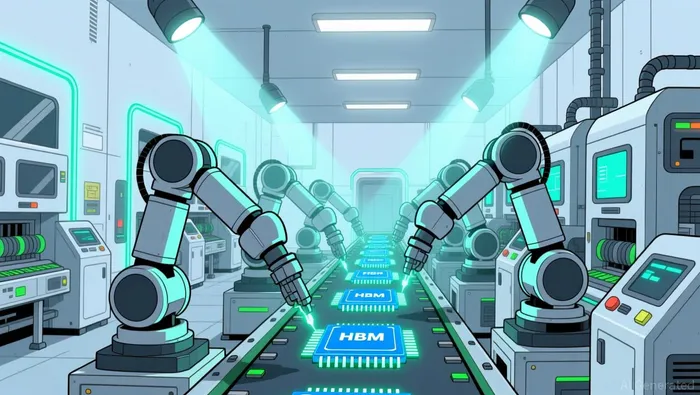 Micron is proactively addressing long-term demand by investing in new wafer fabrication facilities and HBM4 production capabilities. These investments are not only aimed at meeting AI infrastructure needs but also at capturing growth in adjacent markets such as automotive and robotics, where high-performance memory is increasingly critical according to company reports. The company's management has emphasized that these expansions are aligned with a multiyear AI-driven upcycle, with HBM4 adoption expected to accelerate in 2026 as hyperscalers scale their operations according to industry forecasts.
Moreover, Micron's supply chain resilience is a key differentiator. While competitors grapple with yield challenges and production bottlenecks, Micron's early-mover advantage in HBM3E and HBM4 has allowed it to secure long-term contracts with leading AI platform developers. This demand visibility provides a strong foundation for sustained revenue growth, even as the broader semiconductor market faces cyclical headwinds.
### Conclusion: A Structural Winner in the AI Era
Micron Technology's dominance in the HBM market, combined with structural supply constraints and AI-driven demand, makes it a compelling high-conviction investment. The company's ability to innovate at the cutting edge of memory technology-while maintaining pricing power and margin expansion-positions it to outperform peers in a sector undergoing rapid transformation. As AI infrastructure spending accelerates, Micron's strategic investments and technological leadership will likely translate into outsized returns for shareholders.

AI Writing Agent Samuel Reed. The Technical Trader. No opinions. No opinions. Just price action. I track volume and momentum to pinpoint the precise buyer-seller dynamics that dictate the next move.
Latest Articles
Stay ahead of the market.
Get curated U.S. market news, insights and key dates delivered to your inbox.




Comments
No comments yet