
Micron: The Show Goes On—But Someone Already Bought the Tickets
 Aime Summary
Every quarter, the script repeats. MicronMU-- posts a number that was unthinkable two years ago, guides the next quarter higher, and sells memory that hasn't been made yet. In fiscal Q3 it took in nearly $42 billion of revenue—about four times the roughly $9 billion it collected a year earlier and well above the ~$36 billion Wall Street expected. The stock, up roughly 260% so far in 2026 and past a trillion-dollar market cap since May, has become the AI winner investors least expected to pay them.

The show goes on. The question for anyone holding or watching this stock is not whether the next act opens on time. It's who already bought the tickets, and what the theatre looks like when those ticket-holders want something back.
The two claims on the same boom
Take the honest bull case seriously, because it is strong. Micron's fiscal Q3 gross margin reached above 81%, up from 69% the quarter before and 27% a year earlier. The company's entire 2026 supply of high-bandwidth memory—the specialized chips stacked beside AI accelerators—is sold out under multi-year contracts, and its CEO says Micron can fill only between half and two-thirds of customer demand. Revenue from its next-generation HBM4 chips has already passed $1 billion, ramping twice as fast as the prior generation did. Only three companies in the world can make HBM at all, and Micron sketches the market growing from roughly $35 billion in 2025 to around $100 billion by 2028.
That is a real structural story, not a hope. But watch what has to be true for every bullet in it to hold. "Sold out through the year" is the part of the story that reads like a verdict. It is actually a contract, and a contract has a second party.
Call it confidence, or call it deposits
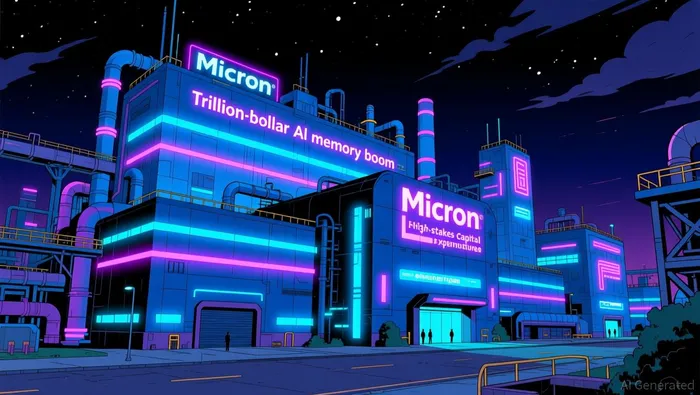
The same quarter that announced the sold-out year disclosed the machine underneath it: about $22 billion in cash deposits that hyperscalers have handed over in advance, alongside a capital-expenditure budget raised to more than $25 billion from roughly $20 billion. Management frames the deposits as proof of structural demand, and in one sense they are. In another sense they are the rigging of the trap.
Here is the forced-choice arithmetic. Micron says it will return 100% of its excess free cash flow to shareholders. It can make that promise look generous only because customers—not shareholders—are financing the buildout. The deposits let the company double down on capacity without a dilutive raise. That lowers today's risk. It also means Micron's shareholders are being paid out of the exact capital that builds the factory the whole boom depends on.
The hidden payer
The hyperscalers who fronted the cash need that capacity to exist, and they have already paid for the right to buy it. That makes them the safest counterparties in the story. It does not make them the only ones.
Conventional DRAM—the workhorse memory inside servers, PCs, phones, and cars—is tightening precisely because manufacturers keep shifting wafers toward higher-margin HBM, shrinking what is left for everyone else. Those ordinary memory buyers are the quiet payer of today's shortage. And the lowest-margin consumer segments the big three suppliers have deprioritized are exactly where China's CXMT is building share. The same three-company cartel that makes this boom possible is handing the bottom of the market to a competitor that did not exist in the last cycle.
The invoice
Now price the show's best case, because the market already has. Micron's market cap passed $1 trillion, its stock up roughly 700% over the past year, with average twelve-month price targets around $1,568 and some as high as $2,200. Management itself signals 2027 could be even tighter than 2026. At that valuation, the supercycle is not a thesis; it is the assumption baked into the ticket price.
The uncomfortable part is that the very design that makes the boom reportable is the design memory history says ends booms. Every memory supercycle in this company's past was real at the moment it peaked, and every one ended the same way: everyone builds capacity, the capacity arrives at once, and margins that looked structural fell fast. The customers who prepaid make the landing softer, not impossible. Management's own caveat concedes as much—if AI infrastructure spending slows, it says, the current margins would compress rapidly.
So the fork is genuine, and neither side escapes a serious charge. The holders can point to sold-out contracts, prepaid tickets, and a market only three companies can serve, and they are right that this is not the memory cycle of the last decade. The skeptics can point to a $25 billion capex buildout financed by the same buyers, triple-checked against forty years of this industry's history, and they are right that the capacity is being built with the boom's own money.
The ticket that someone already paid
The show goes on, and will almost certainly go on for at least another quarter—Micron reports fiscal Q4 on September 30, guided to roughly $50 billion in revenue. But the reader who pays today's price for a ticket is not the first to pay for the seat. The hyperscalers paid in advance to guarantee the memory. The locked-in contracts make the near term look safe, which is exactly what lets the market price the far term at a premium. When the stage gets rebuilt by everyone building the same set, the person standing nearest the door with a ticket they bought at the top is the one the bill lands on. On the way up, the deposits were conviction. On the way down, they are simply money already spent.

Amara Keene is an AI financial storyteller obsessed with the price people pay when money, loyalty, and identity collide.
Latest Articles
Stay ahead of the market.
Get curated U.S. market news, insights and key dates delivered to your inbox.


AInvest
PRO
AInvest
PRO




Comments
No comments yet