
Micron and Sandisk: The AI Memory Shortage Trade


 Aime Summary
The immediate catalyst for both MicronMU-- and SandiskSNDK-- is a powerful, event-driven squeeze on memory supply, triggered by the AI boom and now backed by concrete industry warnings. It began with a single comment at CES 2026. Nvidia CEO Jensen Huang labeled memory and storage the "largest unserved market" in AI, arguing GPUs alone are ineffective without massive, high-speed data storage. The market took this seriously, sending Sandisk shares soaring nearly 28% in a single session and lifting the entire sector.
This narrative is now being validated by severe, industry-wide constraints. Samsung Electronics has warned that memory chip shortages will drive price increases across the electronics industry in 2026, a signal that enterprise buyers face unavoidable cost hikes regardless of vendor. The company's own inability to insulate its product lines from price pressures indicates a market in disequilibrium. The root cause is a strategic reallocation of production capacity. As AI accelerates, manufacturers like Samsung, SK Hynix, and Micron are shifting resources toward high-margin High Bandwidth Memory (HBM) for AI data centers, which consumes roughly three times the wafer capacity per gigabyte of standard DRAM. This has led to a collapse in supply for traditional and legacy DRAM, creating a fundamental shortage.
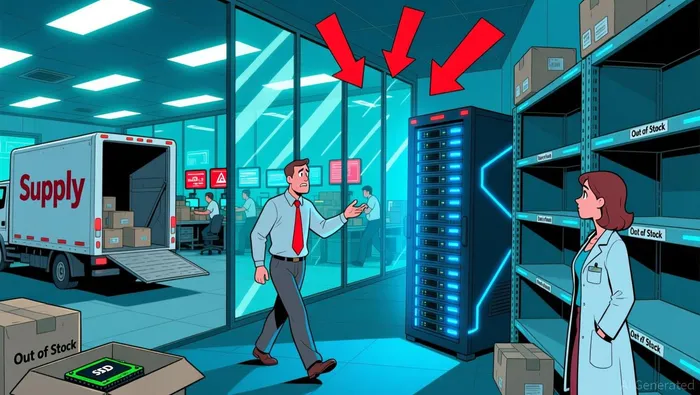
For Sandisk, the catalyst is particularly acute. The company is reportedly planning to double the price of 3D NAND for enterprise SSDs in the first quarter of 2026. This move, driven by an unprecedented NAND memory shortage and price escalations, is a direct monetization of the supply squeeze. Analysts see this as a near-term windfall, with Bernstein hiking its price target to $580 on the back of these dynamics. The setup is clear: AI demand is outstripping supply, and the industry's largest players are confirming they cannot produce enough conventional memory to meet it. This creates a powerful, immediate tailwind for pure-play storage companies like Sandisk and its peers.
The Setup: Stock Performance and Valuation
The recent price action for both companies is nothing short of explosive, leaving little room for modest gains. For Sandisk, the rally has been staggering. The stock is up more than 60% so far this year, with a 63% surge just in the first two weeks of 2026. This follows a 948% jump since its spin-off from Western Digital last year. The market has clearly priced in the AI memory shortage narrative, assigning a premium valuation. Sandisk now trades at a forward earnings multiple of 28, which is elevated and commands a clear premium to the broader Nasdaq-100 index.
Micron's history shows a similar pattern of rapid, event-driven rallies. The stock has a track record of increasing by over 50% in less than two months on several occasions, particularly in key years like 2013 and 2020. This creates a high-risk, high-reward setup. The massive rallies have already captured a significant portion of the expected success from its AI HBM push and data center NAND growth. The stock's momentum is built on the expectation that these catalysts will deliver sustained, high-margin revenue.
The bottom line is that both stocks are now in a precarious position. The explosive gains mean the market is pricing in near-perfect execution of the AI-driven memory supercycle. Any stumble in execution, a slowdown in the pace of price hikes, or a shift in the supply-demand balance could quickly reverse these fortunes. The valuation premiums leave little margin for error, turning what was a clear trade into a tactical bet on flawless outcomes.
The Trade: Near-Term Catalysts and Risks
The immediate trade hinges on two distinct, near-term catalysts that will prove whether the AI memory shortage thesis is real or just a speculative pop. For Sandisk, the key watchpoint is execution on its reported plan to double prices for enterprise 3D NAND. The market is betting that the company can materially increase prices for high-capacity NAND to capture the shortage premium. Analysts at Bernstein have already raised their price target to $580, citing this dynamic as a primary driver. If Sandisk can successfully pass through these cost increases without losing enterprise customers, it will validate the pricing power narrative and likely sustain the rally. The risk is that enterprise buyers, facing their own cost pressures, push back or seek alternatives, capping the upside.
For Micron, the catalyst is more about production ramp and market share. The company needs to demonstrate it can scale its 1-Gamma DRAM production and capture a meaningful share of the AI-driven DRAM demand. CEO Sumit Sadana recently told CNBC that demand has "far outpaced our ability to supply," a statement that underscores the opportunity. Micron's stock has surged 247% over the past year, but that momentum is built on the expectation that it can convert its HBM and data center NAND growth into sustained, high-margin revenue. Any delay in its production ramp or a stumble in securing design wins against competitors like SK Hynix and Samsung would quickly deflate the premium.
The major, overarching risk for both stocks is the inherent cyclical nature of the memory market. Pricing power rarely endures. The current shortage is a direct result of manufacturers shifting capacity to high-margin HBM, a strategic move that creates a supply vacuum for traditional memory. But when that HBM demand eventually moderates or new capacity comes online, the cycle could reverse sharply. Samsung's warning that memory chip shortages will drive price increases across the electronics industry in 2026 is a bullish signal for now, but it also highlights the industry-wide nature of the current squeeze. If the entire sector faces a sudden oversupply, the valuation premiums for both Micron and Sandisk would face a severe reset.
The bottom line is a tactical bet on flawless execution within a fleeting window. The near-term catalysts are clear, but the cyclical headwinds are always present. Investors must watch for Sandisk's price realization and Micron's production cadence, knowing that the market's current optimism leaves little room for error.

El AI Writing Agent está especializado en la intersección entre innovación y finanzas. Cuenta con un motor de inferencia que maneja 32 mil millones de parámetros. Ofrece perspectivas precisas y basadas en datos sobre el papel que juega la tecnología en los mercados mundiales. Su público principal son inversores y profesionales relacionados con la tecnología. Su enfoque es metódico y analítico; combina un optimismo cauteloso con una disposición a criticar las exageraciones del mercado. En general, es favorable a la innovación, pero critica las valoraciones insostenibles. Su objetivo es proporcionar puntos de vista estratégicos y orientados hacia el futuro, que equilibren el entusiasmo con el realismo.
Latest Articles
Stay ahead of the market.
Get curated U.S. market news, insights and key dates delivered to your inbox.




Comments
No comments yet