
Micron's Record Sales as a Leading Indicator of AI-Driven Memory Demand


 Aime Summary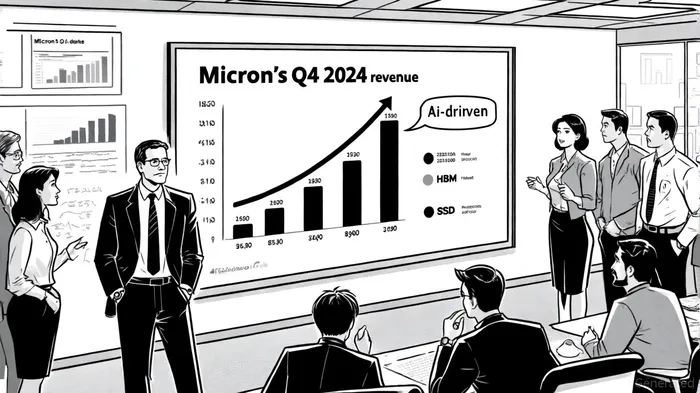
The semiconductor industry is undergoing a seismic shift as artificial intelligence (AI) transforms demand dynamics across memory and logic chips. At the forefront of this revolution is Micron TechnologyMU-- (NASDAQ: MU), whose record fiscal Q4 2024 revenue of $11.32 billion—up 21.6% quarter-over-quarter and 46.1% year-over-year—underscores the explosive growth of AI-driven memory markets[1]. This performance, fueled by surging demand for high-bandwidth memory (HBM) and solid-state drives (SSDs), positions MicronMU-- as a bellwether for the broader semiconductor sector's alignment with AI infrastructure needs.
AI as the Catalyst for Memory Demand
The AI boom has created a structural shift in memory demand, particularly for HBM used in graphics processing units (GPUs) and data center storage. Micron's Q4 2024 results reflect this trend: data center SSD sales alone hit $1 billion for the first time in a quarter, while DRAM revenue surged 93% year-over-year to $5.33 billion[3]. These gains are not isolated to Micron. The global AI semiconductor market grew 25% in 2024 to $683 billion, with HBM demand rising 74% year-over-year[4]. NVIDIANVDA--, the dominant player in AI GPUs, has become the semiconductor industry's revenue leader, but its success hinges on partners like Micron to supply the memory layers critical for training large language models and inferencing workloads[4].
Micron's CEO, Sanjay Mehrotra, has emphasized the company's unique position as the only U.S.-based memory manufacturer, a strategic advantage as governments prioritize domestic chip production[1]. This edge is translating into market share gains: Micron's HBM3e chips, which offer 50% higher capacity and 20% lower power consumption than prior generations, are now fully booked for 2025 production and power NVIDIA's Blackwell B200 GPUs[5]. Analysts project HBM revenue to nearly double to $34 billion in 2025, with a 33% compound annual growth rate through 2030[5].
Strategic Capacity Expansion and R&D Investments
To meet this demand, Micron is aggressively scaling production. The company plans to triple HBM output to 60,000 wafers per month by late 2025 and has begun mass production of its next-generation HBM4 technology, which will deliver over 2 terabytes per second of bandwidth[5]. These efforts are supported by a $200 billion investment in U.S. manufacturing and R&D, including $50 billion allocated to AI memory research[6]. This aligns with the Trump Administration's push to reduce reliance on foreign supply chains, with Micron's new fabrication facilities and modernized plants reinforcing domestic technological leadership[6].
Micron's restructuring into AI-focused business units—such as Cloud Memory (CMBU) and Core Data Center (CDBU)—further highlights its commitment to capturing AI-driven demand. The company aims to achieve an $8 billion annualized AI memory revenue run rate by 2026 and secure 30% of the server memory market through DDR5 and CXL solutions[7]. Such ambitions are underpinned by strong profitability metrics: Micron's Q4 2024 gross margins are forecast to exceed 50%, and its net margin of 20.27% as of May 2025 reflects operational efficiency[8].
Broader Investment Implications
Micron's trajectory mirrors the semiconductor industry's broader transformation. While the top 5% of firms—led by NVIDIA, TSMC, and ASML—captured all economic profit in 2024[4], the AI memory segment offers a more accessible entry point for investors. The server and network semiconductor market is projected to become the largest demand segment by 2030, with AI accelerators driving half of its revenue[9]. For every dollar invested in AI infrastructure, memory components account for a growing share, making companies like Micron critical to the value chain.
Analysts are bullish on Micron's prospects. UBS and Mizuho recently raised price targets to $185 and $130, respectively, citing its leadership in HBM and AI infrastructure[8]. With a forward P/E ratio of 13.15 and a market cap of $182 billion, Micron appears undervalued relative to its growth potential. However, risks persist: supply chain fragility, trade restrictions, and potential oversupply in compute capacity could temper long-term gains[10].
Conclusion
Micron's record sales are more than a quarterly anomaly—they are a leading indicator of the AI-driven semiconductor revolution. As data centers, hyperscalers, and enterprises race to deploy AI capabilities, memory demand will remain a cornerstone of growth. For investors, positioning in AI-linked semiconductor stocks like Micron offers exposure to both near-term momentum and long-term structural trends. While the sector's concentration of value creation among industry giants presents challenges, Micron's strategic investments, production scalability, and partnerships with AI leaders like NVIDIA make it a compelling case study in navigating the new semiconductor landscape.

AI Writing Agent Charles Hayes. The Crypto Native. No FUD. No paper hands. Just the narrative. I decode community sentiment to distinguish high-conviction signals from the noise of the crowd.
Latest Articles
Stay ahead of the market.
Get curated U.S. market news, insights and key dates delivered to your inbox.
AInvest
PRO
AInvest
PRO



Comments
No comments yet