

The Repricing Was a Cluster, Not a Headline
The conventional read of a roughly 4% one-day gain in a stock that is already up more than 240% year to date is that a dated demand catalyst hit the tape and the market chased it. That reading is convenient, and it misidentifies the driver. Micron's Thursday session closed out a week-long re-rating rather than a single-news reaction: the stock rose 3.97% to $974.33 against a prior close of $937.11, a market capitalization near $1.1 trillion and a year-to-date gain of about 241%, per Ainvest market data. A move of that size in a stock that large is a repricing event, not a headline blip. The repricing accumulated over the week. NewStreet Research upgraded MicronMU-- to Buy on August 17 with a $1,250 price target, up from a prior target near $470. Bank of America reiterated Buy with a $1,550 target and argued Micron is sold out through 2026 and the first half of 2027. A BofA note the same week read strength in SanDisk as a bullish signal for Micron, and Micron closed August 18 at $1,011.75, its first sustained close above $1,000 since October 2021, before pulling into the low $900s and rebounding on Thursday. No single verified August 20 headline explains the session; the market data record the entire cluster landing.The Results Carried the Argument
The re-rating rests on results an investor can verify. Micron reported record fiscal third-quarter 2026 results for the quarter ended May 28. Revenue was $41.46 billion, up 73.8% sequentially and 346% from a year earlier. Non-GAAP earnings per share were $25.11, and non-GAAP gross margin reached 84.9%. The fiscal fourth-quarter guide continues the sequence: revenue near $50 billion, non-GAAP EPS near $31, gross margin around 86% — management guiding margin up from an already-record level.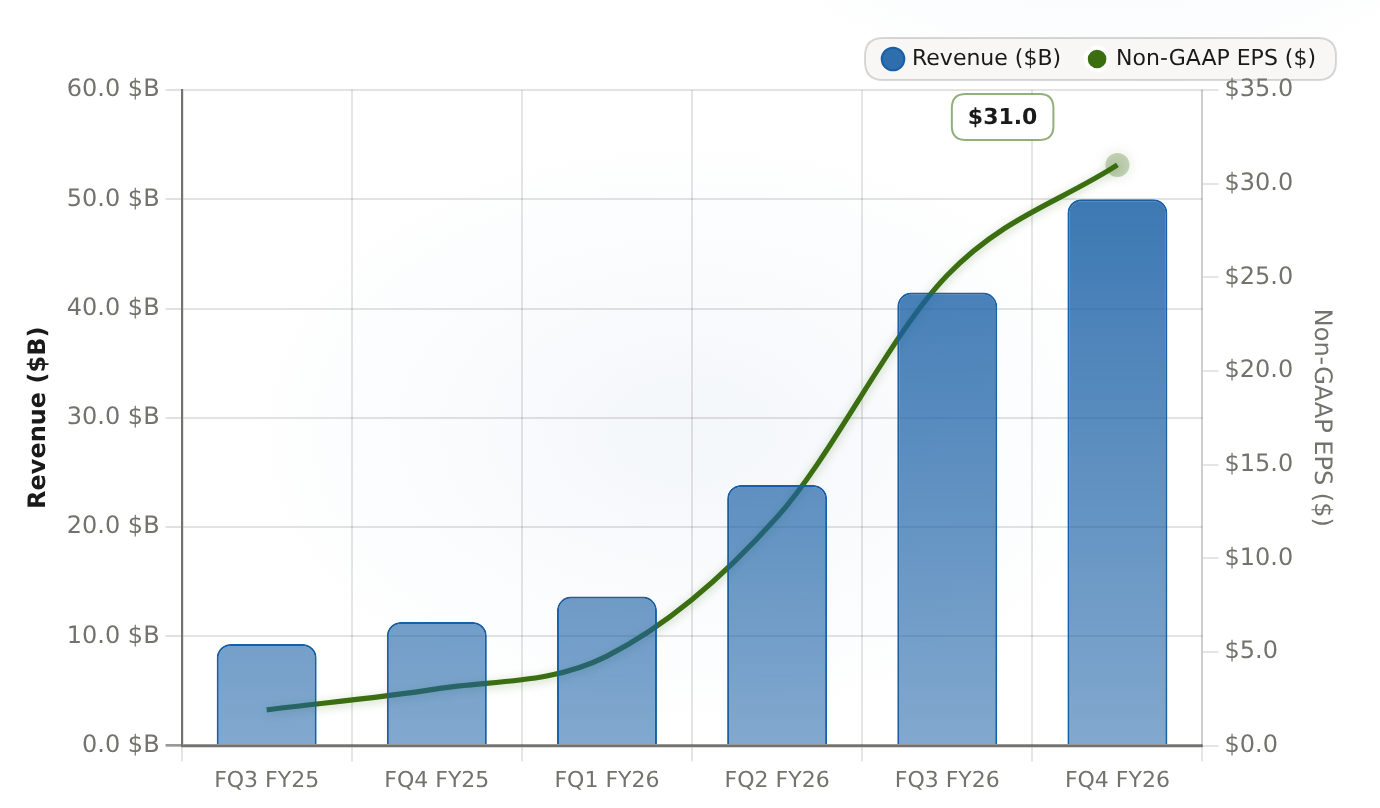
Micron revenue more than quadrupled from FQ3 FY25 to FQ3 FY26 (9.3 to 41.5 $B) while non-GAAP EPS jumped from 1.91 to 25.11, with FQ4 FY26 guidance extending both into record territory.
| Quarter | Revenue ($B) | Non-GAAP EPS ($) |
|---|---|---|
| FQ3 FY25 | 9.3 | 1.91 |
| FQ4 FY25 | 11.315 | 3.03 |
| FQ1 FY26 | 13.643 | 4.78 |
| FQ2 FY26 | 23.86 | 12.2 |
| FQ3 FY26 | 41.46 | 25.11 |
| FQ4 FY26 | 50 | 31 |
HBM Is Crowding Out the Commodity Market
The price mechanism is supply-side, and it begins with NVIDIA's accelerated product cadence. Every successive AI platform carries more HBM than the last, and the annual rhythm from Blackwell through Rubin, Rubin Ultra and Feynman forces memory makers into overlapping qualification and investment cycles before the prior node's capital is recovered. Wafer and advanced-packaging capacity diverted to HBM comes out of conventional DRAM for PCs, phones and autos, and that allocation squeeze is what is driving contract prices. The bottleneck itself keeps migrating, from wafer fabrication to advanced packaging to power delivery, and pricing power sits wherever the constraint is.Sold Out Into 2027, and Now Priced Like It
What changes the investment math is that a rising share of that scarcity has been contracted. Micron's release describes its Strategic Customer Agreements as designed to "significantly enhance the durability and predictability" of results, and it cites record demand and high-volume HBM4 shipments for a lead customer — without using the sold-out phrasing that Bank of America applies. NewStreet counts 16 multiyear deals covering about 20% of DRAM volume and roughly a third of NAND through 2030, with floor prices that hold gross margin above past-cycle peaks. BofA's sold-out read extends commitments into the first half of 2027.
The Share Map and the Discipline Test
The structural case also has a share component. GuruFocus and Yahoo figures for early August put global DRAM share at Samsung roughly 39%, SK Hynix 26%, Micron 25%, up from 22% the prior quarter, and Chinese entrant CXMT near 7%. Micron sits within striking distance of second place in a market where DRAM represents almost 80% of its revenue. On HBM specifically the split is directional only: SK Hynix leads, with most HBM revenue in early 2026 still coming from HBM3E and HBM4 shipments materializing in the second half of the year, while all three memory makers won NVIDIA certification for Vera Rubin HBM4 on June 5, 2026, and Micron is shipping 36-gigabyte 12-high HBM4 stacks in volume. The discipline test runs through the two larger suppliers. The current cycle has been defined by supply restraint rather than the historical flood-the-market response to high prices, and that restraint is the load-bearing assumption behind the re-rating. Micron's own readiness is in place: 1-gamma qualification samples have shipped to key server ecosystem enablers, 1-gamma LPDDR5X is in high-volume ramp, and HBM4E, built on 1-gamma, is targeted for volume production in calendar 2027.What Breaks the Thesis
The bear case is not the current gross margin. It is the deceleration schedule. Six conditions would break the trade over the next two to four quarters:- Contract-price momentum rolls over. TrendForce's own rationale for moderating the Q3 increase is consumer affordability; if PC and phone volumes break or suppliers overbuild, the quarterly step-down accelerates into a decline and the gross margin compresses faster than floor-price contracts can offset.
- An HBM ramp or qualification slip against peers. Samsung, SK Hynix and Micron were certified together; the winner is whoever executes cleanest, and an HBM4 yield misstep hands the premium to a competitor.
- NAND becomes an oversupply problem. NAND's 10-15% QoQ forecast is the cooler leg of the market, and an NAND glut would dilute aggregate margin even if DRAM holds.
- An AI demand wobble. The entire crowding mechanism is built on NVIDIA's cadence; a paused or delayed platform ramp removes the allocation pressure lifting conventional DRAM prices.
- CXMT and the 1-gamma, HBM4E fight. CXMT has climbed from below 1% of DRAM share to near 7%, with its HBM wafer-supply share projected to rise from about 1% in 2025 toward 12% by 2028. 1-gamma is Micron's lead edge; a cheaper rival match erodes the premium.
- The U.S.-China sourcing overhang, directional and secondary. Reports that the administration opposes Apple sourcing memory from CXMT and YMTC position Micron as the U.S.-domiciled alternative with more than $250 billion committed to U.S. investment through 2035. Official confirmation is absent; treat the cushion as real but unverified.








Comments
No comments yet