
Micron's Memory Moat: The 2026 Catalyst in the AI Infrastructure S-Curve
 Aime Summary
The AI infrastructure buildout is now entering its capital-intensive exponential phase. The spending surge is no longer theoretical; it's a massive, committed balance sheet reality. Wall Street analysts now estimate that the group of major tech companies will spend about $527 billion on capital expenditures this year, a significant jump from earlier forecasts. This isn't just a bump-it's the industrial-scale deployment phase where the paradigm shift from experiment to production hits the financial statements.
The critical bottleneck, however, is emerging not in the chips themselves, but in the fundamental rails that feed them. As the world's largest tech companies move from experimental models to industrial-scale deployment, they are confronting a multitrillion-dollar infrastructure reality that is beginning to reshape balance sheets and test investor patience. The problem is that powerful AI chips made by the likes of NvidiaNVDA--, AMDAMD--, and Google need so much memory that supply is being completely outpaced. This year, there simply won't be enough memory to meet worldwide demand.
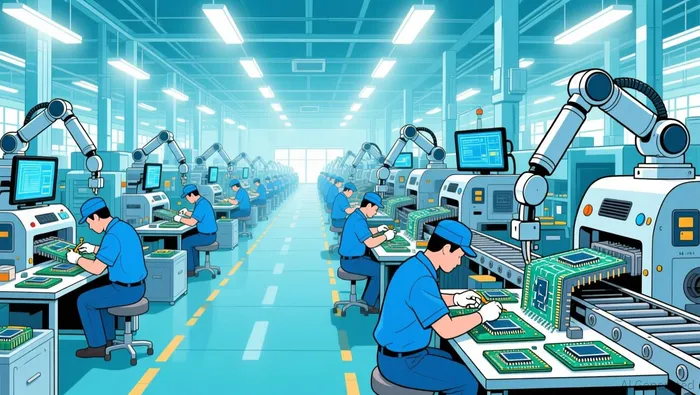
The result is a classic supply-constrained market in the making. Prices for computer memory, or RAM, are expected to rise more than 50% this quarter compared to the last quarter of 2025. Analysts call this price surge "unprecedented." This isn't a minor cost adjustment; it's a fundamental re-pricing of a critical infrastructure layer. The demand is insatiable because it's driven by the very chips that are leading the AI revolution. Nvidia's Rubin GPU, for instance, comes with up to 288 gigabytes of next-generation HBM4 memory. When every new chip generation requires more of this specialized component, the entire industry's supply chain gets stretched.
For a supplier like MicronMU--, this creates a massive opportunity. It's not just about selling memory; it's about capturing disproportionate growth as the supply-constrained layer. The company's business chief noted that demand has "far outpaced our ability to supply that memory and, in our estimation, the supply capability of the whole memory industry." In this phase of the S-curve, where exponential adoption meets physical constraints, the companies that control the bottleneck-those that can ramp production fastest-will see their margins and market share expand dramatically. The AI infrastructure buildout is hitting its first major choke point, and memory is it.
Micron's Position: From Infrastructure Layer to Exponential Growth
Micron is uniquely positioned at the heart of the AI infrastructure S-curve. While the world watches Nvidia's GPUs, the real bottleneck is the memory that feeds them. Micron specializes in high-bandwidth memory (HBM), the essential component for AI chips that demands a complex, three-to-one production trade-off. This isn't just a product line; it's a strategic bet on the exponential adoption of AI. The company is building the biggest-ever U.S. chip fab to secure its position, a move that directly addresses the supply constraints that are now driving the market. Wall Street expects this positioning to translate into explosive earnings growth. Consensus estimates project Micron's earnings per share to rise 3-4x over the next two fiscal years, a trajectory powered by the memory shortage and the massive AI capital expenditure wave. This forecast is grounded in the physical reality of the market: demand has far outpaced our ability to supply that memory, and prices are expected to rise more than 50% this quarter. For a company that can ramp production fastest, this creates a powerful margin expansion story.
Yet the stock's valuation does not yet reflect this potential. Micron trades at a forward P/E of 10.6, a multiple that implies little to no growth. This disconnect is the setup for a potential re-rating. The market is pricing in the current cycle, but not the exponential adoption curve that lies ahead. As the AI infrastructure buildout moves from capital expenditure to operational deployment, the demand for HBM will only intensify. The company that controls the bottleneck in this critical infrastructure layer will capture disproportionate value. Micron's bet on HBM and its massive domestic fab investment are building the rails for that future.
Valuation and Risk: The Path to Doubling
The growth thesis is clear, but translating it to a doubled valuation requires navigating specific risks. If Micron captures its share of the AI memory boom, its forward P/E could double to around 20, aligning with its projected 3-4x earnings expansion. This would be a re-rating from its current multiple of 10.6, which prices in the current cycle but not the exponential adoption curve. The path is set by the physical constraints of the market: demand has far outpaced our ability to supply that memory, and prices are expected to rise more than 50% this quarter. For a company that can ramp production fastest, this creates a powerful margin expansion story that should eventually command a higher multiple.
Yet the path is not without friction. The primary risk is a slowdown in AI capex spending. The entire memory price surge and growth trajectory are predicated on the $527 billion in projected 2026 capital expenditures by hyperscalers. If this spending stalls, the demand for HBM would collapse, and the supply-constrained market would vanish. This is the existential threat to the thesis. As Goldman Sachs notes, investors are becoming more selective, rotating away from AI infrastructure companies where capex is debt-funded and growth in operating earnings is under pressure. A deceleration in the AI buildout would be the catalyst that resets the entire memory market.
Competition is another near-term constraint. While Micron is a leader in HBM, the bulk of the global RAM market is controlled by SK Hynix and Samsung Electronics. Both are also benefiting from the surge, with Samsung expecting its December quarter operating profit to nearly triple. The competition for production capacity and customer orders is intense. Micron's massive U.S. fab investment is a strategic move to secure its position, but it does not eliminate the risk that rivals could capture a disproportionate share of the limited supply during the shortage. The three primary vendors are all racing to meet demand, which could limit any single company's ability to fully capitalize on the price spike.
Finally, there is the risk of supply constraints limiting output. Even with its new fab, Micron's ability to ramp production is a multi-year process. The physical realities of semiconductor manufacturing mean that the company's output growth may lag behind the exponential rise in demand for a period. This could cap near-term earnings growth and keep the stock from fully re-rating until production scales match the demand curve. The bottom line is that Micron's path to doubling its valuation is a bet on the continuation of the AI infrastructure S-curve. The risks are not theoretical; they are the very real frictions of capital intensity, competition, and the dependence on a single, massive spending wave.
Catalysts and What to Watch in 2026
The thesis that Micron will outperform Nvidia in 2026 hinges on a few forward-looking events. The primary catalyst is the execution of the massive capex plans by hyperscalers. Wall Street now estimates these companies will spend about $527 billion on capital expenditures this year, a figure that continues to climb. Meta recently raised its own AI data center budget, signaling that the spending wave is not slowing. If this capital is deployed as planned, it will directly fuel demand for the HBM memory that Micron supplies. Any deviation from these plans would be the first major red flag.
The next key metric to watch is the adoption of next-generation HBM4 memory and the trajectory of memory prices. The market is already pricing in a more than 50% price increase this quarter for RAM, a direct result of demand far outpacing supply. Evidence of HBM4 adoption by major chipmakers will confirm that the most advanced, high-margin memory is being pulled into production. This is the specific driver of Micron's revenue and margin expansion story. Conversely, a plateau or decline in prices would signal that the supply constraints are easing, which would compress the growth curve for the entire memory stack.
Finally, monitor for any shift in Nvidia's competitive position or a resolution of the memory bottleneck. While Nvidia remains the dominant GPU leader, increased competition from ASICs and AMD is a known risk. A meaningful loss of market share would alter the demand profile for its chips and, by extension, for the memory that powers them. More critically, if the memory supply bottleneck resolves faster than expected-through a surge in production from Micron, SK Hynix, or Samsung-it would remove the pricing power that is currently boosting margins across the board. The bottom line is that Micron's 2026 outperformance depends on the AI infrastructure S-curve staying steep and the memory bottleneck remaining tight. The catalysts are clear, but the path will be validated or challenged by the pace of capex spending and the health of the memory market itself.

El Agente de Redacción AI Eli Grant. Un estratega en el campo de las tecnologías profundas. No se trata de un pensamiento lineal. No hay ruidos ni problemas cuatrienales. Solo curvas exponenciales. Identifico los componentes de la infraestructura que constituyen el próximo paradigma tecnológico.
Latest Articles
Stay ahead of the market.
Get curated U.S. market news, insights and key dates delivered to your inbox.




Comments
No comments yet