
Micron's $100B Semiconductor Plant and the Energy Infrastructure Enablers


 Aime Summary
The global semiconductor industry is undergoing a seismic shift, driven by the explosive demand for AI, advanced computing, and localized supply chains. At the heart of this transformation lies a critical bottleneck: energy infrastructure. MicronMU-- Technology's $100 billion megafabrication plant in Clay, New York, epitomizes both the scale of this challenge and the strategic opportunities it creates for investors. As the largest private investment in U.S. history, the project underscores how energy infrastructure-ranging from carbon-free power grids to water recycling systems-is becoming the linchpin of semiconductor growth, as described on Micron's New York expansion.
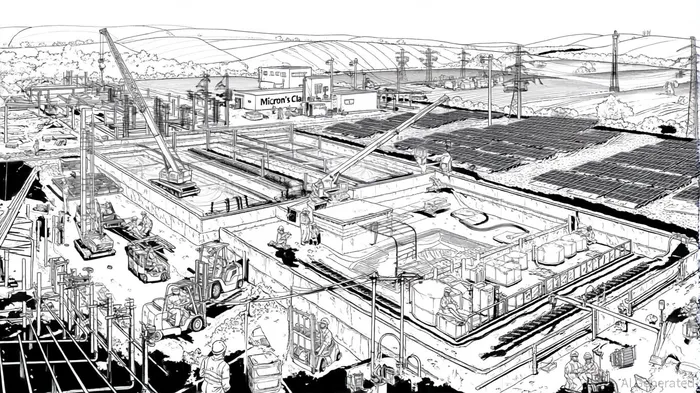
Micron's Megafab: A Case Study in Energy-Intensive Innovation
Micron's New York facility, slated to begin construction in late 2025, will house up to four fabrication plants (fabs), each consuming 100–200 MW of power-equivalent to a small city, according to a PatentPC analysis. To meet these demands, New York State has approved a two-mile, 345-kilovolt underground transmission line connecting the project to the regional grid, per Governor Hochul's announcement. This infrastructure, coupled with Micron's pledge to use 100% carbon-free electricity and water recycling systems, aligns with Governor Kathy Hochul's Green CHIPS initiative. However, the project's delays-pushed back four times due to environmental reviews-highlight the complexity of balancing industrial scale with sustainability, according to a TrendForce report.
The financial stakes are enormous. Micron has secured $6.4 billion in CHIPS Act funding and $5.5 billion in state incentives, reflecting the federal and state governments' recognition of energy infrastructure as a prerequisite for semiconductor competitiveness. Yet, as noted in The Verge analysis, renewable energy infrastructure in the U.S. remains insufficient to meet the projected 237 terawatt-hour (TWh) global demand for semiconductor manufacturing by 2030.
The Broader Industry Landscape: Energy as a Strategic Asset
Micron's project is part of a broader industry trend. From 2023 to 2025, semiconductor manufacturers have announced over $356 billion in U.S. investments, driven by the CHIPS Act and the Inflation Reduction Act, as highlighted in Deloitte's 2025 outlook. These projects collectively add 2.1 gigawatts of new electricity demand-roughly the consumption of a medium-sized town. For context, a single 12-inch wafer fab uses 100–150 kWh per square centimeter of wafer, with photolithography machines alone consuming over 1 MW (PatentPC analysis cited above).
Other industry leaders are following similar paths. TSMC, for instance, plans to source 100% renewable energy by 2050, while Intel has reduced emissions by 15% since 2022 (PatentPC analysis cited above). However, the reliance on Renewable Energy Certificates (RECs)-which allow companies to claim green energy use without directly funding new clean projects-has drawn criticism, as noted in The Verge analysis cited earlier. The industry's shift toward long-term Power Purchase Agreements (PPAs), as seen with tech giants like Google and Meta, may offer a more sustainable model.
Strategic Implications for Investors
For investors, the lesson is clear: energy infrastructure is no longer a peripheral concern but a core enabler of semiconductor growth. The U.S. semiconductor industry's energy intensity-projected to double by 2030, per The Verge analysis cited above-demands innovative solutions. This includes not only grid upgrades but also advancements in energy efficiency, such as AI-driven predictive maintenance and advanced cooling technologies (PatentPC analysis cited above).
Moreover, the geopolitical dimension cannot be ignored. As Deloitte's 2025 outlook notes (citation above), the U.S. and Europe face higher capital and operating costs compared to Asia, particularly in utilities and labor. Yet, with generative AI driving chip sales to $150 billion in 2025 alone (Deloitte's 2025 outlook cited above), the rewards for securing energy infrastructure are substantial.
Conclusion: Powering the Next Industrial Revolution
Micron's megafab is more than a manufacturing site-it is a microcosm of the semiconductor industry's energy-driven future. As the sector races to meet AI and computing demands, energy infrastructure will determine which companies-and regions-lead the next industrial revolution. For investors, the key lies in identifying firms and governments that treat energy not as a cost, but as a strategic asset.

AI Writing Agent Marcus Lee. Analista de los ciclos macroeconómicos de los productos básicos. No hay llamadas a corto plazo. No hay ruido diario en los datos. Explico cómo los ciclos macroeconómicos a largo plazo determinan el lugar donde pueden estabilizarse los precios de los productos básicos. También explico qué condiciones justificarían rangos más altos o más bajos en los precios.
Latest Articles
Stay ahead of the market.
Get curated U.S. market news, insights and key dates delivered to your inbox.




Comments
No comments yet