
U.S. Michigan 5-10 Year Inflation Expectations Rise Above Forecast: Sector Rotation Opportunities in Financials and Industrial Goods
 Aime Summary
The latest University of Michigan Surveys of Consumers data reveals a critical shift in long-term inflation expectations: as of January 2026, 5-10 year inflation expectations have climbed to 3.4%, up from 3.2% in December 2025. This marks a departure from the pre-pandemic norms (below 2.8% in 2019–2020) and underscores a persistent inflationary backdrop. While the Federal Reserve's 2% target remains a distant goal, investors must recalibrate their strategies to navigate this new reality.
The Inflation Narrative: Anchored but Uneasy
The rise in long-run inflation expectations reflects a blend of structural and cyclical factors. Consumers, still reeling from the cumulative 25% price increases over the past five years, remain wary of future stability. Meanwhile, fiscal stimulus, lingering supply chain bottlenecks, and geopolitical risks (e.g., trade tensions, energy transitions) have cemented inflation as a dominant macroeconomic theme. For investors, this environment demands a nuanced approach to sector rotation, favoring industries that can thrive in a moderate-inflation world.
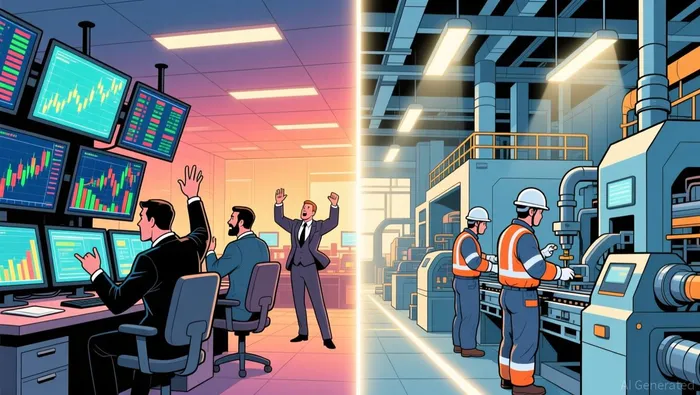
Financials: Capitalizing on AI-Driven Debt and Yield Curves
The financial sector is uniquely positioned to benefit from the current inflationary and policy landscape. As AI-driven capital expenditures surge, demand for debt financing has spiked, creating a fertile ground for banks, asset managers, and insurance firms. The U.S. investment-grade debt market, for instance, has seen a 15% year-over-year increase in issuance, with financial institutionsFISI-- capturing spreads in a high-yield environment.
Moreover, the Federal Reserve's anticipated rate cuts in 2026 (projected at 75 basis points) could further bolster financials. A steeper yield curve, even in a low-rate environment, enhances net interest margins for banks. For example, JPMorgan ChaseJPM-- (JPM) and Goldman SachsGS-- (GS) have already seen earnings revisions outpace peers, driven by their exposure to securitized assets and fintech innovation. Investors should prioritize financials with strong balance sheets and AI-enabled operational efficiency, as these firms are best positioned to weather inflationary pressures while capitalizing on liquidity tailwinds.
Industrial Goods: Navigating Tariffs and AI-Driven Productivity
The industrial goods sector presents a duality of risks and rewards. On one hand, tariffs and global supply chain disruptions have eroded margins, particularly for small- and mid-sized manufacturers. On the other, AI and automation are reshaping industrial productivity, creating opportunities in advanced manufacturing, infrastructure, and energy transition.
Key beneficiaries include firms investing in AI-driven logistics, robotics, and green energy infrastructure. For instance, Caterpillar (CAT) and 3M (MMM) have reported double-digit revenue growth in AI-integrated segments, while traditional manufacturing units face margin compression. The sector's valuation metrics also appear attractive: the MSCI EAFE Industrials Index trades at a 12.8x forward P/E, a 30% discount to the S&P 500's 18.3x. This undervaluation, coupled with improving global PMI data (JPMorgan Global Manufacturing PMI at 50.5 in November 2025), suggests a potential rebound as tariff uncertainty wanes and rate cuts stimulate demand.
Strategic Sector Rotation: Balancing Risks and Rewards
Given the inflationary environment, a selective and diversified approach to sector rotation is essential. Here's how investors can position their portfolios:
- Financials as a Hedge: Overweight financials, particularly those with exposure to high-yield debt and fintech, to capitalize on rising capital expenditures and a steeper yield curve.
- Industrial Goods for Growth: Allocate to industrial firms leveraging AI and automation, avoiding those overly exposed to tariff-driven cost inflation.
- International Diversification: Tap into undervalued international financials and industrials (e.g., MSCI EAFE) to mitigate U.S. market concentration risks.
- Income-Generating Plays: Prioritize dividend-paying industrial and financial stocks, which offer both yield and downside protection in a volatile inflationary climate.
Conclusion: A New Equilibrium in Sector Rotation
The rise in U.S. Michigan 5-10 year inflation expectations signals a shift from the pre-pandemic low-inflation era to a more dynamic, inflation-conscious market. While this environment introduces risks, it also creates opportunities for investors who can identify sectors poised to thrive in a moderate-inflation world. Financials and industrial goods, when strategically selected, offer a compelling mix of yield, growth, and resilience. As the Fed's policy path and global supply chains evolve, agility in sector rotation will be key to outperforming a market still grappling with the legacy of inflation.

Stay ahead of the market.
Get curated U.S. market news, insights and key dates delivered to your inbox.
AInvest
PRO
AInvest
PRO



Comments
No comments yet