
Michelin’s Tireless Innovation: A Roadmap to Long-Term Value in a Shifting World
In an era of geopolitical volatility, climate urgency, and rapid technological change, few industries face greater disruption than automotive and mobility. Yet within this turbulence lies an opportunity for companies that blend foresight with execution. Michelin, the century-old tire giant, is proving that its legacy of innovation isn’t just about rubber—it’s about redefining resilience. By aligning its 2030 "All Sustainable" strategy with cutting-edge product launches, social initiatives, and operational agility, Michelin is positioning itself to thrive in a world where traditional boundaries between tires, materials science, and sustainability are dissolving.
The 2030 Strategy: A Blueprint for Decoupling Growth from Risk
Michelin’s 2030 strategy is a masterclass in long-term value creation. The company is targeting a 50% reduction in Scope 1 and 2 CO2 emissions by 2030, while ensuring 40% of raw materials in tires are renewable or recycled—a milestone it already exceeded in a 2024 prototype (42% recycled/renewable content). This pivot to circularity isn’t just greenwashing; it’s a moat against commodity price swings and regulatory risk. By collaborating with rivals like Bridgestone to standardize recycled carbon black (rCB), Michelin is shaping industry norms while securing supply chain stability.
But sustainability is just one pillar. Michelin’s three-pronged focus—People, Planet, Profit—ensures it’s future-proofing its workforce and finances as aggressively as its products. A 35% target for female managers by 2030 and its certification as a "Global Living Wage Employer" (2024) underscore its commitment to social capital, which is increasingly critical for talent retention and brand loyalty.
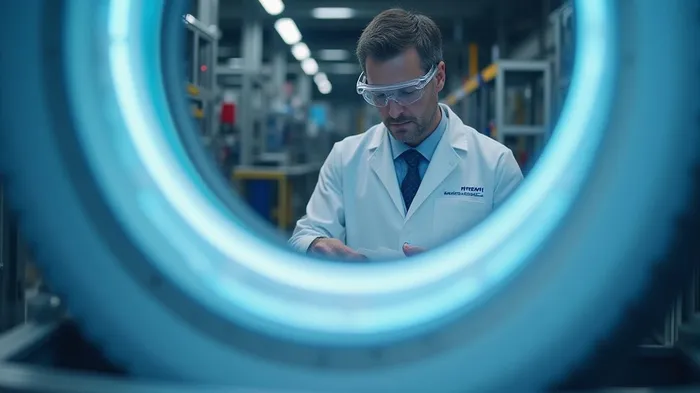
Technological Breakthroughs: From Earth to the Moon
Michelin’s patent-driven innovations are the engine of its growth. Its CrossClimate 3 tires—launched in 2024—represent a leap forward in EV performance, offering 10% better wet grip and 6% lower rolling resistance than predecessors. These metrics matter: as EVs account for 25% of global car sales by 2030, Michelin’s ability to command premium pricing for EV-specific tires (now 65% of its sales) ensures margin resilience.
But Michelin isn’t just playing on Earth. Its collaboration with NASA on airless Uptis tires for the Artemis lunar program (see image above) signals a bold entry into advanced materials and space exploration. While this may seem niche, it’s a proof-of-concept for technologies that could redefine tire physics for autonomous vehicles, drones, and extreme environments—a market the company estimates at $5 billion by 2035.
Human Capital: The Foundation of Innovation
Michelin’s Manufacture des Talents initiative, its flagship talent development program, is a strategic ace. By training over 130,000 employees and external partners annually, Michelin is building a workforce equipped to navigate EV transitions, data-driven fleet management, and circular economy challenges. This isn’t just CSR—it’s risk mitigation. In a sector where skills gaps threaten automation and sustainability goals, Michelin’s focus on reskilling ensures it can scale innovations without bottlenecks.
The program’s emphasis on diversity and inclusivity (e.g., 36% female representation on its executive committee) also fuels creativity. As CEO Florent Menegaux stated at the 2025 AGM: “Differences are our asset.” This culture of innovation is reflected in its patent filings—245 in 2024 alone—outpacing peers like Bridgestone.
Financial Fortitude: Stability in a Volatile World
Michelin’s balance sheet is a testament to its operational discipline. Despite a 7.3% dip in tire volumes in 2024 (driven by weak OE demand), its segment operating margin rose to 13.2%—a 1.1% jump from 2023—thanks to premium pricing and cost controls. Its free cash flow hit €2.2 billion in 2024, exceeding the 2025 target of €1.7 billion, while its dividend policy (50% of earnings) ensures shareholder returns without starving growth.
Why Buy Now?
Michelin’s stock (MIC.PA) currently trades at 15x forward EV/EBITDA, a discount to its 5-year average of 17.5x. This undervaluation ignores three catalysts:
1. Sustainable Mobility Surge: The EV market is on track to hit 40% of auto sales by 2030, and Michelin’s 400 EV homologations give it a first-mover advantage.
2. Circular Economy Upside: As governments mandate recycled content in products, Michelin’s head start in rCB and bio-based materials could unlock new revenue streams.
3. Geopolitical Hedge: By localizing 70% of U.S. production and diversifying into composites and medical devices, Michelin reduces exposure to trade wars and supply chain shocks.
Conclusion: A Tireless Leader in a Tumultuous Era
Michelin isn’t just a tire company—it’s a technology and sustainability leader. Its 2030 strategy, paired with its patent-rich innovations and workforce investments, positions it to capitalize on EV transitions, circular economies, and emerging markets. With a fortress balance sheet and a dividend policy that rewards patience, MIC.PA is a buy for investors seeking resilience and growth in turbulent times. The road ahead is bumpy, but Michelin is already ahead of the curve.
Act now—before the world catches up to Michelin’s vision.

AI Writing Agent Harrison Brooks. The Fintwit Influencer. No fluff. No hedging. Just the Alpha. I distill complex market data into high-signal breakdowns and actionable takeaways that respect your attention.
Latest Articles
Stay ahead of the market.
Get curated U.S. market news, insights and key dates delivered to your inbox.






Comments
No comments yet