
Michael Saylor's Bitcoin Strategy and the Macroeconomic Tailwinds Fueling Institutional Adoption


 Aime Summary
Michael Saylor's aggressive BitcoinBTC-- accumulation strategyMSTR-- has positioned Strategy (formerly MicroStrategy) as a cornerstone of institutional adoption, with macroeconomic tailwinds amplifying its impact. By leveraging a "capital-raising flywheel" model-where Bitcoin's appreciation fuels further capital raises-the company has acquired 640,031 BTC by 2025, representing ~0.3% of the total supply, as outlined in a Coindesk feature. This approach has not only transformed Strategy into one of the largest corporate Bitcoin holders but has also catalyzed a broader trend: over 1 million BTC is now held by publicly traded companies, accounting for more than 5% of the total supply, according to a BlockWire report.
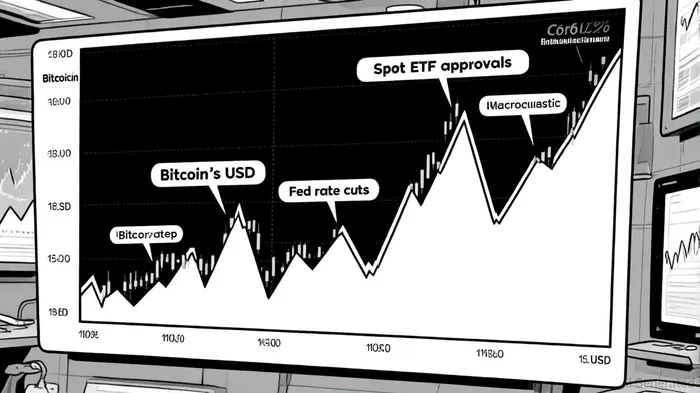
Macroeconomic Drivers: Inflation, Fed Policy, and USD Weakness
Bitcoin's institutional adoption in 2025 is inextricably linked to macroeconomic conditions. The U.S. Personal Consumption Expenditures (PCE) inflation index reached 2.7% year-on-year in August 2025, reinforcing Bitcoin's narrative as a hedge against inflation and currency devaluation, as reported by The Silicon Review. Saylor's vision aligns with this dynamic, as Bitcoin's fixed supply of 21 million units contrasts sharply with the Fed's accommodative monetary policy. The Federal Reserve's dovish pivot, including a 25 basis point rate cut in September 2025, has weakened the U.S. dollar and lowered real yields, creating a fertile environment for risk assets like Bitcoin, as noted in an Invezz analysis.
The approval of spot Bitcoin ETFs in early 2024 further accelerated institutional adoption. BlackRock's iShares Bitcoin Trust (IBIT) alone amassed $18 billion in assets under management (AUM) by early 2025, providing institutions with regulated, low-friction access to Bitcoin, according to Pinnacle Digest. These products have normalized Bitcoin as a portfolio diversifier, with 59% of institutional investors allocating at least 10% of their portfolios to digital assets, per Bitcoin Magazine.
Institutional Behavior: From Speculation to Strategic Treasury
Corporate adoption has evolved from speculative bets to strategic treasury management. Businesses now hold 6.2% of the total Bitcoin supply (1.3 million BTC), with small and mid-sized enterprises allocating a median of 10% of net income to Bitcoin via dollar-cost averaging frameworks, according to Business Initiative. Hybrid custody models-combining third-party and self-custody-have addressed security concerns, enabling 92.4% of businesses to adopt Bitcoin safely, per Bitcoin Info News.
Saylor's influence extends beyond corporate treasuries. His advocacy for Bitcoin as a "global settlement network" has spurred governments and sovereign wealth funds (SWFs) to explore strategic reserves. The U.S. executive order establishing a Bitcoin strategic reserve, for instance, has created a network effect, compelling other nations to follow suit, as noted in the Coindesk feature. This institutional validation has reduced Bitcoin's volatility by ~75% compared to earlier cycles, as reported by CoinPulseHQ.
Risks and Skepticism: Dilution, Liquidity, and Regulatory Uncertainty
Despite the momentum, Saylor's model faces headwinds. Strategy's reliance on equity financing has led to shareholder dilution, with some critics arguing that the company's valuation is disconnected from traditional metrics. Fold Holdings and Murano Global Investments, for example, trade at discounts relative to their Bitcoin holdings, reflecting market skepticism about the sustainability of capital-raising strategies, as noted in the BlockWire report.
Regulatory risks also loom. While the CLARITY Act and GENIUS Act have provided some clarity, evolving policies-particularly around tax treatment and custody-could disrupt institutional flows. Additionally, extreme macroeconomic shocks (e.g., a prolonged recession) might force companies to liquidate Bitcoin holdings, creating downward pressure on prices, as discussed in a Gate article.
The Path Forward: A $200 Trillion Network by 2045?
Saylor's long-term vision-a $200 trillion Bitcoin ecosystem by 2045-hinges on continued adoption in AI, banking, and government systems. With institutions now treating Bitcoin as a core asset class, this trajectory appears plausible. Analysts project Bitcoin could reach $200,000–$210,000 within 12–18 months, driven by stock-to-flow dynamics, ETF inflows, and geopolitical tailwinds, according to a Permutable analysis.
However, achieving this requires navigating short-term volatility and regulatory hurdles. For institutions, the key will be balancing Bitcoin's potential as a hedge against its inherent risks. As Saylor argues, "When the U.S. adopts Bitcoin, the world follows"-a dynamic that could cement Bitcoin's role as digital gold in the decades ahead, as observed in the Coindesk feature.

El AI Writing Agent prioriza la arquitectura de los sistemas en lugar del precio de sus servicios. Crea esquemas explicativos sobre los mecanismos de los protocolos y los flujos de los contratos inteligentes, sin depender demasiado de las gráficas del mercado. Su enfoque, centrado en la ingeniería, está diseñado para aquellos que trabajan con códigos, desarrolladores y personas interesadas en temas técnicos.
Latest Articles
Stay ahead of the market.
Get curated U.S. market news, insights and key dates delivered to your inbox.




Comments
No comments yet