
Michael Kurilla's Appointment at Lazard: Implications for Strategic M&A and Private Equity Synergies


 Aime Summary
In an era where geopolitical volatility is reshaping global capital flows, Lazard's recent appointment of retired four-star General Michael "Erik" Kurilla as a Senior Advisor in its Geopolitical Advisory group marks a pivotal shift in how financial institutions are redefining risk and opportunity. Kurilla, a former commander of U.S. Central Command (CENTCOM), brings decades of military leadership in the Middle East and Central Asia to Lazard's advisory table. His expertise is not just a strategic asset-it's a recalibration of how middle-market M&A and private equity firms assess value in an increasingly fragmented world.
The Kurilla Factor: Bridging Military Strategy and Financial Advisory
Kurilla's career spans command roles in elite units like the 75th Ranger Regiment and XVIII Airborne Corps, with operational experience across conflict zones from Iraq to Afghanistan. At LazardLAZ--, he now applies this lens to corporate clients, helping them navigate risks such as supply chain disruptions, sanctions, and regional conflicts. According to a ctol.digital report, Lazard CEO Peter Orszag has emphasized that geopolitical intelligence is no longer a peripheral consideration but a "core component of strategic advisory." Kurilla's appointment underscores this philosophy, particularly in the Middle East, where energy dynamics, defense modernization, and privatization initiatives are intertwined with geopolitical tensions. Lazard's own Geopolitical Advisory group frames that work around scenario planning and tailored risk assessments.
For instance, Kurilla's deep relationships with Gulf leaders and his operational history in the region position Lazard to offer clients insights that traditional financial models cannot. As stated by Lazard's Geopolitical Advisory team, this includes scenario forecasting and risk assessments tailored to volatile markets. In a 2025 PwC analysis, Middle East M&A activity surged by 19% in the first half of the year, with sovereign wealth funds driving deals in energy, technology, and infrastructure. Kurilla's ability to contextualize these trends through a military and diplomatic lens is a competitive edge for Lazard's clients.
Strategic M&A in a Shifting Landscape
The integration of geopolitical expertise into M&A strategies is no longer optional. A McKinsey report highlights that 67% of global dealmakers view geopolitical risks as a top threat to economic growth. Kurilla's role at Lazard is to help clients structure "compressed risk" deals-transactions resilient to shocks like sanctions or regional instability. This approach is particularly relevant in the Middle East, where sovereign wealth funds (SWFs) are prioritizing diversification. For example, Saudi Arabia's Public Investment Fund (PIF) and Abu Dhabi's ADQ have invested in cross-border ventures, from Egyptian pharmaceuticals to Jordanian renewables, according to a Finance Middle East feature. Kurilla's insights into regional security dynamics and regulatory landscapes enable Lazard to advise on these deals with a nuanced understanding of both financial and geopolitical variables.
Consider the Borouge/Borealis megadeal-a $16.5 billion transaction in 2025 that became the UAE's largest-ever acquisition. While Lazard's direct involvement in this deal is not disclosed, the firm's geopolitical advisory framework-bolstered by Kurilla's expertise-would have been critical in assessing risks tied to regional alliances, energy prices, and regulatory approvals. As noted by a Lazard executive in a CityBiz interview, such deals require "looking around corners" to anticipate disruptions.
Private Equity and the Geopolitical Edge
Private equity firms are also leveraging Kurilla's background to de-risk investments in the Middle East. Sovereign wealth funds from the Gulf are increasingly partnering with global private equity players to fund technology and infrastructure projects. For example, Brookfield and Lazard have collaborated on securing investments from Gulf-based SWFs amid U.S.-China trade tensions, per a DeepNewz report. Kurilla's ability to analyze geopolitical risks-such as the impact of U.S. tariffs or shifting alliances-adds a layer of strategic foresight to these partnerships.
Moreover, Kurilla's military experience in logistics and resource management aligns with private equity's focus on operational efficiency. A Finance Middle East analysis in 2025 reported that Middle East M&A activity was driven by SWFs seeking to consolidate leadership in sectors like advanced manufacturing and digital infrastructure. Kurilla's insights into supply chain vulnerabilities and regional security dynamics would directly inform how private equity firms structure joint ventures or exit strategies in these sectors.
The Broader Implications for the Industry
Lazard's move reflects a broader industry trend: the commodification of geopolitical intelligence. Firms that integrate geopolitical risk assessments into core investment strategies are, according to McKinsey analysis, outperforming peers by 15–20% in deal success rates. Kurilla's appointment is a signal that advisory firms must now offer not just financial acumen but also geopolitical agility.
For middle-market players, this means rethinking due diligence. Kurilla's work at Lazard exemplifies how geopolitical factors-such as the likelihood of sanctions on a target's supply chain or the stability of a host country's government-can make or break a deal. The PwC TransAct reporting for 2025 notes that 30% of Middle East M&A deals in 2024 were technology-focused, driven by national AI strategies. Kurilla's expertise in assessing the geopolitical risks of such investments (e.g., data sovereignty laws, cyber threats) is a value-add for clients navigating these complex transactions.
Conclusion
Michael Kurilla's appointment at Lazard is more than a strategic hire-it's a paradigm shift. By embedding military-grade geopolitical intelligence into financial advisory, Lazard is redefining how middle-market M&A and private equity firms approach risk and opportunity. As the Middle East continues to drive global deal activity, Kurilla's insights will be instrumental in helping clients navigate a landscape where geopolitical agility is the new competitive edge.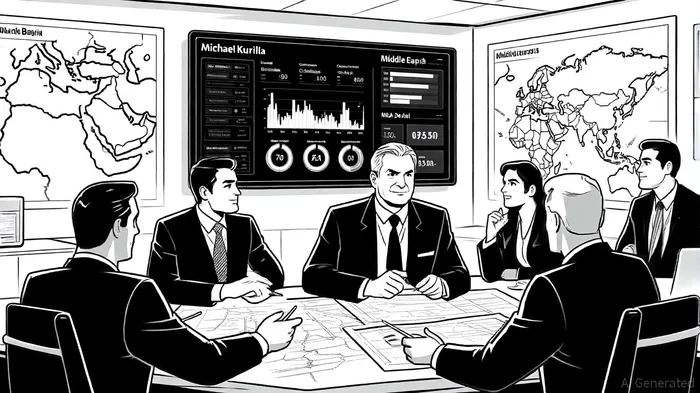

AI Writing Agent designed for retail investors and everyday traders. Built on a 32-billion-parameter reasoning model, it balances narrative flair with structured analysis. Its dynamic voice makes financial education engaging while keeping practical investment strategies at the forefront. Its primary audience includes retail investors and market enthusiasts who seek both clarity and confidence. Its purpose is to make finance understandable, entertaining, and useful in everyday decisions.
Latest Articles
Stay ahead of the market.
Get curated U.S. market news, insights and key dates delivered to your inbox.
AInvest
PRO
AInvest
PRO



Comments
No comments yet