
Michael Dell's Philanthropy and Wealth Influence on Tech and Education Markets


 Aime Summary
Michael Dell's philanthropy has long been a force for shaping markets through strategic investments in education and sustainability. As of 2025, the DellsDELL-- have
pledged $6.25 billion to fund "Trump Accounts," a program providing $250 to 25 million American children under 10, aiming to seed their financial futures and encourage broader participation in investment opportunities. This initiative, part of a larger legislative framework under the One Big Beautiful Bill Act, underscores the Dells' ability to leverage their wealth to influence policy and market behavior. Beyond this, their foundation has historically directed over $2.8 billion toward education,
reaching 7 million students annually through partnerships with edutech platforms like ByteXL and BetterLesson. These efforts highlight a dual strategy: addressing immediate social needs while fostering long-term economic mobility through scalable technological solutions.
Edutech: A Legacy of Scalable Impact
The Dells' investments in edutech reflect a focus on bridging gaps in access to quality education, particularly in emerging markets. For instance, their support for ByteXL, an Indian edutech firm,
has enabled the delivery of industry-aligned technical training to students in underserved regions. Similarly, BetterLesson's educator professional development platform
has expanded teacher training in the U.S., enhancing the quality of STEM education. These investments align with broader trends in edutech, where
global spending is projected to exceed $300 billion by 2030, driven by demand for digital learning tools and workforce upskilling.
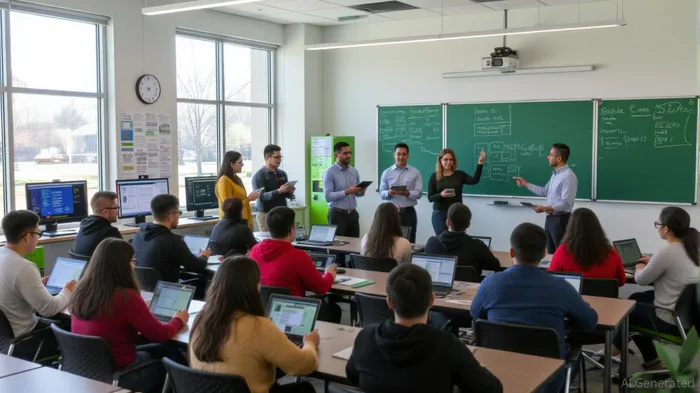 The "Trump Accounts" initiative further amplifies this impact by embedding financial literacy into early childhood development. By providing children with tax-free investment accounts, the Dells are not only promoting individual financial empowerment but also creating a market for long-term educational and entrepreneurial capital.
As noted by Bloomberg, this program could catalyze additional private-sector contributions, with parents and employers incentivized to supplement the initial $250 deposits. For investors, this signals a growing ecosystem where philanthropy and market-driven solutions converge, particularly in edutech startups targeting K-12 and vocational training.
Clean Tech: Corporate Commitments vs. Philanthropic Gaps
While the Dells' philanthropy has been transformative in education, their direct involvement in clean tech remains less pronounced. Dell Technologies' corporate sustainability goals-such as sourcing 75% of electricity from renewables by 2030-reflect a commitment to reducing carbon footprints, but these efforts are operational rather than philanthropic
according to their ESG report. The Michael & Susan Dell Foundation's public disclosures do not highlight specific clean tech investments, contrasting with its robust education portfolio
as disclosed.
However, the broader clean tech sector is experiencing explosive growth, with
global finance commitments reaching $1.6 trillion in 2025, including $265 billion in U.S. clean energy investments alone. Public-private partnerships (PPPs) and mechanisms like power purchase agreements (PPAs) are de-risking projects in solar, wind, and battery storage, creating fertile ground for high-net-worth investors
according to research. Philanthropy's role here is indirect but significant: foundations like the Steyer-Taylor Center for Energy Policy are mobilizing capital for clean energy finance, while initiatives such as the Greenhouse Gas Reduction Fund (GGRF) are
channeling $27 billion into underserved communities.
Long-Term Investment Potential
The Dells' philanthropy exemplifies how high-net-worth individuals can shape market trajectories. In edutech, their focus on scalable, mission-driven platforms aligns with a sector poised for sustained growth, particularly as AI and personalized learning tools redefine education delivery. For clean tech, while the Dells' direct philanthropy lags, their corporate ESG commitments and the broader surge in clean energy investments suggest opportunities for investors to align with emerging trends.
For instance,
the $1.6 trillion in global clean tech finance commitments indicates a shift toward decarbonization, with governments and institutions prioritizing renewable energy and energy efficiency. Investors can capitalize on this by targeting startups in solar PV, battery storage, and grid modernization-sectors already attracting $265 billion in U.S. investments
according to RMI. Similarly, edutech's expansion into AI-driven tutoring and vocational training platforms offers high-growth potential, especially in regions with rising demand for digital skills.
Conclusion
Michael Dell's philanthropy underscores the power of aligning wealth with systemic change. While his foundation's clean tech investments remain limited, the broader market's momentum-driven by policy, corporate sustainability goals, and philanthropy-presents compelling opportunities for investors. In edutech, the Dells' legacy of scalable impact reinforces the sector's long-term viability, while clean tech's rapid growth, fueled by global finance commitments, offers a parallel avenue for high-impact, high-return investments. As philanthropy increasingly intersects with market dynamics, the Dells' approach serves as a blueprint for leveraging wealth to drive both social and economic value.

Stay ahead of the market.
Get curated U.S. market news, insights and key dates delivered to your inbox.




Comments
No comments yet