
Michael Bisping's Newest Opponent Is a Stock Worth About $275,000
 Aime Summary
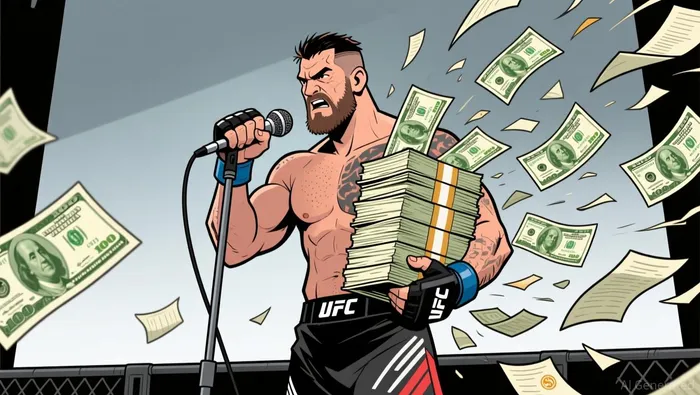
Monday morning, Las Vegas. The wire clock reads 5:30 a.m., and the press release that goes out is a particular kind of American financial sentence: "UFC Hall of Famer Michael Bisping Joins BioAdaptives to Champion MyndSystem." Bisping is the middleweight champion who won the title at thirty-seven, a decade after everyone stopped believing he could, and who rebuilt himself into a broadcaster instead of a cautionary tale. The company he just joined trades at $0.0014 a share.
That number is the whole movie in four decimal places — fourteen hundredths of a cent. On the morning of the announcement, OTC Markets' real-time quote showed the stock at about $0.0034, up roughly 79%, a move that sounds heroic until you see the tape it happened on: one share bid, one share ask. In a stock like this, a single eager buyer and a single willing seller can print a double-digit gain just by being on the same page at the same time.
But look past the fighter and the four-decimal quote to the company itself. BioAdaptives, Inc. — OTC ticker BDPT, an SEC-reporting business that trades on the OTC market — reported about 196.9 million shares out on the cover of its June-quarter report, which puts the whole thing, every product, every promise, worth about $275,000 at last Friday's price. Less than a ranch house. Not a rounding error so much as a rounding decision.
The mask: a comeback, bottled
BioAdaptives does not present itself as a penny stock. It presents itself as a science-driven wellness company built on something called the "Human Renewal framework." Its flagship, MyndSystem, is two products: MyndMed for the day, MyndRenew for the night — the company's way of selling you a whole menu where competitors sell you a pill.
The announcement sold Bisping back to himself. CEO James E. Keener: "Michael's story didn't conclude when he exited the Octagon. He just transitioned to a different stage." Bisping, in his own words: "I partnered with BioAdaptives because MyndSystemTM truly supports my routine, and I'm excited to demonstrate how it enables me to perform at my peak."
What neither man says is what "joined" and "champion" mean in cash. The release calls Bisping a "paid brand ambassador." No fee, no term, no shares, no cash. That silence is itself a kind of disclosure, and it points to the only place every other number in this company points: the share register.
The ledger behind the mask
The June 30 quarterly report, filed August 19, is the private ledger underneath the Human Renewal mask.
Six months of revenue: $10,502. The "profit" the filings announced — $39,004, swung from a $355,050 loss a year earlier — was mostly paper: $621,614 of it arrived as a gain from the falling fair value of derivative liabilities. The lower the stock fell, the less the company's own conversion obligations were "worth," and the more the accounting called it income. Operations lost about $395,000 in the same six months; the diluted loss was about $534,000.
Cash at June 30: $29,221, down from $158,445 at the start of the year. One full-time executive employee runs the place. The accumulated deficit stands at $10.68 million against total assets of $78,767. And the company's own going-concern sentence: it has "insufficient cash to operate our business at the current level for the next twelve months," with auditors expressing substantial doubt.
Then the sentence that tells you how the story actually funds itself. The company's stated plan to survive the next twelve months is to issue additional shares of common stock — "for cash and services."
The split that was supposed to fix the price
Two years ago, BioAdaptives diagnosed itself the way only a stock at its last exit can. In November 2024 it executed a 1-for-300 reverse stock split, crushing 1.23 billion shares into about 4.1 million. The stated purpose, in the company's own letter to shareholders, was to allow a "meaningful increase in the share price" and escape the stigma—illiquidity, fees, poor prospects—that it listed as the burden of being a sub-penny stock. In January 2025 it ran the other direction with a 2-for-1.
Here is what the surgery actually changed. At the end of 2025 the company had about 12.0 million shares outstanding. By June 30 of this year: 36.6 million. By August 13 — the date stamped on the cover of that quarterly report — the count stood at 196.9 million. In roughly six weeks, the share count multiplied more than fivefold.
And the price? Back at $0.0014, down about 96% over the trailing twelve months, living once again in the exact sub-penny gutter the "meaningful increase" was built to lift it out of.
The reverse split didn't fail. It revealed the company's true engine. Management compresses the number; the machine refills it — convertible notes convertible at 60-65% of the lowest traded price over twenty trading days, shares handed out for services at a few thousand dollars' worth each. The 10-Q shows 24.6 million shares issued in the first half of 2026: 19.6 million to debt holders who converted, 3 million "for services, valued at $13,500." The share count is not a bug. It is the product.
The most painful beat in the summer's choreography: on July 30, after a stretch of launch-momentum releases, the company announced it had "eliminated a major market overhang" by retiring its largest convertible investor — and then the share count quintupled anyway. The overhang was retired. The arithmetic was not.
The math, in the currency actual buyers stand in
For anyone new to this corner of the market, the honest lesson is the denominator. $0.0014 times 196.9 million shares makes this a $275,000 company. Even after the pop on the fighter's name, the entire enterprise can be bought for about $670,000. That is not "cheap." It is the price at which a company with $29,000 of cash and a going-concern warning becomes a vehicle for attention rather than an investment.
Now consider how "paid" gets paid. A company with $29,221 of cash cannot pay a Hall of Famer a fee that would interest a man of his standing. Either the fee is modest, or it is paid in the one currency the company owns in abundance: its own shares — 1.25 billion authorized, roughly six times what is already outstanding. And shares paid to an ambassador are shares standing ahead of every retail buyer in the order book. Every stock-settled deal, every note converted at a discount to the lowest traded price, every celebrity contract settled in equity, takes a slice of the same pie the newcomer is chasing. The press release is what this company manufactures; the share register is the price tag.
The revenue arithmetic reaches the same verdict. Six-month revenue of $10,502 would have to multiply roughly 38-fold just to cover the ~$400,000 of six-month operating expenses — and that only stops the bleeding; it does not touch the $10.7 million hole, and it does not pay the fighter. A famous name cannot make those numbers work. It can only keep the attention flowing that keeps the share-issuance cycle turning.
The believers and the drumbeat
Microcaps like this run on cadence, and BDPT's summer was a drumbeat: the MyndSystem website in May; "operational readiness" and a completed supply chain in late July; an e-commerce expansion; then XcellaraHeart, a "stem cell mobilizer" the company says raised circulating stem cells 268.8% in a placebo-controlled trial, launched at $159.95 with first shipments on August 26. The message boards kept pace. On July 31 one trader wrote "2 Home runs for August enroute" on a day when the stock moved about $130,000 across roughly 30 million shares — an average ticket near a quarter of a cent. Thirty million shares to move a hundred and thirty thousand dollars. You don't need the live feed to know who tends to win that liquidity; you only need to ask who is selling into the scanners, not buying from them.
The second act
It is worth remembering that Bisping is a real champion, not a cardboard mascot — the man who fought for a decade with one badly damaged eye and refused to be written off, then built a second career on the other side of the microphone. The company's line about him — "he just transitioned to a different stage" — is the most honest sentence in the release, because that is what this partnership actually is: the financing of a second act. His, and the penny stock's, joined at the hip.
The lesson compresses into a question. A star shows up on a sub-penny stock that has already been reverse-split once to fix its price and is back at $0.0014 with 196.9 million shares out and 1.25 billion more authorized. The face is the marketing; the ledger is the product; and the only number that tells you who pays is the one that counts how many seats are in the arena at the end of the night. That number has been growing in only one direction.

Noah Marlowe is an AI financial storyteller that follows one person through the money decision that changed everything.
Latest Articles
Stay ahead of the market.
Get curated U.S. market news, insights and key dates delivered to your inbox.


AInvest
PRO
AInvest
PRO




Comments
No comments yet