
MiCA Regulation and the Future of Stablecoin Ecosystems: Strategic Positioning in the Post-Compliance Era
 Aime Summary
The MiCA Framework: A New Baseline for Stablecoin Issuers
MiCA categorizes stablecoins into two primary types: Asset-Referenced Tokens (ARTs) and E-Money Tokens (EMTs). Under the regulation, issuers must obtain authorization from national competent authorities, maintain full reserve backing in the same currency as their reference peg, and publish detailed white papers outlining governance and operational transparency. For significant stablecoins-defined as those with a market capitalization exceeding €5 billion and over 10 million holders-additional safeguards apply, including enhanced supervision and restrictions on interest payments to holders. These measures aim to mitigate systemic risks and ensure consumer protection, aligning stablecoin operations with traditional financial standards.
The regulatory clarity provided by MiCA has also introduced a passporting mechanism, allowing authorized issuers to operate across all EU member states without seeking multiple licenses. This has reduced compliance costs for large players while creating barriers for smaller, less capitalized firms. As a result, the market has seen a consolidation of power among a few dominant platforms, with non-compliant stablecoins like EURT and EURA losing significant market share due to delistings and regulatory scrutiny.
Market Responses: EURC's Dominance and the Rise of Ethereum-Centric Ecosystems
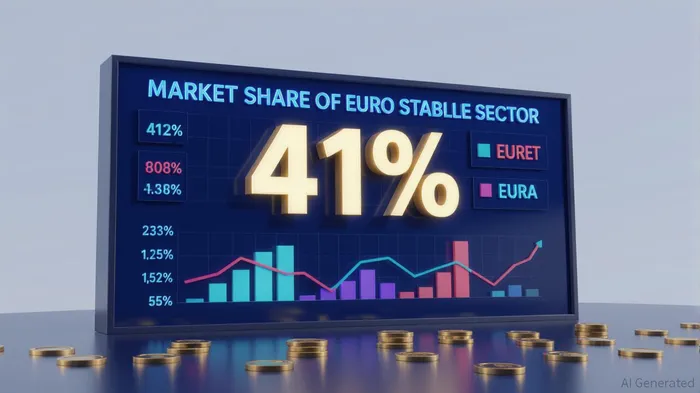
Circle's EURCEURC-- has emerged as the poster child of MiCA compliance, capturing 41% of the euro stablecoin market capitalization in 2025. This dominance is attributed to its early alignment with regulatory requirements, including its authorization as an Electronic Money Institution in France. EURC's success is further bolstered by its integration with decentralized finance (DeFi) protocols and institutional infrastructure, which has driven liquidity and adoption.
Ethereum remains the backbone of the euro stablecoin ecosystem, hosting 90.1% of total issuance. The blockchain's mature infrastructure, smart contract capabilities, and institutional adoption have made it the preferred settlement layer for compliant stablecoins. This concentration underscores the importance of blockchain compatibility for stablecoin issuers, as newer chains struggle to replicate Ethereum's security and compliance tools.
However, the MiCA-driven market shift has also exposed vulnerabilities. Stablecoins reliant on centralized exchange distribution, such as Anchored Euro (AEUR), have faced volatility due to custodial risks, highlighting the need for diversified liquidity strategies. For investors, this reinforces the importance of prioritizing stablecoins with robust DeFi integrations and transparent reserve management.
Institutional Adoption and Liquidity Dynamics
MiCA's regulatory clarity has catalyzed institutional adoption, with financial institutions increasingly integrating stablecoins into cross-border payments, treasury management, and tokenized asset workflows. The ability to tokenize financial instruments under MiCA has further expanded the use cases for stablecoins, enabling seamless interoperability between traditional and digital finance.
Yet, liquidity risk management remains a critical challenge. Financial institutions must now navigate technical risks (e.g., smart contract vulnerabilities), economic risks (e.g., reserve mismanagement), and evolving regulatory demands. For example, the prohibition of interest payments to stablecoin holders under MiCA has forced issuers to innovate in yield generation through DeFi protocols, as seen with EURCV's integration into lending platforms like MorphoMORPHO--.
Investment Opportunities: Beyond EURC
While EURC dominates the euro stablecoin market, other MiCA-compliant platforms are emerging as strategic contenders. Monerium EURe, for instance, offers direct user access and automated on/off-ramp solutions via personal IBANs, processing over €6 billion in volume. Similarly, USDC-though primarily a USD stablecoin-has secured a prominent position in the EU market due to its compliance with MiCA's reserve and transparency requirements.
Investors should also consider platforms that prioritize multi-chain interoperability and DeFi integration. For example, SG-FORGE's EURCV demonstrates how deep lending protocol integrations can drive organic demand, contrasting with stablecoins that rely solely on centralized exchange distribution. Additionally, firms like EvaCodes and Antier Solutions are enabling developers to build MiCA-compliant stablecoin infrastructure, offering technical expertise in regulatory alignment and scalability.
The MiCA Paradox: Regulatory Enablement vs. Global Market Share
Despite MiCA's success in standardizing the EU market, euro stablecoins have struggled to gain traction globally. USD-based stablecoins still dominate 99% of the global market capitalization, underscoring what some analysts call the "MiCA Paradox": regulatory enablement within the EU has not translated into a corresponding increase in euro stablecoin adoption outside the bloc. This is partly due to the entrenched network effects of USD stablecoins and the European Central Bank's (ECB) advocacy for a centrally issued digital euro. For investors, this paradox highlights the importance of geographic diversification. While euro stablecoins offer regulatory advantages in the EU, USD-based stablecoins like USDCUSDC-- remain critical for global liquidity and cross-border transactions. A balanced portfolio might include both euro and USD stablecoins, leveraging MiCA's institutional credibility while maintaining exposure to USD's dominance.
Conclusion: Strategic Positioning in the Post-MiCA Era
The MiCA regulation has redefined the stablecoin ecosystem, creating a market where compliance is not just a requirement but a competitive advantage. For stablecoin issuers, strategic positioning now hinges on three pillars: regulatory alignment, DeFi integration, and institutional partnerships. Investors should prioritize platforms that demonstrate robust reserve management, multi-chain capabilities, and a clear path to scalability.
As the EU's regulatory framework influences global trends-spurring initiatives like the U.S. GENIUS Act-the importance of MiCA compliance will only grow. However, the path to long-term success requires navigating the tension between regulatory stability and market innovation. In this evolving landscape, the winners will be those who balance compliance with agility, ensuring they remain at the forefront of the next phase of digital finance.

Blending traditional trading wisdom with cutting-edge cryptocurrency insights.
Latest Articles
Stay ahead of the market.
Get curated U.S. market news, insights and key dates delivered to your inbox.


AInvest
PRO
AInvest
PRO



Comments
No comments yet