
MiCA Compliant Stablecoins Shift European Liquidity Toward USDC Amid Regulatory Enforcement
 Aime Summary
- The Markets in Crypto-Assets (MiCA) regulation transition period expired on July 1, 2026, requiring EU exchanges to delist non-compliant stablecoins like USDT.
- Major venues have restricted USDT and reweighted trading pairs toward authorized assets such as Circle's USDCUSDC-- and EURCEURC--.
- A consortium of 12 European banks, operating under the Qivalis venture, has selected Fireblocks to build infrastructure for a MiCA-compliant euro stablecoin.
- Tokenized real-world assets hit a record $32.1 billion in July 2026, driven by tokenized US Treasuries and a shift toward compliant issuers .
The expiration of the 18-month transitional period for the EU's Markets in Crypto-Assets regulation has fundamentally altered the European digital asset landscape. As of August 2026, the compliance perimeter is strictly enforced, forcing exchanges to distinguish between authorized and unauthorized tokens . Major venues, including Binance and OKX, have restricted or relabeled non-compliant stablecoins, effectively reweighting trading pairs toward authorized assets like USDC and EURC . This regulatory shift has operationalized a routing problem for traders, bifurcating liquidity by region and making USDC the default base asset in the EEA .
The delisting of Tether's USDT from EU-based exchanges highlights the strict requirements of the new framework. MiCA mandates that stablecoin issuers hold liquid reserves and maintain backing in European banks, conditions TetherUSDT-- declined to meet . Consequently, authorized electronic money tokens reached a market capitalization of $77.7 billion, with Circle's USDC accounting for 94.9% of that compliant supply . The broader stablecoin market cap contracted by 1.02% to $308 billion as Tether and USDC experienced significant outflows, reflecting both regulatory pressure and softer trading activity .
How Is Europe Building A Regulated Euro Stablecoin?
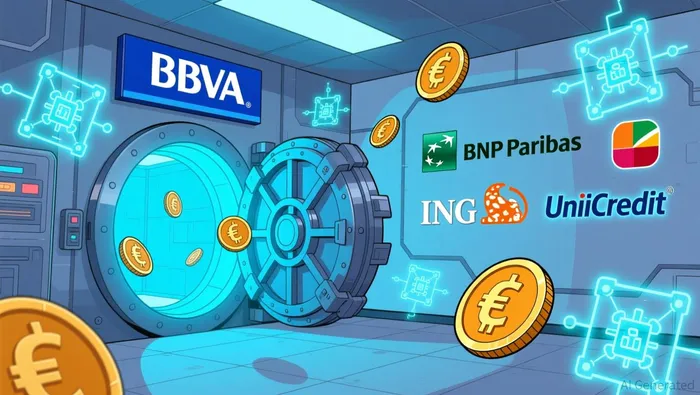
In response to the dominance of dollar-denominated stablecoins, which account for roughly 99% of the $320 billion global market, European banks are accelerating efforts to create a regulated euro-native alternative . A consortium of 12 European banks under the Qivalis venture has selected Fireblocks to build the infrastructure for a MiCA-compliant euro stablecoin . Incorporated in Amsterdam and backed by major institutions including BBVA, BNP Paribas, ING, and UniCredit, Qivalis plans to issue a fully regulated, 1:1-backed euro token .
The project is structured as an electronic money institution under Dutch supervision, with De Nederlandsche Bank granting the required approval under the MiCA framework . Fireblocks will supply tokenization technology, wallet infrastructure, custody services, and compliance tools covering identity verification and sanctions screening . The stablecoin is designed primarily for institutional use, targeting settlement, treasury operations, and tokenized asset transactions . This initiative aims to reduce reliance on dollar-based alternatives and position regulated euro tokens as a credible instrument in European institutional finance .
Why Are Tokenized Assets Reaching Record Levels?
Concurrent with the regulatory tightening on stablecoins, tokenized real-world assets reached a record $32.1 billion in July 2026, up 11.5% from the previous month . CoinDesk Research reports that tokenized US Treasuries led this growth, accounting for $19.2 billion, or 58.3% of the total . This sector expansion occurred despite a contraction in the broader stablecoin market, highlighting the distinct demand for on-chain traditional instruments .
Tokenization places traditional instruments such as bonds and equities onto public blockchains, enabling round-the-clock settlement and driving on-chain value to roughly triple over the past year . Beyond Treasuries, tokenized public equities and commodities also set fresh on-chain records . The shift toward compliant issuers like USDC has facilitated this growth, as corporate treasuries and decentralized autonomous organizations move stable payouts to compliant assets to reduce friction with banks and auditors . Global Dollar's USDG also saw its market cap rise 14.2% to a record $3.26 billion, benefiting from the migration toward compliant issuers .
What Is The Operational Impact On Trading Desks?
The compliance requirements imposed by MiCA have created a complex operational environment for trading desks and financial institutions operating in the EEA. Liquidity is bifurcating by region, with USDC becoming the default base asset in the EEA while USDT remains dominant globally but restricted for EEA accounts . On decentralized exchanges, EU-facing front ends have adjusted default routing to favor USDC pools, although fragmentation persists as global traders continue to rely on USDT .
Trading desks must adapt by rebasing quote currencies to USDC or EURC for EEA pairs and adjusting treasury mixes to hold working balances in compliant assets . Risk models need to account for potential basis widening between USDC and USDT markets during policy shifts . The MiCA Crypto Alliance has further highlighted compliance gaps by launching a searchable CASP tracker, exposing firms like Binance and MEXC as lacking full authorization. This tool turns compliance into a consumer-facing issue, making it harder for firms to operate in a grey zone unnoticed . As the European financial system integrates these regulated instruments, the distinction between compliant and non-compliant digital assets will continue to drive structural changes in market liquidity and settlement infrastructure .

Blending traditional trading wisdom with cutting-edge cryptocurrency insights.
Latest Articles
Stay ahead of the market.
Get curated U.S. market news, insights and key dates delivered to your inbox.


AInvest
PRO
AInvest
PRO




Comments
No comments yet