
Mexico’s Q4 GDP Surpasses Forecasts, Reversing Prior Contraction
 Aime Summary
Mexico's Q4 GDP growth accelerated to 0.9% quarter-over-quarter, surpassing forecasts of 0.8% and reversing a -0.3% contraction in the prior quarter. The reading highlights a potential stabilization in the Mexican economy, possibly driven by strong domestic demand and resilient trade relations.
Mexico's quarterly GDP data is a critical barometer of economic health in Latin America's second-largest economy. The 0.9% gain in Q4 2025 marks a sharp turnaround from the previous quarter's contraction, suggesting that the country's economy may be gaining traction following policy adjustments and improved external conditions. While the U.S. remains a key export destination for Mexico, the country has also been working to diversify trade relationships, which could help insulate its economy from U.S.-driven volatility according to analysis.
What Does Mexico's GDP Growth Signal About Economic Momentum?
Mexico's GDP data is often interpreted as a proxy for the broader Latin American economic cycle, given its size and integration into global value chains. A faster-than-expected growth rate of 0.9% may indicate stronger-than-anticipated domestic demand, improved consumer sentiment, or a rebound in manufacturing and construction activity. This is particularly noteworthy given recent uncertainties around U.S. trade policy, including the Supreme Court's invalidation of certain Trump-era tariffs and the introduction of new proposed tariffs under a potential Trump administration. Mexico's economy secretary has noted that 85% of Mexican exports are currently tariff-free due to trade agreements, but the country remains wary of policy shifts that could affect trade flows .
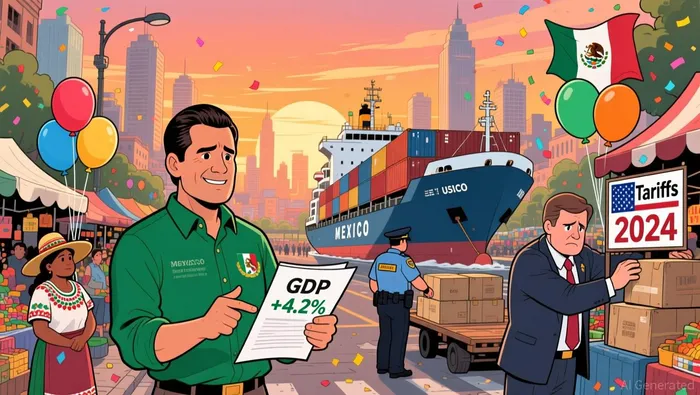
The GDP reading could also impact inflation expectations and monetary policy in Mexico. If the current growth trajectory persists into 2026, the Bank of Mexico may face increasing pressure to balance inflationary risks against the need to support economic activity. Historically, rapid GDP growth has been associated with inflationary pressures, especially in economies with high import dependence and currency exposure.
Why Are Investors Watching Mexico's GDP Data Now?
Investors are paying closer attention to Mexico's GDP figures due to the country's economic exposure to the U.S. and the broader U.S. policy landscape. Mexico's trade-dependent economy makes it particularly sensitive to changes in U.S. import regulations and tariff policies. For example, businesses in border regions like Ciudad Juárez are already analyzing how potential tariffs might affect their operations. The uncertainty created by shifting U.S. trade policies is complicating international trade relationships and affecting global investments and exports .
In addition, Mexico's GDP data is a key factor in assessing the country's creditworthiness and macroeconomic stability. A sustained period of positive GDP growth could help Mexico attract more foreign investment and improve its standing in global capital markets. However, if the growth is driven by temporary factors rather than structural reforms, the long-term implications for economic resilience may be less certain.
The recent GDP print also comes at a time when other emerging markets are showing mixed economic signals. While some economies are grappling with inflation and tightening monetary conditions, Mexico's relative strength could position it as a more favorable investment destination within the broader emerging markets asset class. Nevertheless, investors should remain cautious, as global trade tensions and domestic policy shifts could still pose risks to the current momentum.
What Investors Should Watch Next
While the Q4 GDP data is encouraging, it is just one piece of the economic puzzle. Investors should look to upcoming releases for a more comprehensive view of Mexico's economic trajectory. Key indicators to monitor include the February inflation report and employment data for the first quarter of 2026. These will provide insight into whether the recent GDP growth is being accompanied by broad-based demand and wage increases, or whether it is driven by temporary factors such as inventory adjustments or one-time fiscal policies.
In terms of policy, the Bank of Mexico's next monetary policy meeting will also be closely watched. If the central bank perceives inflationary pressures building due to stronger-than-expected economic activity, it may consider tightening policy sooner rather than later. Conversely, if the data continues to show signs of softness, the bank may maintain a more accommodative stance to support growth.
In summary, Mexico's Q4 GDP reading of 0.9% quarter-over-quarter is a positive signal for the economy, but it should be interpreted in the context of broader global and domestic factors. Investors are advised to watch upcoming data and policy developments to better assess the sustainability of the current growth trajectory and the implications for portfolio allocations.

Stay ahead of the market.
Get curated U.S. market news, insights and key dates delivered to your inbox.


AInvest
PRO
AInvest
PRO



Comments
No comments yet