
Mexico’s 3.12% Inflation Checks Peso Rally
 Aime Summary
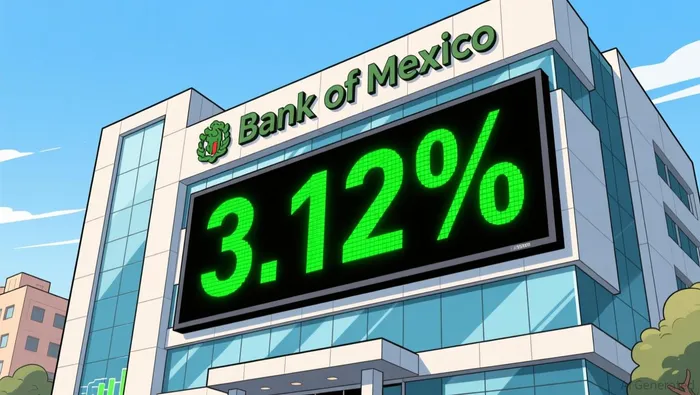
- Mexico’s consumer price index (CPI) accelerated to 3.12% year-over-year in August 2026, matching analyst consensus but marking a deceleration from the previous month’s 3.37% reading.
- The data reinforces the Bank of Mexico’s (Banxico) cautious stance on monetary policy, as inflation remains slightly above the central bank’s 3% target band.
- Core inflation metrics, which strip out volatile food and energy prices, are likely to remain the primary focus for investors assessing the likelihood of near-term rate cuts.
- Geopolitical de-escalation in the Gulf region has recently supported the Mexican Peso, but domestic inflation data continues to dictate the local currency’s fundamental floor.
Mexico’s latest inflation data arrives at a critical juncture for both the central bank and global investors monitoring emerging market (EM) yields. The August CPI reading of 3.12% suggests that while the worst of the inflationary spike may have passed, price pressures remain stubbornly entrenched. For Banxico, this data validates a patient approach to monetary easing, as premature rate cuts could reignite inflation expectations. Meanwhile, the Mexican Peso’s recent nine-day rally, driven by geopolitical easing in the Middle East, faces a reality check from these domestic fundamentals. Investors must now weigh the allure of higher EM yields against the persistent risk of sticky inflation in Mexico’s largest economy.
What Does Mexico’s 3.12% CPI Print Signal for Inflation Trajectory?
The August 2026 CPI print of 3.12% represents a modest cooling from the previous month’s 3.37% acceleration, yet it remains firmly above the Bank of Mexico’s (Banxico) 3% inflation target. This data point is significant because it indicates that disinflationary trends are not yet linear or guaranteed. The fact that the actual reading matched the forecast of 3.12% suggests that markets had already priced in a stabilization in price pressures, but the persistence above target keeps the policy path uncertain. Historically, when headline inflation hovers in the low 3% range, Banxico has demonstrated a willingness to hold rates steady to ensure inflation expectations remain anchored.
The nuance in this data lies in the composition of price increases. While headline CPI is a broad measure, core inflation—which excludes volatile food and energy components—is often a better predictor of future monetary policy. If core inflation remains elevated alongside headline figures, it suggests that underlying demand pressures or service-sector pricing power are keeping costs high. This environment complicates Banxico’s task of balancing growth support with price stability. For retail investors, this means that the "soft landing" scenario is still being tested, and any deviation in subsequent months could trigger significant volatility in Mexican fixed-income assets.
Why Are Investors Watching Banxico’s Policy Reaction Function Now?
The intersection of Mexico’s inflation data and Banxico’s monetary policy is a primary driver for both the Mexican Peso (MXN) and local government bonds (CETES). As an emerging market currency, the MXN has recently benefited from a broader "risk-on" environment fueled by de-escalation in the Gulf region, which has pushed investors toward higher-yielding assets like Mexican debt. However, this external momentum is tempered by domestic realities. If Banxico signals that inflation remains sticky, it may delay rate cuts, which would support the peso’s yield advantage but potentially dampen equity markets.
Market participants are closely monitoring the spread between Mexican and U.S. interest rates. A persistent inflation differential could force Banxico to maintain a tighter policy stance relative to the Federal Reserve, which typically supports the MXN. Conversely, if inflation data continues to cool toward the 3% target, markets may anticipate earlier rate cuts, which could lead to a weakening of the peso. The recent technical strength of the MXN, which rallied to a one-month high on geopolitical optimism, is now being tested against these fundamental inflation metrics. Investors should watch for any divergence between headline CPI and core inflation, as this will dictate whether Banxico adopts a more dovish or hawkish tone in its next policy announcement.
What Should Investors Monitor in the Coming Months?
Looking ahead, the key metric for investors is the trajectory of core inflation and Banxico’s forward guidance. The August data provides a snapshot, but the trend over the next few quarters will determine the sustainability of Mexico’s disinflationary path. Investors should also monitor global risk sentiment, as the MXN remains sensitive to geopolitical developments. The recent rally driven by Middle East de-escalation highlights how external shocks can temporarily overshadow domestic data. However, long-term trends in nearshoring and foreign direct investment (FDI) continue to provide structural support for the Mexican economy.
Additionally, the performance of global health and insurance sectors, as seen in recent earnings from companies like Cigna and Oscar Health, offers a microcosm of broader economic health. While these are U.S.-centric stories, they reflect global trends in cost containment and margin pressure that can spill over into EM markets. For Mexican investors, the focus remains on the interplay between domestic inflation, central bank policy, and global liquidity conditions. Any signs of inflation re-acceleration could quickly reverse the recent gains in the MXN, while a sustained move toward the 3% target could unlock further upside for both the currency and local equities.

Stay ahead of the market.
Get curated U.S. market news, insights and key dates delivered to your inbox.


AInvest
PRO
AInvest
PRO




Comments
No comments yet