
Mexican scientists use pig experiments to refine clandestine grave detection for cartel victims
 Aime Summary
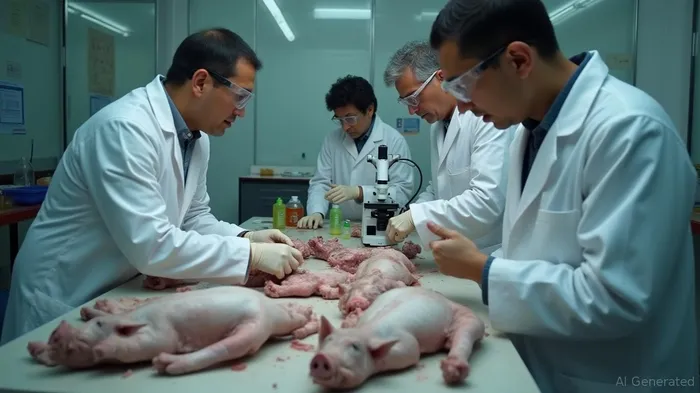
Mexican scientists are conducting experiments using pigs as human proxies to develop techniques for locating clandestine graves linked to cartel violence. The project, led by the federal research institute CentroGeo and involving Guadalajara University, Mexico’s National Autonomous University, and the University of Oxford, aims to refine satellite, geophysical, and biological mapping methods. Pigs are buried in simulated crime scenes, sometimes dismembered or treated with lime, to study decomposition patterns and test technologies like hyperspectral cameras and thermal drones. These tools detect soil anomalies such as phosphorus or nitrogen levels, which could indicate hidden burial sites. The initiative responds to the staggering number of missing people in Mexico—over 130,000 since 2006—often left to search for relatives with limited official support.
The research combines scientific rigor with practical urgency. José Luis Silván, the project coordinator, emphasized the need to apply findings immediately, as families rely on such methods to locate loved ones. For instance, thermal drones and laser scanners are already aiding local searches, though broader adoption by authorities remains uncertain. Derek Congram, a Canadian forensic anthropologist, acknowledged that technology alone cannot solve the crisis; 90% of discoveries still depend on witness testimony and manual digging.
The project also integrates insights from families of the missing, who have developed intuitive skills to identify graves through plant growth and soil patterns. Maribel Cedeño, searching for her brother, and Héctor Flores, seeking his son, exemplify the grassroots expertise guiding the research. Meanwhile, the Jalisco Search Commission, which reports 15,500 missing cases in the state, collaborates with scientists to map cartel routes and analyze decomposition ecosystems.
Critics note the scale of the problem—Mexico’s missing could populate a small city—and the lack of institutional willingness to address it. The Jalisco commission’s director, Tunuari Chávez, described each grave as a “micro ecosystem,” underscoring the complexity of environmental and forensic factors. Yet, the project’s interdisciplinary approach, blending satellite analysis, biology, and community knowledge, reflects a growing emphasis on science-driven solutions to humanitarian crises.
The urgency is underscored by the grim legacy of Mexico’s drug war. Since 2006, cartel violence has fractured society, with disappearances often used to eliminate threats. The United Nations has described the practice as “generalized or systematic.” While over 6,000 clandestine graves have been found since 2007, tens of thousands of remains remain unidentified. The pig experiments, though still in early stages, offer a novel path to address this crisis. As Silván stated, “Science and action” must work in tandem to yield results within three years.
The collaboration highlights both hope and limitations. Researchers warn against overreliance on technology, stressing that community-driven efforts remain critical. Yet, the project’s innovative methods—such as using drones to detect phosphorus-induced flower growth—could enhance existing search strategies. For now, the pigs’ decomposition provides data to refine techniques, while families continue their relentless quest for answers.
[1]https://fortune.com/2025/07/29/mexico-cartel-mass-graves-pigs-buried-missing/
Source: [1] Mexican Scientists Are Creating Mass Graves of Pigs in the Hope They’ll Someday Lead to Cartel Victim Discoveries (https://fortune.com/2025/07/29/mexico-cartel-mass-graves-pigs-buried-missing/)

Stay ahead of the market.
Get curated U.S. market news, insights and key dates delivered to your inbox.


AInvest
PRO
AInvest
PRO



Comments
No comments yet