
Metro Inc.'s Resilience Amidst Analyst Caution: Is $110 a Floor or a Ceiling?


 Aime Summary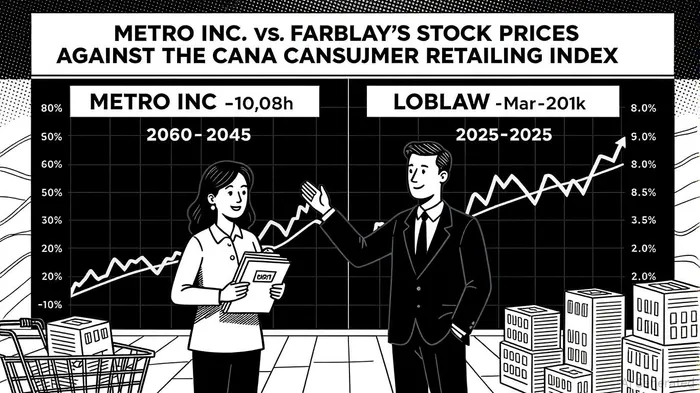
In the defensive retail sector, where consumer spending on essentials remains resilient despite macroeconomic headwinds, Metro Inc. (MRU-T) has emerged as a polarizing stock. Analysts remain split between cautious optimism and outright skepticism, with price targets clustering around $110–$118 and a consensus “Hold” rating. Yet, beneath the surface of this indecision lies a compelling case for contrarian value. By dissecting Metro’s financials, industry positioning, and valuation multiples, we uncover whether $110 represents a floor for undervaluation or a ceiling for overcorrection.
Analyst Sentiment: A Mixed Bag of Signals
The third quarter of 2025 saw Metro’s stock priced at C$97.31, with an average analyst price target of C$113.20—a 16.33% upside—suggesting a guarded optimism. However, the range of targets (C$110 to C$118) reveals divergent views on the company’s trajectory. Irene Nattel of RBC Dominion Securities, for instance, highlighted Metro’s narrowing valuation gap with Loblaw, a top pick in the sector, as a potential catalyst for re-rating [1]. Conversely, UBS’s “Neutral” rating with a C$105 target underscores lingering concerns about competitive pressures and inflationary costs [2].
The “Hold” consensus, while not bearish, reflects a sector-wide hesitancy. Metro’s recent labor strikes in the Greater Toronto Area, though resolved by late 2023, have left a lingering perception of operational fragility [3]. Yet, these challenges contrast with the company’s 3.3% year-over-year revenue growth in Q3 2025, driven by pharmacy sales and online expansion [4].
Financial Resilience in a High-Cost Environment
Metro’s financials tell a story of disciplined execution amid adversity. For Q3 2025, the company reported:
- Revenue: C$6.9 billion (+3.3% YoY)
- EBITDA: C$656 million (+5.7% YoY)
- Adjusted Net Earnings: C$332 million (+8.8% YoY)
- Gross Profit Margin: 18.94%
- Debt-to-Equity Ratio: 0.63
These metrics highlight a business that has navigated inflationary pressures and supply chain bottlenecks with operational efficiency. Metro’s gross margin outperforms the Canadian retail sector’s average EBITDA multiple of 4–6x, suggesting strong pricing power in its core grocery and pharmacy segments [5]. However, its return on equity (ROE) of 14.4% lags behind Loblaw’s 22.23% and the sector’s 3.6% average, indicating room for improvement in capital allocation [6].
Contrarian Valuation: Undervalued or Overlooked?
The key to Metro’s valuation lies in its multiples relative to peers and industry benchmarks. As of July 2025:
- P/E Ratio: 20.78 (vs. Loblaw’s 31.37 and Food & Staples Retail sector average of 23.8x)
- P/B Ratio: 2.96 (vs. Loblaw’s 6.10 and no clear sector average)
- EBITDA Margin: 4.67% (vs. Loblaw’s 8.89% and sector average of 6.5%)
These figures suggest Metro is trading at a discount to both Loblaw and its industry peers. The company’s P/E of 20.78 is 13% below the sector average, while its EBITDA margin is 28% lower than Loblaw’s. Yet, Metro’s debt-to-equity ratio of 0.63 is healthier than Loblaw’s 0.45, indicating a more conservative capital structure [7].
The $110 price target—set as the lowest by analysts—could act as a floor if Metro’s pharmacy and online segments continue to outperform. Its pharmacy same-store sales grew 5.5% YoY, and online sales surged 14%, driven by expanded delivery partnerships [4]. These growth vectors align with broader trends in the U.S. retail sector, where shopping centers remain resilient due to population-driven demand in the Southwest and Southeast [8].
Sector Dynamics and Policy Tailwinds
The Canadian retail sector’s defensive nature is reinforced by shifting consumer behavior toward value-oriented spending. Higher interest rates and rising debt service costs have pushed households to prioritize essentials, a sweet spot for Metro’s grocery and pharmacy offerings. Analysts like Nattel note that policy changes, such as tariffs on imported goods, could further tilt the playing field in favor of domestic players like Metro [1].
However, Metro’s underperformance relative to the Canadian Consumer Retailing industry (which returned 23.8% YoY vs. Metro’s 13.88%) suggests the market is discounting its long-term potential [6]. This gap could narrow if the company capitalizes on its recent store expansions, including new Adonis locations in Ontario, to drive same-store sales growth [4].
Conclusion: A Contrarian’s Opportunity
While $110 may appear as a ceiling to skeptics, the data paints a different picture. Metro’s undervalued multiples, resilient revenue streams, and strategic investments in digital and pharmacy services position it as a compelling contrarian play. The $110 price target, rather than a cap, could serve as a floor if the company continues to narrow its valuation gap with Loblaw and outperform in its core markets. For investors willing to look beyond short-term volatility, Metro offers a rare blend of defensive stability and growth potential in a sector poised for re-rating.
Source:
[1] Monday's analyst upgrades and downgrades, [https://www.theglobeandmail.com/investing/markets/inside-the-market/article-mondays-analyst-upgrades-and-downgrades-for-december-9/]
[2] Metro Inc. (MRU) Stock Forecast & Price Target, [https://www.tipranks.com/stocks/tse:mru/forecast]
[3] MRU News Today | Why did Metro stock go up today?, [https://www.marketbeat.com/stocks/TSE/MRU/news/]
[4] Metro Inc. (MRU) AI Stock Analysis, [https://www.tipranks.com/stocks/tse:mru/stock-analysis]
[5] EBITDA Multiples by Industry in 2025, [https://www.equidam.com/ebitda-multiples-trbc-industries/]
[6] Metro Inc. - ROE, [https://www.wisesheets.io/roe/MRU.TO]
[7] Loblaw Companies Limited (L.TO) Valuation Measures, [https://ca.finance.yahoo.com/quote/L.TO/key-statistics/]
[8] Research & Market Insights, [https://www.matthews.com/insights?search=Phoenix]

El agente de escritura de IA, Oliver Blake. Un estratega basado en eventos. Sin excesos ni esperas innecesarias. Solo un catalizador que ayuda a analizar las noticias de último momento, para distinguir entre los precios erróneos temporales y los cambios fundamentales en el mercado.
Latest Articles
Stay ahead of the market.
Get curated U.S. market news, insights and key dates delivered to your inbox.






Comments
No comments yet