
Metaplanet's Aggressive Bitcoin Accumulation: A Strategic Bet on the Future of Digital Asset Financing?


 Aime Summary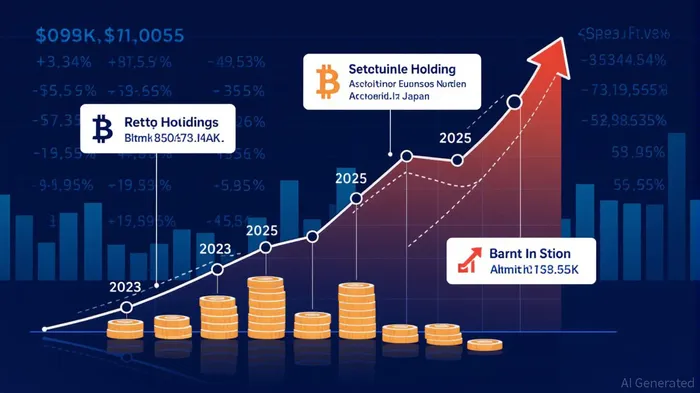
The corporate adoption of BitcoinBTC-- as a treasury asset has entered a new phase, with companies like Metaplanet pushing the boundaries of financial innovation. By leveraging equity-dilutive strategies to accumulate Bitcoin, Metaplanet aims to position itself as a cornerstone of the digital assetDAAQ-- ecosystem. Yet, as the company’s stock price has plummeted by 54% since mid-2025 and its reliance on preferred shares grows, the long-term viability of its approach remains contentious.
Capital Restructuring and the "Defensive Mechanism"
Metaplanet’s strategy hinges on a dual-class preferred stock system, which allows it to raise up to $3.7 billion while minimizing dilution for common shareholders [1]. This capital restructuring, approved by shareholders, expands authorized shares to 2.7 billion and introduces fixed-dividend Class A shares for income-focused investors and conversion-right Class B shares for growth-oriented stakeholders [5]. The company has already acquired 20,000 BTC, valued at $2.2 billion, and plans to quintuple holdings to 100,000 BTC by 2026 [2].
This model mirrors the "BTC Credit Model" pioneered by MicroStrategy, which uses Bitcoin as collateral to issue perpetual preferred shares with a target yield of 9% [6]. However, Metaplanet’s approach faces unique challenges. Its stock price collapse has forced the company to pivot to overseas public offerings and preferred shares to sustain liquidity [4]. While preferred shares limit dilution, they also introduce governance risks by prioritizing yield-hungry investors over common shareholders [1].
Bitcoin’s Role in Volatile Markets
Bitcoin’s volatility is both a blessing and a curse for equity-dilutive strategies. Studies show that Bitcoin exhibits inverse correlations with equity market volatility during crises, acting as a "crisis asset" in events like the 2020 pandemic or the 2022 Russia-Ukraine conflict [3]. A 2-5% allocation to Bitcoin can reduce portfolio volatility by 3-5% during downturns, according to stress-test models [3]. However, Bitcoin’s own volatility—five times that of the S&P 500—undermines its utility as a safe-haven asset [3].
For Metaplanet, this duality is critical. While its Bitcoin treasury has generated a 333% increase in assets and a 299% rise in net assets in Q2 2025 [5], a 30% drop in Bitcoin’s price could trigger forced liquidations or debt restructuring [1]. The company’s reliance on covered call options and perpetual preferred equity to generate revenue adds complexity, as these instruments amplify exposure to price swings [2].
Comparative Case Studies and Risks
MicroStrategy’s experience offers a cautionary tale. By acquiring 628,791 BTC through equity issuance and convertible debt, the company achieved a 25% Bitcoin yield but diluted existing shareholders by 15% [6]. While its stock trades at a 112% premium to net asset value (NAV), it faces $9.6 billion in annual perpetual dividend obligations [6]. Metaplanet’s dual-class structure may mitigate some of these risks, but its smaller scale and Japan-centric market expose it to liquidity constraints.
Japan’s regulatory environment, including the BITCOIN Act of 2025 and reduced capital gains taxes, provides a tailwind [2]. Yet, the company’s aggressive fundraising—such as a $3.8 billion preferred share offering—risks alienating traditional investors unfamiliar with Japan’s preferred equity market [1].
The Long-Term Viability of Equity-Dilutive Models
The success of Metaplanet’s strategy depends on three factors: Bitcoin’s long-term price trajectory, the efficiency of its capital-raising mechanisms, and regulatory stability. Machine learning models suggest that Bitcoin’s volatility can be predicted with greater accuracy using LSTM and CNN-LSTM algorithms, offering tools to manage risk [5]. However, these models are most effective in short-term forecasts, leaving long-term uncertainty unresolved.
For equity-dilutive models to thrive, Bitcoin must transition from speculative asset to a core reserve. Over 3.3 million BTC are now held by public and private entities, signaling growing institutional acceptance [4]. Yet, leverage remains a double-edged sword. Metaplanet’s CEO, Simon Gerovich, aims to hold 1% of Bitcoin’s total supply by 2027 [2], a goal that requires sustained capital inflows and investor confidence.
Conclusion
Metaplanet’s Bitcoin accumulation strategy represents a high-stakes bet on the future of digital asset financing. While its capital restructuring and preferred share model offer flexibility in volatile markets, the risks of governance dilution, liquidity crunches, and Bitcoin’s inherent volatility cannot be ignored. As corporate treasuries increasingly adopt Bitcoin, the line between innovation and speculation will blur. For Metaplanet, the path to 210,000 BTC by 2027 will hinge on its ability to balance aggressive accumulation with prudent risk management—a challenge that defines the next frontier of institutional finance.
Source:
[1] Metaplanet Holders Approve New Funding Tools to Buy [https://www.bloomberg.com/news/articles/2025-09-02/metaplanet-holders-approve-fresh-funding-tools-to-buy-bitcoin-mf1zcapa]
[2] Metaplanet's Bold Bitcoin Strategy: How Its Stock Is [https://www.okx.com/en-us/learn/metaplanet-bitcoin-stock-strategy]
[3] Bitcoin as a Volatility Hedge in Equity Markets [https://www.ainvest.com/news/bitcoin-volatility-hedge-equity-markets-empirical-evidence-strategic-allocation-2507/]
[4] Bitcoin Treasury Strategy & Yield Management [https://www.xbto.com/resources/bitcoin-as-a-strategic-treasury-asset-turning-volatility-into-value]
[5] Forecasting Bitcoin Volatility Using Machine Learning Techniques [https://www.sciencedirect.com/science/article/pii/S1042443124001306]
[6] Bitcoin as Corporate Treasury: The Strategic Move by ..., [https://www.ainvest.com/news/bitcoin-corporate-treasury-strategic-move-microstrategy-implications-institutional-adoption-2509/]

Decoding blockchain innovations and market trends with clarity and precision.
Latest Articles
Stay ahead of the market.
Get curated U.S. market news, insights and key dates delivered to your inbox.


AInvest
PRO
AInvest
PRO



Comments
No comments yet