
MetaMask's mUSD and the Future of Wallet-Native Stablecoins


 Aime Summary
The evolution of decentralized finance (DeFi) has long been constrained by a critical bottleneck: the gap between on-chain utility and real-world adoption. Traditional stablecoins, while foundational to DeFi's liquidity and stability, often require users to navigate fragmented ecosystems, external custodians, and regulatory uncertainties. MetaMask's launch of mUSD, a wallet-native stablecoin, represents a paradigm shift. By embedding a dollar-pegged asset directly into its self-custodial wallet, MetaMask is not merely introducing a new token—it is redefining the architecture of DeFi accessibility and mass adoption.
A New Model for Stablecoins: Wallet-Native Utility
mUSD's innovation lies in its integration with MetaMask, the world's leading self-custodial wallet with over 100 million users. Unlike conventional stablecoins such as Tether (USDT) or USD Coin (USDC), which rely on third-party custodians and external bridges, mUSD is natively built into the MetaMask ecosystem. This eliminates the need for users to interact with multiple platforms to access stable assets, reducing onboarding friction and enhancing security. For instance, users can now swap, bridge, or spend mUSD directly within the wallet, bypassing intermediaries and minimizing counterparty risk.
The technical collaboration between Bridge (a Stripe company) and M0 further strengthens mUSD's value proposition. Bridge ensures regulatory compliance and real-time transparency by backing mUSD 1:1 with U.S. cash and short-duration Treasuries. M0, meanwhile, provides a decentralized infrastructure for minting and managing the stablecoin, enabling cross-chain composability. This hybrid model balances innovation with trust, a critical factor as global regulators increasingly scrutinize stablecoin operations.
Bridging On-Chain and Off-Chain Utility
MetaMask's strategy hinges on dual utility: mUSD is designed to function seamlessly in both DeFi protocols and real-world transactions. On-chain, it will integrate with core DeFi platforms such as lending markets and decentralized exchanges, providing liquidity and enabling yield generation. Off-chain, the MetaMask Card—a Mastercard-linked spending tool—will allow users to spend mUSD at millions of global merchants by year-end 2025. This dual utility addresses a key pain point for crypto adoption: the inability to transition between on-chain value and everyday spending.
Consider the implications for user behavior. A retail investor can now deposit fiat into MetaMask, convert it to mUSD, earn yield via DeFi protocols, and then spend the proceeds at a coffee shop—all within a single interface. This streamlined experience lowers the barrier to entry for non-technical users, a demographic critical to scaling web3.
Strategic Positioning in a Competitive Landscape
The stablecoin market is dominated by Tether and CircleCRCL--, but mUSD's wallet-native design positions it as a disruptive force. Traditional stablecoins often prioritize institutional use cases, whereas mUSD is tailored for retail users and developers. For example, its integration with Linea—a Layer 2 network developed by Consensys—will accelerate the growth of DeFi applications by reducing gas fees and improving scalability. This creates a flywheel effect: as more developers build on Linea, mUSD's liquidity and utility expand, attracting further users.
Regulatory alignment also strengthens MetaMask's position. The U.S. GENIUS Act, which established a federal framework for payment stablecoins, has created a more favorable environment for innovation. By launching mUSD in this context, MetaMask is signaling its commitment to compliance while leveraging its first-mover advantage in a wallet-native model.
Investment Implications and Strategic Considerations
For investors, mUSD's launch represents a pivotal moment in the crypto ecosystem. The stablecoin's success hinges on three factors:
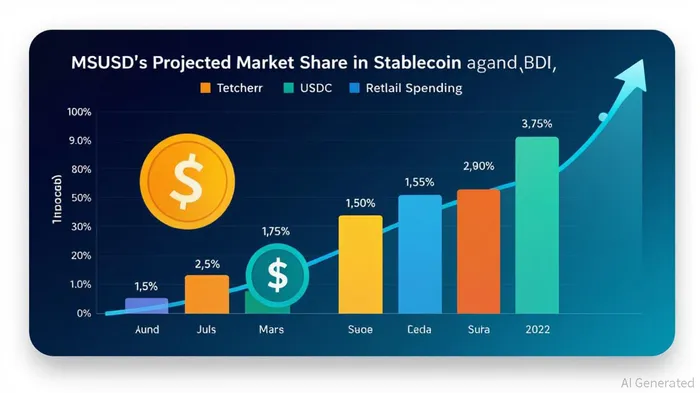
1. Adoption Metrics: Tracking MetaMask's user growth and mUSD's market share against competitors like USDCUSDC-- will provide early signals of its viability.
2. TVL Expansion: As mUSD integrates with DeFi protocols, its impact on TVL could mirror the growth trajectories of earlier DeFi tokens.
3. Regulatory Resilience: mUSD's compliance-first approach may insulate it from the volatility affecting other stablecoins, making it a safer bet in a tightening regulatory environment.
Investors should also monitor the broader implications for Consensys, MetaMask's parent company. A thriving mUSD ecosystem could drive revenue through transaction fees, card spending, and developer tooling. Additionally, the rise of wallet-native stablecoins may spur competition among major crypto platforms (e.g., CoinbaseCOIN--, Binance) to replicate MetaMask's model, accelerating industry-wide adoption.
Conclusion: A Catalyst for Mass Adoption
MetaMask's mUSD is more than a stablecoin—it is a blueprint for the next phase of crypto growth. By embedding a dollar-pegged asset directly into a self-custodial wallet, MetaMask is addressing the core challenges of accessibility, security, and utility. For investors, this represents an opportunity to participate in a structural shift within DeFi, one that bridges the gap between on-chain innovation and real-world usage. As the crypto ecosystem matures, wallet-native stablecoins like mUSD may emerge as the linchpin of mass adoption, redefining how value is stored, moved, and spent in the digital age.

Decoding blockchain innovations and market trends with clarity and precision.
Latest Articles
Stay ahead of the market.
Get curated U.S. market news, insights and key dates delivered to your inbox.




Comments
No comments yet