
Meta Unveils New Smart Glasses, Wristband Controller, and AI-Powered Ray-Ban Metas at Meta Connect 2025
ByAinvest
Friday, Sep 19, 2025 10:43 am ET1min read
META--
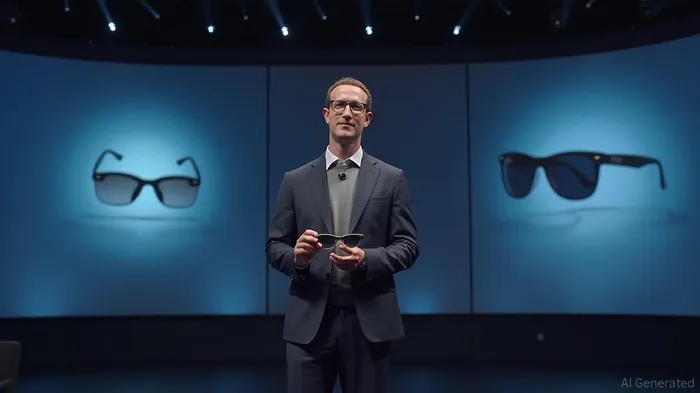
The second-generation Ray-Ban Meta smart glasses were introduced as an updated version of the first-generation model, which has sold two million units. Mark Zuckerberg demonstrated AI capabilities on the Ray-Ban Metas, but the demo failed, drawing attention to the challenges in integrating AI with wearables.
The Meta Ray-Ban Display, a new addition to the Ray-Ban line, features a built-in high-resolution display and a wrist-worn controller called the Meta Neural Band. The display is designed to deliver visual feedback without obstructing natural vision, making it suitable for brief interactions such as reading messages, previews, and captions. The glasses also come with a 12-megapixel camera and support for gesture control via the Neural Band. The device is priced at US$799 and is scheduled for release in the United States on September 30, 2025, with international rollout planned for early 2026 [1].
The Oakley Meta Vanguard, another new product, is positioned as a more advanced augmented reality (AR) system compared to the Ray-Ban Display. It is designed to provide immersive overlays, combining AI, display technology, and vision capabilities. The Oakley Meta Vanguard is expected to be more expensive and is aimed at early adopters and tech enthusiasts.
The event underscored Meta's commitment to AI wearables and its strategy to integrate AI into everyday devices. The company has been investing heavily in AI research and development, with the Neural Band's technology trained using data from nearly 200,000 participants [1]. The market for AI wearables is expected to grow significantly, with Statista projecting the global wearable devices market to reach $62 billion by 2025, driven by AI integrations [2].
Meta's efforts to regain its footing in the AI race are evident in the new smart glasses unveiled at Meta Connect 2025. The company is positioning itself as a leader in AI wearables, with a focus on integrating AI into everyday devices and providing seamless user experiences.
At Meta Connect 2025, the company unveiled three new smart glasses: the second-generation Ray-Ban Meta, the Meta Ray-Ban Display, and the Oakley Meta Vanguard. Meta has sold two million of the first-generation Ray-Ban Meta smart glasses. Mark Zuckerberg demonstrated AI capabilities on the Ray-Ban Metas, but the demo failed. The event highlighted Meta's focus on AI wearables and its efforts to regain its footing in the AI race.
Meta, the parent company of Facebook, revealed three new smart glasses at the Meta Connect 2025 event. The event highlighted Meta's focus on AI wearables and its efforts to regain its footing in the AI race. The new products include the second-generation Ray-Ban Meta, the Meta Ray-Ban Display, and the Oakley Meta Vanguard.The second-generation Ray-Ban Meta smart glasses were introduced as an updated version of the first-generation model, which has sold two million units. Mark Zuckerberg demonstrated AI capabilities on the Ray-Ban Metas, but the demo failed, drawing attention to the challenges in integrating AI with wearables.
The Meta Ray-Ban Display, a new addition to the Ray-Ban line, features a built-in high-resolution display and a wrist-worn controller called the Meta Neural Band. The display is designed to deliver visual feedback without obstructing natural vision, making it suitable for brief interactions such as reading messages, previews, and captions. The glasses also come with a 12-megapixel camera and support for gesture control via the Neural Band. The device is priced at US$799 and is scheduled for release in the United States on September 30, 2025, with international rollout planned for early 2026 [1].
The Oakley Meta Vanguard, another new product, is positioned as a more advanced augmented reality (AR) system compared to the Ray-Ban Display. It is designed to provide immersive overlays, combining AI, display technology, and vision capabilities. The Oakley Meta Vanguard is expected to be more expensive and is aimed at early adopters and tech enthusiasts.
The event underscored Meta's commitment to AI wearables and its strategy to integrate AI into everyday devices. The company has been investing heavily in AI research and development, with the Neural Band's technology trained using data from nearly 200,000 participants [1]. The market for AI wearables is expected to grow significantly, with Statista projecting the global wearable devices market to reach $62 billion by 2025, driven by AI integrations [2].
Meta's efforts to regain its footing in the AI race are evident in the new smart glasses unveiled at Meta Connect 2025. The company is positioning itself as a leader in AI wearables, with a focus on integrating AI into everyday devices and providing seamless user experiences.
Stay ahead of the market.
Get curated U.S. market news, insights and key dates delivered to your inbox.


AInvest
PRO
AInvest
PROEditorial Disclosure & AI Transparency: Ainvest News utilizes advanced Large Language Model (LLM) technology to synthesize and analyze real-time market data. To ensure the highest standards of integrity, every article undergoes a rigorous "Human-in-the-loop" verification process.
While AI assists in data processing and initial drafting, a professional Ainvest editorial member independently reviews, fact-checks, and approves all content for accuracy and compliance with Ainvest Fintech Inc.’s editorial standards. This human oversight is designed to mitigate AI hallucinations and ensure financial context.
Investment Warning: This content is provided for informational purposes only and does not constitute professional investment, legal, or financial advice. Markets involve inherent risks. Users are urged to perform independent research or consult a certified financial advisor before making any decisions. Ainvest Fintech Inc. disclaims all liability for actions taken based on this information. Found an error?Report an Issue


ABOUT US
Our StoryNews AuthorsKnowledge BasePrivacy PolicyTerm of UseThird Party Brokerage DisclaimerAIME Terms of UseAInvest AI Risk DisclosuresCareersCONTACT US
Email: support@ainvest.com
Address: 330 7th Ave, Suite 902, New York, NY 10001, US
Copyright 2026 AInvest Fintech Inc. All rights reserved.


Comments
No comments yet