
Meta's Ray-Ban Display Smart Glasses: A Leap Forward, But Barriers to Mainstream Adoption Remain
ByAinvest
Friday, Sep 19, 2025 12:15 pm ET1min read
META--
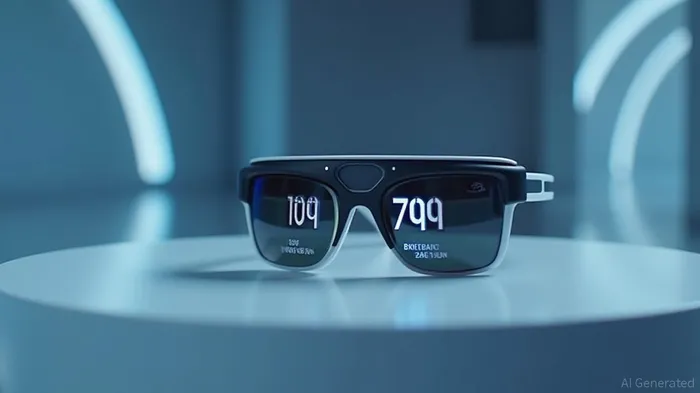
The Ray-Ban Display smart glasses feature a built-in AR display that projects information directly into the wearer's field of view. This display, housed in the right lens, can show notifications, maps, translations, and even video calls without obstructing the user's view. The glasses are designed to resemble classic Ray-Ban Wayfarer sunglasses, making them less conspicuous than earlier attempts at smart eyewear [1].
A key component of the Ray-Ban Display is the Neural Band wrist controller. This water-resistant band reads electrical signals from the user's arm to translate subtle finger movements into commands. Users can swipe, pinch, and even write in mid-air using this intuitive, phone-free control method. The Neural Band is built to withstand daily wear and has a battery life of around 18 hours .
The glasses are packed with advanced hardware, including a Qualcomm Snapdragon AR1 Gen 1 chip, a 12-megapixel camera, five microphones, and open-ear stereo speakers. These components enable features like real-time subtitles, live language translation, turn-by-turn walking navigation, and POV video calling .
While the Ray-Ban Display represents a significant advancement in AI wearables, analysts caution that improvements on price, weight, and battery life are needed to win over consumers. The glasses are initially available for purchase in-person at select US retailers starting September 30, with global expansion to Canada and parts of Europe slated for early 2026 .
The success of the Ray-Ban Display will depend on its ability to offer a compelling use case that justifies its price point. Meta's CEO, Mark Zuckerberg, envisions smart glasses as the ideal form factor for personal superintelligence, but widespread adoption remains uncertain until software and use-cases mature .
Meta's new Ray-Ban Display smart glasses feature an in-lens display and gesture controls, but analysts think improvements on price, weight, and battery life are needed to win over consumers. The glasses will retail for $799 and are available for purchase starting Sept. 30. While a big step forward for AI wearables, the road to widespread adoption is still uncertain.
Meta, the social media giant, has unveiled its latest innovation in the realm of augmented reality (AR) wearables with the introduction of the Ray-Ban Display smart glasses. Priced at $799, these glasses are set to revolutionize the way users interact with technology by offering a seamless blend of AI-powered assistance and everyday functionality.The Ray-Ban Display smart glasses feature a built-in AR display that projects information directly into the wearer's field of view. This display, housed in the right lens, can show notifications, maps, translations, and even video calls without obstructing the user's view. The glasses are designed to resemble classic Ray-Ban Wayfarer sunglasses, making them less conspicuous than earlier attempts at smart eyewear [1].
A key component of the Ray-Ban Display is the Neural Band wrist controller. This water-resistant band reads electrical signals from the user's arm to translate subtle finger movements into commands. Users can swipe, pinch, and even write in mid-air using this intuitive, phone-free control method. The Neural Band is built to withstand daily wear and has a battery life of around 18 hours .
The glasses are packed with advanced hardware, including a Qualcomm Snapdragon AR1 Gen 1 chip, a 12-megapixel camera, five microphones, and open-ear stereo speakers. These components enable features like real-time subtitles, live language translation, turn-by-turn walking navigation, and POV video calling .
While the Ray-Ban Display represents a significant advancement in AI wearables, analysts caution that improvements on price, weight, and battery life are needed to win over consumers. The glasses are initially available for purchase in-person at select US retailers starting September 30, with global expansion to Canada and parts of Europe slated for early 2026 .
The success of the Ray-Ban Display will depend on its ability to offer a compelling use case that justifies its price point. Meta's CEO, Mark Zuckerberg, envisions smart glasses as the ideal form factor for personal superintelligence, but widespread adoption remains uncertain until software and use-cases mature .
Stay ahead of the market.
Get curated U.S. market news, insights and key dates delivered to your inbox.
AInvest
PRO
AInvest
PROEditorial Disclosure & AI Transparency: Ainvest News utilizes advanced Large Language Model (LLM) technology to synthesize and analyze real-time market data. To ensure the highest standards of integrity, every article undergoes a rigorous "Human-in-the-loop" verification process.
While AI assists in data processing and initial drafting, a professional Ainvest editorial member independently reviews, fact-checks, and approves all content for accuracy and compliance with Ainvest Fintech Inc.’s editorial standards. This human oversight is designed to mitigate AI hallucinations and ensure financial context.
Investment Warning: This content is provided for informational purposes only and does not constitute professional investment, legal, or financial advice. Markets involve inherent risks. Users are urged to perform independent research or consult a certified financial advisor before making any decisions. Ainvest Fintech Inc. disclaims all liability for actions taken based on this information. Found an error?Report an Issue


ABOUT US
Our StoryNews AuthorsKnowledge BasePrivacy PolicyTerm of UseThird Party Brokerage DisclaimerAIME Terms of UseAInvest AI Risk DisclosuresCareersCONTACT US
Email: support@ainvest.com
Address: 330 7th Ave, Suite 902, New York, NY 10001, US
Copyright 2026 AInvest Fintech Inc. All rights reserved.


Comments
No comments yet